
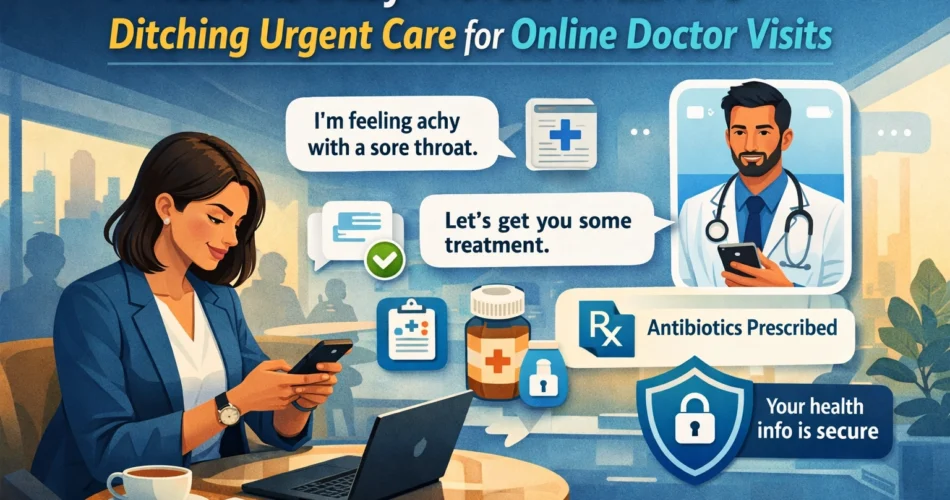
Medically reviewed by ChatWithDr Medical Team
You're in back-to-back meetings until 6 PM. Your throat is killing you. The nearest urgent care closes at 7 PM, and you know there's at least a 90-minute wait once you get there. Sound familiar?
Welcome to the healthcare dilemma facing millions of busy professionals in 2026. Between demanding work schedules, family commitments, and the general chaos of modern life, fitting in a trip to urgent care feels like scheduling a root canal: inconvenient, time-consuming, and somehow always at the worst possible moment.
But here's the thing: more professionals are discovering they don't actually need to sit in a waiting room next to someone's coughing kid to get quality medical care. The shift to online urgent care is accelerating, and it's not just about convenience: though that's a huge part of it. It's about fundamentally rethinking how healthcare fits into a busy life.
Let's break down exactly why the traditional urgent care model is losing ground to text-based telehealth platforms.
1. Zero Commute Time (And Zero Waiting Room Hours)
Think about your last urgent care visit. You probably spent 15-30 minutes driving there, another 45-90 minutes in the waiting room, 10 minutes with the actual doctor, then another 15-30 minutes driving home. That's easily 2-3 hours of your day, gone.

Online doctor consultations eliminate every single one of those time-wasters. You can text with a licensed physician from your office desk during a meeting break, from your couch while watching TV, or even from your car between appointments. According to recent healthcare accessibility research, professionals who switched to virtual urgent care saved an average of 2.5 hours per medical visit.
The beauty of text-based platforms like ChatWithDr is that you don't even need to look presentable or find a quiet space for a video call. Just send a secure message describing your symptoms, and a doctor will respond: typically in under 2 hours.
2. No Appointment Needed, Ever
Traditional urgent care operates on a "first come, first served" model, which sounds fair until you realize it means showing up at 4 PM could mean waiting until 6:30 PM. Primary care appointments? You're looking at 2-3 weeks out for most practices, according to data from the American Academy of Family Physicians.
Online platforms have flipped this script entirely. No scheduling. No appointment slots. No "can you do Thursday at 2:15 PM?" negotiations with a receptionist while you're trying to remember what meetings you have that day.
You need medical advice at 11 PM on a Sunday? Send a message. Need a prescription refill while you're traveling for work? Chat with a doctor from your hotel room. Have a concern pop up during your lunch break? Handle it in 10 minutes without leaving your desk.
This on-demand model is particularly valuable for common urgent care concerns like sinus infections, sore throats, pink eye, and UTIs: conditions that are uncomfortable but don't require in-person examination for diagnosis and treatment.
3. Predictable, Transparent Pricing (That Won't Break Your Budget)
Here's a question: Do you know how much your last urgent care visit actually cost? Most people don't, because urgent care pricing is notoriously opaque. Depending on your insurance, what looked like a $75 copay can turn into a $300+ bill weeks later.

Online doctor visits offer something revolutionary in American healthcare: price transparency. Platforms like ChatWithDr charge a flat $39.99 rate: no insurance hassles, no surprise bills, no mysterious "facility fees" that appear on your statement two months later.
For professionals with high-deductible health plans (which is most of us these days), paying $40 out-of-pocket for a text consultation often beats paying $200-400 toward your deductible at urgent care, especially when insurance hasn't kicked in yet early in the year.
4. Faster Response Times Than Your Email Inbox
The average wait time at urgent care facilities is 60-90 minutes, according to patient satisfaction surveys. Even "walk-in" clinics require significant waiting. Meanwhile, text-based telehealth platforms are delivering response times that put your coworkers to shame.
With ChatWithDr's 24/7 telehealth service, most patients receive a response from a licensed physician in under 2 hours: often much faster. Compare that to trying to reach your primary care doctor's office, where you might get a callback in 24-48 hours if you're lucky.
This speed matters when you're dealing with acute issues that are disrupting your workday. Getting quick guidance on whether you need antibiotics for a suspected bacterial infection, securing a prescription refill for your asthma inhaler, or obtaining treatment for a migraine can mean the difference between a productive afternoon and a lost day.
5. Perfect for Prescription Refills and Chronic Condition Management
Here's a scenario that plays out millions of times each year: You're out of your blood pressure medication. Your prescription expired. Your doctor's office says you need to schedule an appointment for a refill, but the next available slot is three weeks away.
This is absurd for stable, chronic conditions that don't require a full in-person workup every 90 days. Busy professionals managing conditions like asthma, high blood pressure, high cholesterol, or chronic migraines are discovering that online prescription services offer a much more sensible approach.
A quick text consultation reviewing your current symptoms, medications, and treatment response allows licensed physicians to issue refill prescriptions safely and appropriately: without forcing you to take time off work for a 10-minute "check-in" appointment that should've been a phone call.
6. Work-Life Balance Actually Means Something
Let's be honest: Taking time off work for a medical appointment still carries stigma in many professional environments. Even in 2026, saying "I need to leave early for a doctor's appointment" can feel like admitting weakness or lack of commitment.

Text-based telehealth removes this friction entirely. You can handle a medical consultation during your morning coffee, between Zoom calls, or while waiting for your takeout order. No one needs to know. No guilt about leaving early. No burning precious PTO on a sinus infection.
This discrete, asynchronous model also benefits professionals who travel frequently for work. Sick while on a business trip in another state? You can still chat with a licensed doctor and get prescriptions sent to a local pharmacy. No need to find an urgent care in an unfamiliar city or navigate foreign healthcare systems.
7. Reduced Exposure to Other Illnesses (Remember 2020?)
This one seemed niche before COVID-19. Now it's permanent common sense. Why sit in a waiting room full of sick people when you're trying to get healthy?
Urgent care waiting rooms are, by definition, filled with contagious patients. You might go in with a suspected UTI and leave with someone else's respiratory virus. This exposure risk is particularly concerning during cold and flu season, or for professionals who can't afford to get sick before important presentations, travel, or events.
Virtual consultations eliminate disease transmission risk entirely. You get medical care without exposing yourself to additional pathogens. For conditions that don't require physical examination: which encompasses the majority of urgent care visits: this makes text-based platforms objectively safer than in-person facilities.
Making the Switch: What You Need to Know
If you're ready to try online urgent care, the process is refreshingly simple. Platforms like ChatWithDr don't require creating an account or storing payment information upfront: you can get started immediately when you need care.
Here's how it typically works:
- Visit the platform and describe your symptoms via secure text messaging
- A licensed physician reviews your case and responds, usually within 2 hours
- The doctor can issue prescriptions, recommend treatments, or advise if you need in-person care
- Pay the flat $39.99 rate: no insurance claims, no billing surprises
Common conditions well-suited for online treatment include cold, flu, and COVID, migraines, nausea and vomiting, and many other non-emergency conditions that traditionally send people to urgent care.
When You Still Need Traditional Care
To be clear, online doctor consultations aren't appropriate for every situation. Chest pain, severe injuries, uncontrollable bleeding, difficulty breathing, or other emergency symptoms require immediate in-person care: call 911 or head to an emergency room.
Similarly, some conditions require physical examination or diagnostic testing that can't be done virtually. But research suggests that 70-80% of urgent care visits could be handled effectively through telehealth, which means most professionals can handle most of their acute healthcare needs without ever leaving home.
The Future of Healthcare for Busy Lives
The shift away from traditional urgent care isn't about technology replacing doctors: it's about technology enabling doctors to serve patients more efficiently. Text-based consultations let physicians practice medicine without the overhead of physical facilities, which translates to lower costs and better access for patients.
For busy professionals tired of healthcare that doesn't respect their time, online doctor visits represent something rare in modern medicine: an actual improvement in convenience, cost, and quality all at once.
Ready to experience the difference? Book your first consultation and see why more professionals are making the switch from waiting rooms to text messages.
Disclaimer: This information is not a substitute for professional medical advice, diagnosis, or treatment. Always seek the advice of your physician or qualified health provider with questions regarding medical conditions or treatments.
Related posts:
 7 Reasons Busy Professionals Are Ditching Urgent Care (And What They’re Doing Instead)
  Online Medical Chat: Why Busy Professionals Are Ditching Waiting Rooms for Instant Doctor Access
  Your Guide to Virtual Urgent Care Online Doctor Visits
  Difference Between Urgent Care and Emergency Explained
  Live Medical Chat vs. Traditional Urgent Care: Why Busy Professionals are Switching