

When that unmistakable, agonizing burn of a UTI hits, your first instinct is to run to the pharmacy for an over the counter medicine for uti. And who could blame you? You want relief, and you want it now.
While products like AZO can be a lifesaver for managing the immediate pain and burning, it's absolutely critical to understand their limits: no OTC medication can cure the underlying bacterial infection. To actually get better, you'll need a prescription antibiotic from a doctor.
Finding Immediate UTI Symptom Relief
That sudden, intense urge to go, paired with a sharp, burning pain, is the classic one-two punch of a urinary tract infection. In that moment, your only goal is to make the discomfort stop. This is exactly where over-the-counter products come in—they’re a temporary bridge to ease your symptoms while you get proper medical care.
Think of these OTC options as a painkiller for a toothache. They'll make you feel better for a little while, but they won't fix the cavity causing the pain. The bacterial infection will keep smoldering and can get much worse if you don't treat the root cause.
The Role of OTC vs Prescription Medicine
Understanding the difference between managing symptoms and getting a real cure is the most important part of treating a UTI. Just relying on OTC products is a risky game because it gives the bacteria time to multiply unchecked. That's why getting professional medical advice isn’t just a good idea; it’s essential for a safe and complete recovery.
Over-the-counter medicines provide a crucial, yet limited, function. They are built for comfort, not for a cure. Masking the pain without eliminating the bacteria can lead to more severe health complications down the road.
This is exactly why UTIs are such a huge public health issue. In the United States, they are the seventh most common reason people go to the emergency room, leading to over one million visits every year. Of those, about 220,000 cases are considered complicated UTIs, resulting in around 100,000 hospital admissions annually—often because the right treatment was delayed.
To give you a clearer picture, here's a quick breakdown of your options when that UTI pain strikes.
Quick Guide to UTI Relief Options
| Relief Option | Primary Purpose | Cures Infection? | Best For |
|---|---|---|---|
| Phenazopyridine (e.g., AZO) | Numbing urinary tract pain | No | Immediate, short-term relief from burning and urgency. |
| Methenamine (e.g., Cystex) | Slowing bacterial growth | No | Mild symptom relief and helping to prevent future UTIs. |
| NSAIDs (e.g., Ibuprofen) | Reducing inflammation & pain | No | Easing overall discomfort and bladder pain. |
| D-Mannose Supplements | Preventing bacteria from sticking | No | Long-term prevention, not for treating an active infection. |
| Prescription Antibiotics | Killing the bacteria | Yes | The only way to actually cure a bacterial UTI. |
As you can see, only one option truly solves the problem. Everything else is just a temporary fix to help you feel more comfortable.
Bridging the Gap with Modern Healthcare
The good news? You no longer have to choose between suffering in pain while you wait for a doctor's appointment or spending hours at an urgent care clinic. Modern telehealth offers a fast, effective way to get real help.
Services like ChatWithDr give you immediate access to medical professionals who can diagnose your UTI and prescribe the antibiotics you need. By exploring the options for online urgent care, you can get a real cure sent to your pharmacy in a matter of hours, not days.
Understanding Your OTC Options for Symptom Control
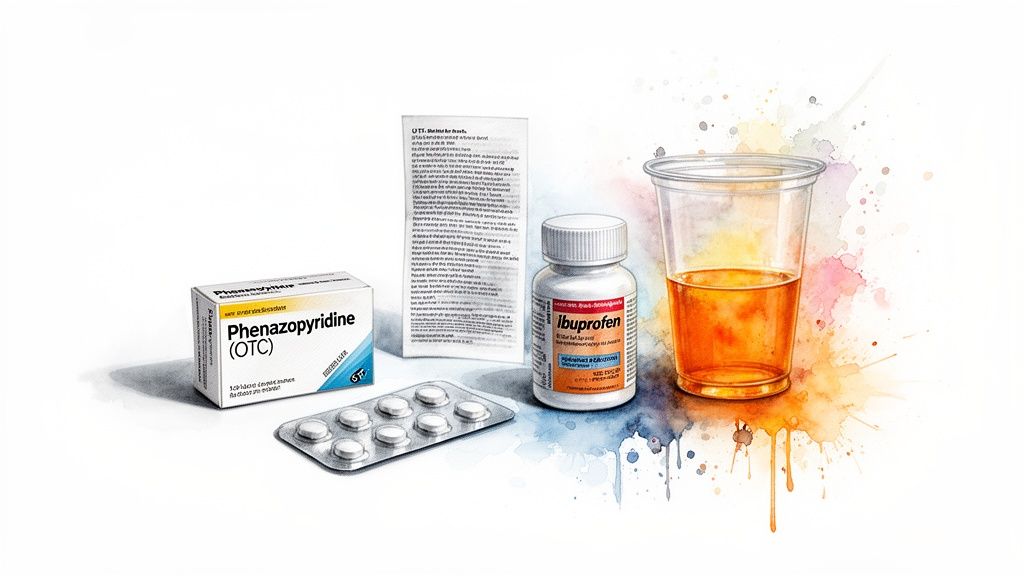
When you're standing in the pharmacy aisle, miserable with UTI symptoms, it’s tempting to grab anything that promises a cure. But it’s critical to know that over the counter medicine for a UTI works in a very specific way—it only masks the pain and urgency, it doesn't fight the infection itself.
The main product you’ll see on the shelf is a urinary analgesic called phenazopyridine. It’s the powerhouse ingredient in brands like AZO Urinary Pain Relief. Think of it like a local anesthetic made just for your urinary tract. It works by coating the lining of your bladder and urethra, numbing the nerve endings to give you fast relief from that relentless burning and the constant feeling that you have to go.
This numbing effect can feel like a lifesaver, but it’s just quieting the alarm bells—it’s not putting out the fire. Phenazopyridine does absolutely nothing to kill the bacteria causing the infection.
Key Analgesics for UTI Pain Relief
While phenazopyridine is the specialist for that unique urinary pain, general pain relievers can also play a supporting role in managing the broader discomfort that comes with a UTI.
- Phenazopyridine: This is your go-to for targeted relief. It works directly on the burning and urgency, right where you feel it most.
- Ibuprofen (NSAIDs): An anti-inflammatory like ibuprofen can help dial down bladder inflammation and ease other related pains, like lower abdominal cramping or a low-grade fever.
Using these together can make a huge difference in your comfort level while you're waiting for antibiotics to kick in. But they come with some important rules you absolutely need to follow for your safety.
Important Safety and Usage Guidelines
Using any over the counter medicine for UTI symptoms means paying close attention to the instructions. If you don't, you could end up masking a worsening infection or dealing with unnecessary side effects.
One of the most startling effects of phenazopyridine is that it will turn your urine a bright, reddish-orange color. It's a totally normal and harmless side effect, but it can be shocking if you aren't expecting it. Be warned: it can also permanently stain contact lenses and clothing, so be careful.
Crucial Warning: You should never use phenazopyridine for more than two consecutive days. Its only job is to provide temporary relief while you get a proper diagnosis and start antibiotics. Using it longer can hide the symptoms of an infection that’s getting worse and possibly spreading to your kidneys.
Always read the package directions, stick to the recommended dose, and never, ever use these products as a substitute for a doctor's care. They are a temporary bridge to comfort, not a cure.
Diving Into Natural Supplements for Urinary Health
When you're trying to sidestep another UTI, you've probably heard about natural supplements. Beyond the pharmacy aisle, options like cranberry and D-mannose have become incredibly popular for ongoing support. It's important to be crystal clear here: these are not a substitute for antibiotics during an active infection. Instead, their goal is to make your urinary tract a much less inviting place for bacteria to set up camp in the first place.
Think of your bladder lining as a smooth wall. The bacteria that cause most UTIs, usually E. coli, have tiny, sticky fingers they use to grab onto that wall. Once they latch on, the infection can take hold. The powerhouse compounds in cranberry, known as proanthocyanidins (PACs), are believed to work by making that wall "slippery," so the bacteria just can't get a grip and are flushed out when you urinate.
D-mannose, another fan favorite, works a bit differently but with a similar end goal.
D-Mannose and Probiotics
D-mannose is a simple sugar that happens to look a lot like the receptors on your bladder wall. The theory is that when you take it, D-mannose floods your urinary system. The bacteria, hunting for a place to attach, end up grabbing onto these free-floating D-mannose molecules instead of your bladder lining. This essentially neutralizes them, allowing them to be rinsed away harmlessly.
This interest in preventative care is more than just a trend. The global market for urology supplements is projected to hit USD 2.2 billion in 2025, with the U.S. market alone making up USD 843.4 million of that. These numbers show a powerful desire for supportive health measures that go beyond just treating active infections.
Probiotics are another key player. By supporting a healthy balance of good bacteria in your gut and vaginal microbiomes, they help create an environment where the harmful bacteria that cause UTIs struggle to thrive.
Key Takeaway: Supplements like cranberry, D-mannose, and probiotics are all about prevention and support. They are not a cure for an active UTI and should never be used instead of seeing a doctor and getting prescribed antibiotics when you have an infection.
Of course, supplements are just one piece of the puzzle. It's always a good idea to understand broader UTI prevention strategies, especially for more vulnerable individuals.
Comparing Popular UTI Supplements
To help you understand where each of these popular supplements fits in, here’s a quick side-by-side look at how they work and when they might be most useful.
| Supplement | How It May Work | Scientific Evidence | Best Use Case |
|---|---|---|---|
| Cranberry (PACs) | Makes bladder walls "slippery" to prevent bacterial adhesion. | Mixed, but some studies show modest preventative benefits. | Long-term prevention for those with recurrent UTIs. |
| D-Mannose | Attaches to bacteria, preventing them from sticking to the bladder. | Promising evidence, particularly for E. coli related UTIs. | Prevention, especially for UTIs often triggered by sex. |
| Probiotics | Supports a healthy microbiome to crowd out bad bacteria. | Growing evidence for supporting overall urinary health. | General wellness and restoring gut flora after antibiotics. |
While each of these has a role, they're most effective as part of a proactive approach to urinary health. They support your body's natural defenses but can't fight off an established infection on their own.
The Dangers of Relying on OTC UTI Treatments Alone

Grabbing an over the counter medicine for uti might feel like a smart, quick fix when that all-too-familiar burning sensation starts. But relying on these products alone is a dangerous gamble. They're designed to do one thing: mask your symptoms. While they might temporarily dull the pain and urgency, they do absolutely nothing to stop the bacterial infection brewing inside you.
Think of it like putting tape over a flashing check-engine light in your car. Just because you can't see the warning anymore doesn't mean the engine isn't about to seize. You might feel better for a few hours, but the root cause—the bacteria—is still multiplying, growing stronger, and getting ready to move into more dangerous territory.
This delay in getting real treatment is a huge problem. UTIs are actually the seventh most common reason for emergency room visits in the U.S., driving over one million trips to the ER every year. A shocking 22% of those cases become complicated, leading to roughly 100,000 hospital admissions annually. Often, this happens because someone tried to self-treat with OTC products and delayed a proper diagnosis. You can read more about these sobering UTI treatment statistics and their impact.
When an Infection Escalates
An untreated bladder infection (cystitis) has a direct path to becoming something much worse. Bacteria don't just stay put. They can travel up the ureters—the tubes that connect your bladder and kidneys—and spark a severe kidney infection, known as pyelonephritis.
A kidney infection isn't just a "bad UTI." It's a serious medical emergency that can cause permanent kidney damage or even sepsis, a life-threatening, whole-body response to infection. That's why you have to know the signs that a simple bladder infection has taken a dangerous turn.
Warning Signs of a Worsening Infection
If you experience any of these symptoms along with the usual UTI discomfort, it's a huge red flag. Don't wait. You need to seek immediate medical attention because the infection has likely spread to your kidneys.
- Fever and Chills: Any body temperature over 100.4°F (38°C) is a major warning.
- Back or Flank Pain: A sharp, persistent pain in your lower back, side, or just under your ribs is a classic sign of kidney involvement.
- Nausea and Vomiting: Feeling sick to your stomach is not a normal symptom of a simple bladder infection.
- Intense Fatigue: Feeling completely wiped out, weak, or generally unwell is another red flag.
Trying to push through these symptoms with more OTC pills can have devastating consequences. The only thing that will truly stop the infection is a prescription for antibiotics—something that actually kills the bacteria causing the problem.
Why Antibiotics Are the Only Real Cure for UTIs
While reaching for an over the counter medicine for uti can feel like a good first step, it’s important to know what they can and can’t do. Think of OTC products as providing temporary relief—they can dial down the pain and urgency, but they don’t touch the root of the problem.
The real issue is a bacterial infection, and for that, you need the heavy-duty solution: antibiotics.
Prescription antibiotics are the only treatment that actually eliminates the bacteria causing your UTI. They get to work by stopping the invaders from multiplying, effectively wiping out the infection at its source. This is the only way to truly resolve your symptoms for good and prevent the infection from turning into something much more serious, like a kidney infection.
A doctor’s guidance is non-negotiable here, because not all antibiotics work for every type of bacteria.
Selecting the Right Treatment
A healthcare professional will look at your health history and even local patterns of bacterial resistance to pick the right antibiotic for you. Common choices include:
- Nitrofurantoin (Macrobid)
- Trimethoprim-sulfamethoxazole (Bactrim)
- Fosfomycin (Monurol)
Matching the right drug to the right bug is a precise science. That’s why getting a professional diagnosis is the only safe and effective way to treat a UTI.
The single most important part of your treatment is finishing the entire course of antibiotics. It’s tempting to stop once you feel better, but that’s a huge mistake. Feeling better doesn't mean the infection is gone.
Stopping your prescription early is like letting a weakened enemy regroup. The few bacteria that survive are often the toughest ones. They can multiply, leading to a relapse that’s much harder to treat. This not only puts your health at risk but also contributes to the growing problem of antibiotic resistance worldwide.
By taking every last pill, you ensure 100% of the bacteria are wiped out. It’s a simple step that protects your own health and helps keep these crucial medications working for everyone.
Get a UTI Diagnosis and Prescription Online
When you're dealing with the burning, constant urge of a UTI, the last thing you want is a delay. You already know that over the counter medicine for uti is just a temporary fix for the symptoms. To actually kill the bacteria causing the infection, you need a prescription antibiotic.
So, how do you bridge that gap between knowing what you need and getting it—fast?
The modern answer is telehealth. Instead of suffering through a long wait at an urgent care clinic or struggling to get a same-day appointment with your doctor, you can get a professional diagnosis and a prescription right from home. It's a way to skip the stress and inconvenience of an in-person visit and take back control of your health right away.
How Online UTI Treatment Works
The whole process is designed to be simple, private, and incredibly fast. It puts the power back in your hands, letting you get the care you need without blowing up your entire day.
- Start Your Consultation: You’ll begin by filling out a secure, confidential online form. This is where you describe your symptoms, answer a few questions about your health history, and give a doctor all the details they need to make an accurate diagnosis.
- A Doctor Reviews Your Case: A U.S.-licensed, board-certified physician will thoroughly review everything you’ve submitted. Because the consultations are text-based, there are no awkward video calls required, giving you maximum privacy.
- Receive Your Treatment Plan: The doctor provides a professional diagnosis and a personalized treatment plan. If antibiotics are the right call for your situation, a prescription is sent electronically to whatever local pharmacy you choose.
- Pick Up Your Medicine: You’ll typically get a notification within a few hours that your prescription is ready. You can then pick it up and start feeling better the very same day.
This streamlined process means you can go from that first "uh-oh" symptom to having a real prescription in hand in just a few hours. It's the fastest, most direct path to a cure.
When you're dealing with a UTI, this decision tree visualizes the two main paths you can take: just masking the symptoms or actually killing the bacteria causing the problem.
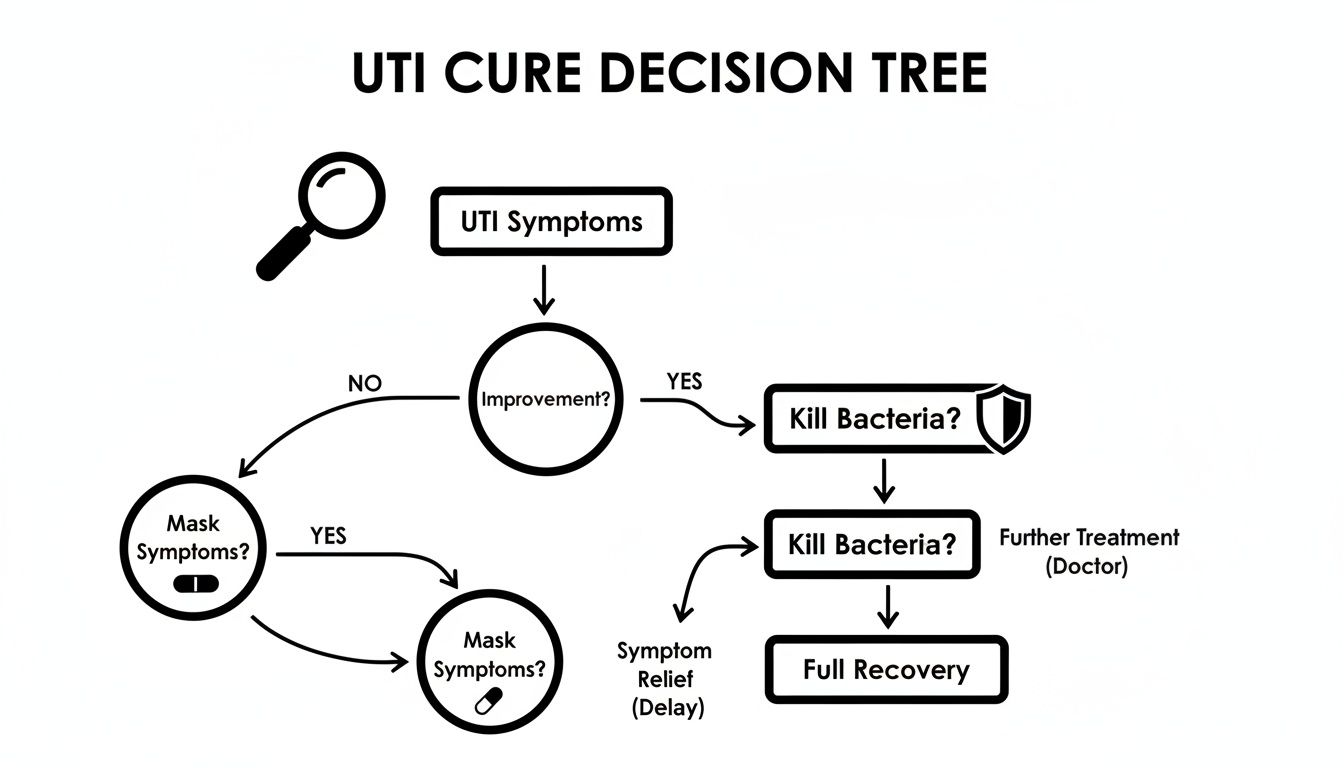
As the flowchart shows, while OTC options can help with the discomfort, only a medical diagnosis leads to the antibiotics needed to wipe out the infection for good.
Take Control of Your Health Today
Services like ChatWithDr offer a fast, affordable solution for a flat fee, with no hidden costs or surprises. You don't have to wait around in pain or rearrange your schedule just to see a doctor.
By choosing telehealth, you get the expertise of a board-certified physician combined with the convenience of modern technology. To see just how easy it is, explore the simple steps for getting online UTI treatment and get on the path to feeling better now.
Common Questions About Over-The-Counter UTI Medicine
When you're dealing with the misery of a UTI, you want answers—and you want them fast. Understanding what over-the-counter (OTC) medicines can and can't do is the first step to getting some relief and knowing when it's time to call in a doctor. Let's clear up a few of the most common questions.
Can I Take AZO and Antibiotics Together?
Yes, it's generally fine—and often recommended—to take a urinary pain reliever like phenazopyridine (the active ingredient in AZO) for the first day or two after starting antibiotics. Think of it as a one-two punch: the antibiotic is the heavy hitter that's actually fighting off the bacteria, while the OTC product is there to numb the pain and take the edge off while the real medicine gets to work.
But there's a catch. You should stop taking phenazopyridine after 48 hours. It's not designed for long-term use and, more importantly, it can mask your symptoms. If the infection isn't getting better, you need to know, and masking the pain can give you a false sense of security. Always follow your doctor's specific advice.
How Fast Does OTC UTI Medicine Work?
Those OTC pain relievers can start to dull the burning and urgency within an hour or two, which can feel like a lifesaver when you're in the thick of it. But it's crucial to remember that this is just temporary relief. It’s only managing the symptoms, not curing the infection itself.
You should start to feel a real improvement from the infection within 24 to 48 hours of taking your first dose of the correct antibiotic. If two days go by and you're still not feeling any better, you need to get back in touch with your doctor. For any other general questions, you can check out our answers to frequently asked questions about ChatWithDr services.
Can Men Use the Same OTC Remedies?
While a man can technically use phenazopyridine for symptom relief just like a woman, a UTI in a man is a completely different ballgame. It's automatically considered a more complicated issue because it often points to a bigger problem lurking under the surface, like an enlarged prostate or a kidney stone.
Because of this, it is absolutely essential for any man with UTI symptoms to get a prompt medical diagnosis from a doctor instead of trying to self-manage with OTC products. The risk of a more serious, underlying condition is significantly higher.
Ready to skip the waiting room and get a real diagnosis and the prescription you actually need? With ChatWithDr, you can consult a board-certified physician online and get a treatment plan sent to your pharmacy, often in just a few hours. Start your consultation now.