

Think of an online doctor consultation as a convenient, digital house call. Instead of carving out time to travel to a clinic, you connect with a licensed physician right from your home, using technology you already have. The whole process is structured, private, and surprisingly straightforward, designed to get you medical care efficiently and securely.
How an Online Doctor Consultation Actually Works
So, how does this all happen behind the screen? If you’ve ever used a secure online banking app, you already get the core idea. You provide your information through a protected portal, a professional reviews it, and you receive expert guidance without ever leaving your couch.
This digital-first approach has quickly become a cornerstone of modern patient care. The market for online doctor consultations has seen explosive growth, surging from a value of USD 8.72 billion to a projected USD 68.23 billion by 2033. This massive shift was kicked into high gear by the COVID-19 pandemic, which triggered a staggering 500% increase in virtual consultations and fundamentally changed how we all seek medical advice.
The entire process is broken down into a few simple, manageable steps.
Step 1: Secure Patient Intake
The first step is always the patient intake process. This is where you give the doctor all the necessary information to understand what’s going on. The big advantage here? Unlike a rushed conversation in a busy clinic, you can take your time to be thorough and accurate.
This digital "paperwork" typically includes:
- Symptom Description: You'll describe what you're feeling, when it started, and any other details that seem relevant.
- Medical History: You’ll be asked about existing conditions, allergies, and any medications you’re currently taking to ensure your safety.
- Photo Uploads (If Applicable): For visible issues like skin rashes or pink eye, uploading a few clear photos can be incredibly helpful for a quick diagnosis.
Step 2: Professional Physician Review
Once you submit your information, it’s securely sent to a board-certified, state-licensed physician. The doctor then carefully reviews everything—your intake form, your medical history, and any photos you provided. This asynchronous method allows the physician to thoughtfully consider your case without the time pressures of a traditional office visit.
The success of a text-based consultation really hinges on two things: the quality of the information you provide and the expertise of the physician reviewing it. A detailed intake allows for a precise and effective diagnosis, even without a face-to-face chat.
This step ensures that a qualified medical professional is making an informed decision about your health. For a deeper dive into the mechanics of these virtual visits, you can explore how different providers structure these interactions.
Step 3: Personalized Diagnosis and Treatment Plan
After a thorough review, the doctor provides a diagnosis and a personalized treatment plan. This plan is sent directly to you through the secure platform, clearly explaining your condition and outlining the recommended course of action.
This written format is a huge benefit. You have a permanent record of the doctor’s recommendations that you can look back on at any time, which helps prevent misremembering instructions that were given verbally.
This visual guide breaks down the simple, linear flow of an online doctor consultation, from the moment you start to the moment you get care.
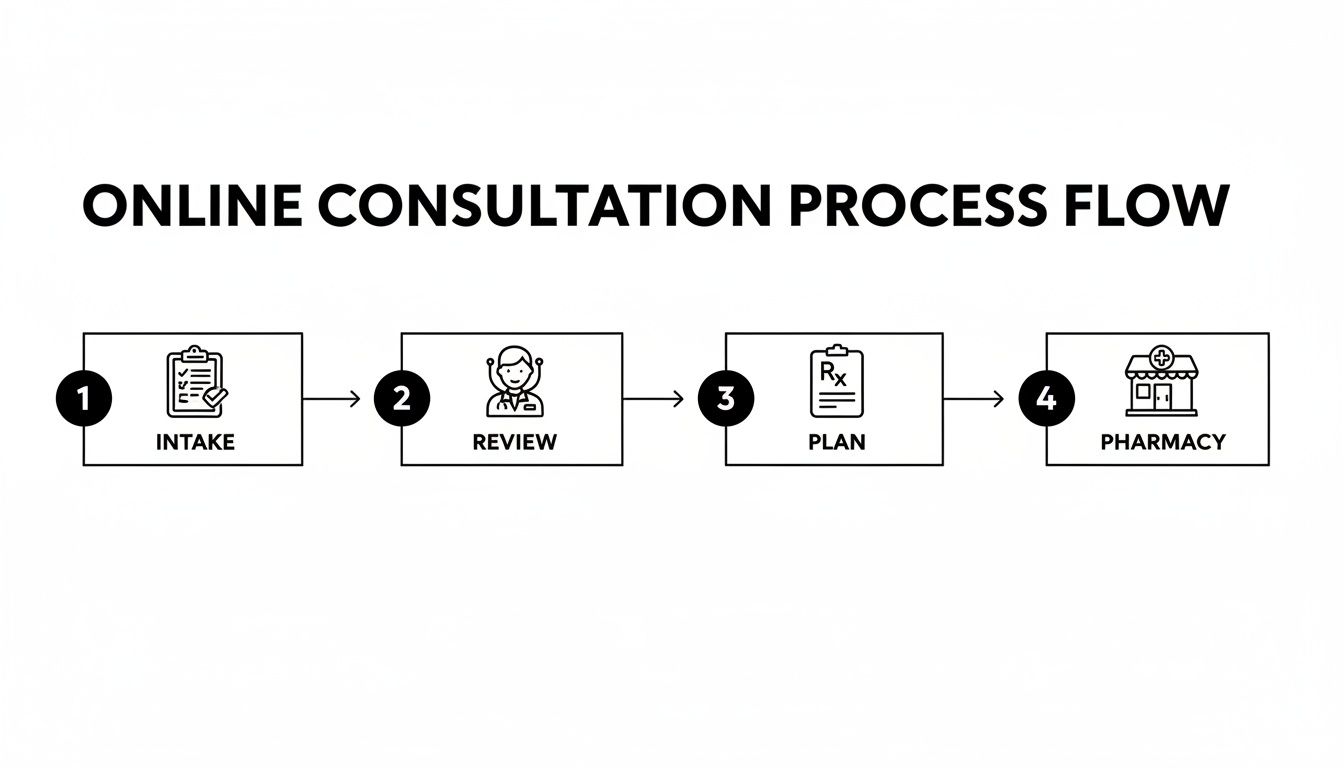
As you can see, each step is designed to move your case forward efficiently and securely, making for a seamless patient experience.
To help you visualize the flow, here's a quick summary of what happens at each stage.
The Online Consultation Process at a Glance
| Step | What Happens | Key Benefit |
|---|---|---|
| Intake | You complete a secure online form with your symptoms, medical history, and photos. | You can provide detailed information at your own pace without feeling rushed. |
| Review | A licensed physician thoroughly examines your submitted information. | A medical expert thoughtfully considers your case with all the necessary context. |
| Plan | The doctor provides a diagnosis and a personalized treatment plan via the platform. | You receive a written record of your diagnosis and instructions you can reference anytime. |
| Pharmacy | If needed, an e-prescription is sent directly to your chosen local pharmacy. | Your medication is ready for pickup quickly, completing the care process seamlessly. |
This table shows just how logical and patient-focused the modern online consultation has become.
Step 4: E-Prescription to Your Pharmacy
If the physician determines that medication is necessary, they will send an e-prescription directly to your preferred local pharmacy. You just head over and pick it up when it's ready. This final step completes the care loop, connecting the virtual consultation with your real-world pharmacy needs.
The entire process, from start to finish, is built for maximum convenience. You can learn more about this streamlined approach by seeing how ChatWithDr's process works on their website.
Common Conditions You Can Treat Online
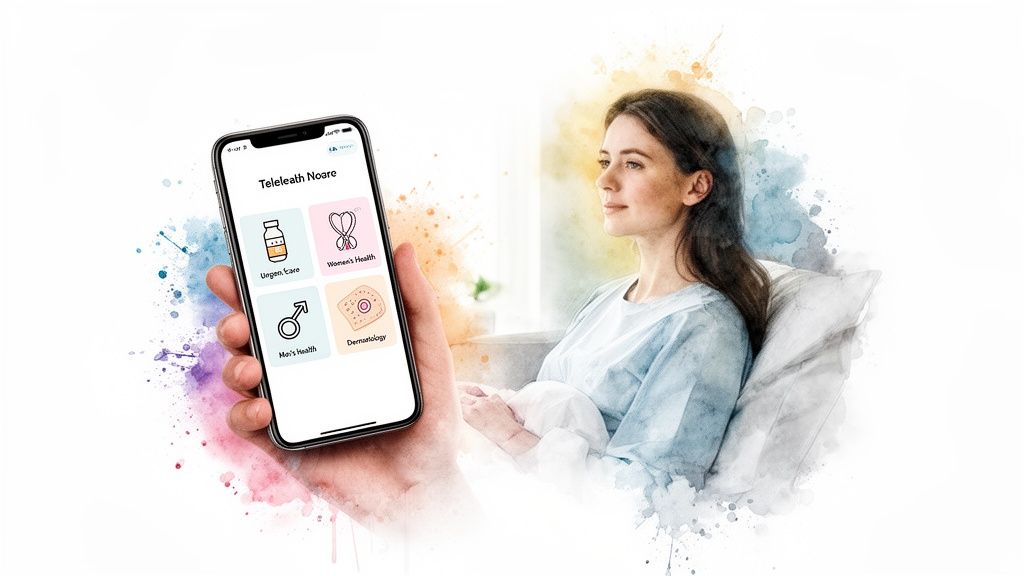
One of the first questions people ask about online doctor consultations is, "What can you actually treat this way?" The answer is: a lot more than you’d think. Telehealth isn't meant to replace all healthcare, but it's an incredibly effective tool for a huge range of common, non-emergency issues that used to mean a trip to the clinic.
Think about it. Instead of blowing half your day to get a prescription for a miserable sinus infection, you can get a diagnosis and have a prescription sent to your pharmacy in just a few hours. That's why millions are making virtual care their first stop.
Urgent Care From Your Couch
Lots of acute—but not life-threatening—illnesses are a perfect match for virtual care. These are the annoying, disruptive problems that don't necessarily require a doctor to physically touch you.
A doctor can often make a spot-on diagnosis based on your detailed description of symptoms and, in some cases, a clear photo.
Common urgent care needs include:
- Urinary Tract Infections (UTIs): The classic symptoms of a UTI are so specific that a doctor can confidently diagnose it based on what you report.
- Sinus Infections: That awful sinus pressure, congestion, and facial pain are all key signs a doctor can assess through a detailed intake form.
- Pink Eye (Conjunctivitis): A clear picture of your eye is often all a doctor needs to diagnose this common infection and prescribe treatment.
- Strep Throat and Bronchitis: By evaluating your symptoms like a sore throat, cough, and fever, a doctor can figure out the likely cause and get you the right treatment plan.
Telehealth is a global movement, but North America is leading the charge, holding a massive 41.24% of the global market share. This boom is driven by our solid digital infrastructure and the new habits we all formed during the pandemic. With 96% of U.S. adults using the internet, the stage is set for services like ChatWithDr to offer text-based care for common issues at a simple flat fee. You can get a deeper look at these market trends in this detailed industry report about the online doctor consultation market.
Focused Care for Women's and Men's Health
Beyond sniffles and infections, online platforms are a discreet and easy way to handle specific health issues for both women and men. Many of these topics can feel sensitive, and the privacy of a text-based chat creates a comfortable space for people to get help without feeling judged.
For routine needs and sensitive health topics, an online doctor consultation removes barriers like stigma and inconvenience. It empowers people to proactively manage their health on their own terms, from a place where they feel most comfortable.
This kind of direct access is a game-changer for ongoing care or problems that just don't need an in-person visit.
Common Women's Health Services
- Birth Control Refills: Easily and safely renew your ongoing birth control prescription without a clinic appointment.
- Yeast Infections: Just describe your symptoms to get a diagnosis and treatment plan quickly and discreetly.
- Bacterial Vaginosis (BV): Get fast care for this common condition based on a simple review of your symptoms.
Common Men's Health Services
- Erectile Dysfunction (ED): Discuss your situation privately with a licensed physician to get a prescription if it's right for you.
- Hair Loss: A doctor can look at your medical history, assess your situation, and prescribe treatments like finasteride.
- Premature Ejaculation (PE): Seek confidential advice and treatment options from the comfort and privacy of home.
Dermatology and Skin Conditions
Dermatology is one of the most natural fits for telehealth. You know the old saying, "a picture is worth a thousand words"? It’s especially true for skin problems. A few clear, well-lit photos can give a physician a perfect view of a rash, weird spot, or acne breakout.
This visual-first approach makes treating many common skin issues incredibly effective.
- Acne: Get a personalized treatment plan and prescriptions to manage your breakouts.
- Rashes and Eczema: A doctor can identify the type of rash and recommend the right creams or medications to calm it down.
- Insect Bites and Minor Burns: Get a quick assessment and advice on how to care for minor skin irritations without having to wait.
By breaking down care into these clear categories, online doctor platforms make it simple to get help for exactly what you need, proving that great healthcare can be both incredibly accessible and convenient.
Choosing Between Online and In-Person Visits
Deciding between an online doctor consultation and a traditional in-person visit can feel like choosing between two different tools for the same job. Neither is automatically better; the right choice really boils down to your specific health needs, your schedule, and what you’re dealing with. The goal isn’t to replace one with the other but to know when to grab which tool for the best possible outcome.
Think of it this way: an online consultation is like sending a detailed, secure message to an expert for a quick, precise answer. An in-person visit is like popping the hood of your car so a mechanic can see exactly what’s going on. Both are valuable, but they serve different purposes. For a lot of common issues, that detailed message is all you need to get back on the road to feeling better.
The Power of Convenience and Speed
Let's be honest, the biggest draw for an online doctor consultation is its sheer convenience. It completely gets rid of the logistical headaches that often make seeking healthcare feel like a chore. There’s no travel time, no traffic to deal with, and zero time spent in a waiting room with other sick people.
This model is built for the chaos of modern life. You can get medical advice from your couch, your office, or even while you’re on vacation. For busy parents, working professionals, or students with packed schedules, this kind of access is a total game-changer. It means you can tackle a health issue like a UTI or a sinus infection almost immediately, often getting a diagnosis and a prescription in just a couple of hours.
Cost Transparency and Financial Control
Another huge factor is the cost. Traditional healthcare can come with a lot of financial question marks. Between co-pays, deductibles, and surprise facility fees, the final bill can be a shock. For many, this unpredictability is stressful enough to make them put off getting necessary care.
Online platforms like ChatWithDr typically run on a simple, flat-fee model. You know the exact cost of the consultation before you even start—for example, a single fee of $39.99. This transparency gives you complete control over the expense, wiping away the anxiety of hidden charges. While this fee is usually out-of-pocket, many platforms let you use HSA or FSA cards, and any medications prescribed can still be covered by your insurance at the pharmacy.
An online doctor consultation excels when clarity, speed, and convenience are your top priorities. It's designed for straightforward medical issues where a physical examination isn't required to make an accurate diagnosis.
This direct-to-patient approach cuts out the administrative fluff, focusing only on delivering efficient care for a clear, predictable price.
Knowing the Limitations of Virtual Care
While powerful, an online doctor consultation is not a one-size-fits-all fix. Its main limitation is the lack of a physical exam. For certain medical conditions, a doctor absolutely needs to be able to see, hear, or feel what’s happening to make a safe and accurate diagnosis.
It is absolutely critical to understand that virtual care is not for medical emergencies. If you are experiencing symptoms like chest pain, trouble breathing, severe bleeding, or signs of a stroke, you must call 911 or get to the nearest emergency room immediately.
On top of that, some conditions require hands-on assessment or instant diagnostic tests. A doctor can’t listen to your lungs through a screen or do a throat swab for strep remotely. For complex issues, managing a chronic disease that requires physical monitoring, or anything needing urgent lab work, an in-person visit is still the gold standard.
A Head-to-Head Comparison
To help you decide on the spot, let’s break down the key differences in a simple format. This table gives you a quick visual summary to guide your choice based on what matters most to you right now.
| Feature | Online Consultation (e.g., ChatWithDr) | In-Person Visit |
|---|---|---|
| Convenience | Accessible 24/7 from anywhere; no travel or wait time. | Requires scheduling, travel, and time in a waiting room. |
| Speed of Care | Diagnosis and treatment plan often within 1-2 hours. | Can take days or weeks to get an appointment. |
| Cost | Transparent, flat fee paid upfront. | Variable costs involving co-pays, deductibles, and insurance. |
| Scope of Care | Best for common, non-emergency conditions. | Suitable for all conditions, including emergencies and complex cases. |
| Physical Exam | Not possible; relies on patient reporting and photos. | Full hands-on examination and diagnostic tests are available. |
| Privacy | Highly private, text-based communication. | Less private due to shared waiting rooms and verbal exams. |
Ultimately, having both options available puts you in control. Knowing which to choose and when is the key to getting the right care for the right problem, right away.
Understanding Privacy, Security, and Costs

Handing over your personal health information and credit card details online can feel like a leap of faith. It’s completely natural to wonder: Is this safe? How is my data being protected? And what is this actually going to cost me?
These are crucial questions. Legitimate online doctor consultation services are built from the ground up to answer them with total confidence. Let's be direct: using a professional telehealth platform is worlds away from just sending a text or an email. Reputable services operate under strict federal laws designed to keep your most sensitive information locked down tight.
Your Digital Health Information is Secure
In the U.S., the gold standard for healthcare privacy is HIPAA (the Health Insurance Portability and Accountability Act). Think of HIPAA compliance as a digital bank vault for your health data. It legally requires any platform handling your information to use robust security measures to protect it at all times.
This isn't just a suggestion; it's the law. These measures include things like:
- Data Encryption: All communication between you and the doctor is scrambled, making it completely unreadable to anyone else.
- Secure Servers: Your information is stored in protected environments with multiple layers of security.
- Access Controls: Only authorized personnel, like the physician you're consulting with, can ever view your medical details.
A HIPAA-compliant platform isn't just a nice feature; it's a legal and ethical requirement. It ensures your online doctor consultation is just as private and confidential as a conversation in a traditional doctor's office.
These platforms invest heavily in enterprise-grade security to earn your trust. For a closer look at this commitment, you can review the specific measures outlined in the ChatWithDr privacy policy. And as technology evolves, understanding the global standards for safeguarding patient information is key; navigating the complexities of AI in healthcare data privacy in Canada offers valuable insights into these protections.
A Clear and Simple Cost Structure
Beyond ironclad security, financial clarity is a huge reason people turn to online doctor consultations. Traditional healthcare can often feel like a maze of co-pays, deductibles, and confusing bills that show up weeks later. Virtual care platforms cut right through that complexity.
With a service like ChatWithDr, the pricing model is straightforward and transparent. You pay a single, flat fee—for example, $39.99—for the entire consultation. There are no surprise charges or hidden costs. You know the exact price before you even begin, which puts you in complete control of your healthcare spending.
How Payments and Prescriptions Work
The payment process itself is designed to be as simple as any other online purchase you’d make. Most platforms accept standard payment methods, making the whole thing seamless.
Here’s what you can typically expect:
- Payment Methods: You can almost always pay with any major credit or debit card.
- HSA and FSA Cards: Many services, including ChatWithDr, accept Health Savings Account (HSA) and Flexible Spending Account (FSA) cards, allowing you to use your pre-tax dollars for your care.
- Insurance for Medication: While the consultation fee itself is often an out-of-pocket expense, any medication prescribed by the doctor can be covered by your health insurance. You just use your insurance at your local pharmacy like you always would.
This model smartly separates the cost of the doctor's time from the cost of your medication. It gives you transparency for the consultation and lets you use your insurance benefits where they matter most—at the pharmacy counter. This clear, secure, and affordable structure is designed to give you total peace of mind.
How to Prepare for Your First Virtual Visit
Jumping into your first online doctor consultation might feel a little new, but a few minutes of prep can make all the difference. Think of it like organizing your thoughts before an important meeting—having the right information ready helps make the conversation focused and effective.
You don't need to do much to get the most value out of your visit. The entire process is designed to be simple. But spending a moment gathering key details helps your physician make a more accurate diagnosis and build the best treatment plan for you.
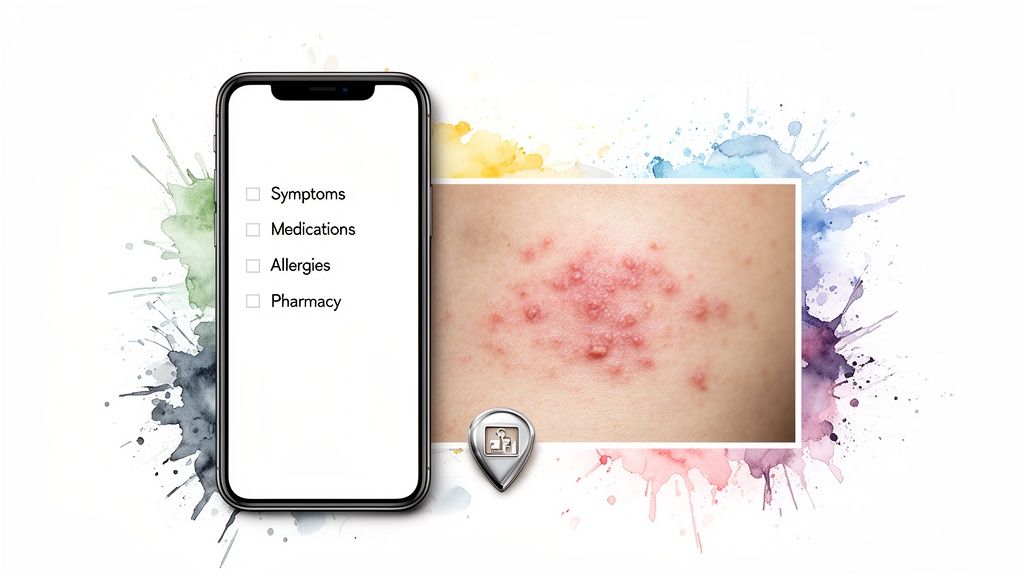
This simple checklist walks you through the essentials. Following these tips can ease any first-time jitters and ensure your doctor gets the high-quality information they need to provide excellent care, even without a video call.
Gather Your Key Medical Information
Before you even start the intake process, take a moment to pull together some basic health details. Having this info on hand makes filling out the secure form faster and far more accurate. Your goal is to paint a crystal-clear picture of your current health for the doctor.
You should have the following ready to go:
- A Detailed List of Your Symptoms: Jot down what you’re feeling, when it all started, and anything that seems to make it better or worse. The more specific you can be, the better.
- Your Current Medications: List everything—prescriptions, over-the-counter drugs, vitamins, and any supplements you take. If you know the dosages, include those too.
- Known Allergies: Make a quick note of any allergies, especially to medications like penicillin or sulfa drugs.
This little bit of prep work gives the doctor the full context of your condition, which is crucial for your safety and for getting the right treatment.
Take Clear and Helpful Photos
For any issue you can see on your body, a few clear photos can be just as good as an in-person look. A good picture is often all a doctor needs to diagnose skin problems like rashes, insect bites, or acne.
Here are a few tips to snap effective medical photos:
- Use Good Lighting: Natural daylight is your best friend. Try to avoid harsh shadows or dim rooms that can hide important details.
- Get in Focus: Make sure the image is sharp, not blurry. Just tap your phone’s screen on the affected area to focus before you take the picture.
- Show Some Context: Take one close-up shot of the issue itself and another from a little farther away to show its location on your body.
When it comes to an online doctor consultation, especially for something like dermatology, a clear photo is worth a thousand words. It gives the physician the visual proof they need to accurately size up your condition from a distance.
Final Touches for a Smooth Experience
With your information and photos ready, there are just two final things to think about. These last steps make sure your consultation is efficient and private, letting you finish the intake process without any interruptions.
Find a quiet, private space where you can focus on answering the intake questions thoughtfully. Being able to concentrate without distractions helps you provide the most accurate information possible.
Finally, have your preferred pharmacy's details ready, including its name and address. That way, if a prescription is necessary, the doctor can send it straight to the right place without any holdups, getting you on the road to recovery that much faster.
Why Virtual Care Is No Longer Just a “Nice-to-Have”
Let’s be honest: life is chaotic. Between school runs, back-to-back meetings, and just trying to keep up, finding time to see a doctor feels like a logistical nightmare. An online doctor consultation isn't just a tech trend; it's a necessary shift in healthcare that finally fits into the way we actually live. It pulls medical support out of the clinic and integrates it right into our daily digital routines.
Think about it. For a busy parent, a professional stuck in the office, a college student miles from their family doctor, or even a traveler needing quick advice on the road, virtual care removes the usual roadblocks. No more rearranging your entire day for a 15-minute appointment. It’s about getting quality medical help on your terms.
Meeting the Needs of a Changing World
This shift isn't happening in a vacuum. Two massive global changes are pushing accessible, ongoing medical support from a convenience to a necessity.
First, populations are aging, and chronic diseases are on the rise. These aren't one-and-done illnesses; they require constant monitoring and management. By 2030, a staggering 1.4 billion people worldwide will be over 60. This demographic shift, paired with the surge in long-term health conditions, highlights exactly why virtual care is so crucial. You can read more about how these trends are shaping the market to see the full picture.
For older adults with mobility issues or anyone managing a long-term condition, this patient-first model is a lifeline. It delivers consistent medical guidance without the physical and mental toll of frequent trips to a clinic.
The real magic of virtual care is that it meets you where you are. It understands that your life is complicated and busy, and it bends healthcare to fit your world—not the other way around.
A Future Woven into Our Digital Lives
Ultimately, the growth of online consultations shows us a clear picture of a patient-first future. Healthcare is breaking free from the four walls of a clinic. Instead, it’s becoming a flexible, integrated part of our daily lives, available on the same devices we use to connect with work, family, and friends.
This change empowers us to be more proactive about our health. By knocking down the classic hurdles—time, travel, and inconvenience—an online doctor consultation makes it easier to get help for small issues before they snowball into big problems. It's simply a smarter, more efficient way to stay healthy in a world that never stops moving.
Questions We Hear All the Time
Jumping into the world of virtual healthcare is a smart move, but it's totally normal to have a few questions before you start. Let's clear up some of the most common ones so you can feel confident getting the care you need, right when you need it.
Can a Doctor Really Figure Out What’s Wrong Without Seeing Me in Person?
This is probably the number one question we get, and the answer is a resounding yes—for a whole lot of common issues. While it’s not a replacement for a hands-on exam in every single case, a detailed, structured questionnaire paired with a couple of clear photos gives a doctor a surprisingly complete picture.
Think of it like a detective piecing together clues. Your thorough answers about symptoms, your medical history, and how things have progressed, along with visual proof for things like a nasty rash or pink eye, give the doctor all the critical information needed to make an accurate diagnosis.
Are Prescriptions from an Online Doctor Actually Legit?
Absolutely. Prescriptions you get from a legitimate online doctor are just as valid as the paper script you'd get at a clinic. The key is that the service must use U.S.-licensed physicians who are legally cleared to practice and prescribe medicine in your state.
When a licensed doctor on a HIPAA-compliant platform like ours sends an e-prescription, it goes straight to a licensed U.S. pharmacy. It’s the same secure, regulated system that traditional doctor's offices use, ensuring your medication is both safe and legitimate.
This modern system makes sure you get authentic medication from a source you can trust, seamlessly connecting your virtual visit with your neighborhood pharmacy.
What Happens If My Condition Can’t Be Treated Online?
Good question. Any reputable platform is upfront about the limitations of virtual care. If a physician reviews your case and decides your condition needs an in-person exam, some lab work, or might be a medical emergency, they will not move forward with treatment.
Instead, they'll point you in the right direction, like heading to an urgent care clinic or the emergency room. In most situations where a doctor can't provide treatment, you'll get a full refund for the consultation fee. These services are built for non-emergency problems only.
How Fast Will I Get My Medication?
While the whole consultation process is incredibly fast, it helps to know the timeline. After a doctor reviews everything and sends over your treatment plan—which often happens in just 1-2 hours—the e-prescription zips over to your pharmacy.
From that point, it’s all about your pharmacy’s own workflow and how busy they are. Most of the time, prescriptions are ready for pickup within a few hours. For even more detailed answers, check out our complete guide covering other frequently asked questions about telehealth.
Ready for fast, hassle-free healthcare on your terms? Get a diagnosis and treatment plan from a board-certified U.S. doctor in as little as an hour. With ChatWithDr, you can skip the waiting room and get the care you need for just $39.99. Start your consultation now.