
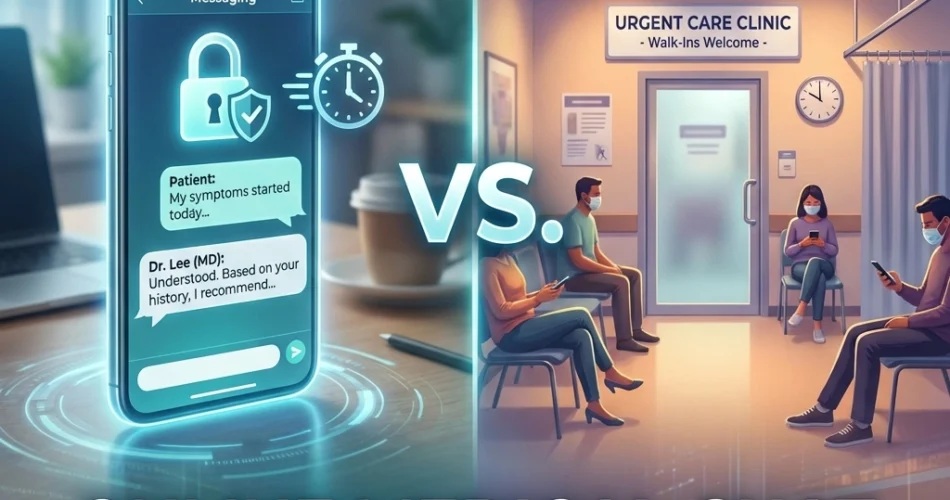
It's 11 PM on a Tuesday. You've got a painful UTI that won't quit, and you're weighing your options: drive to urgent care and sit in a waiting room for who knows how long, or try to chat with a doctor 24/7 from your couch. Both can get you treatment: but which one actually makes sense for your situation?
The rise of online medical chat services has fundamentally changed how people access healthcare. But that doesn't mean urgent care centers are obsolete. Understanding when each option works best can save you time, money, and unnecessary stress.
Let's break down the real differences between live medical chat and traditional urgent care so you can make smarter healthcare decisions.
Speed: How Fast Can You Actually Get Care?
When you're not feeling well, waiting is the last thing you want to do. Here's how the two options stack up.

Online medical chat services like ChatWithDr typically connect you with a licensed physician in under two hours: often much faster. There's no driving, no check-in process, and no sitting in a room full of other sick people. You text your symptoms, and a doctor responds directly to your phone.
Urgent care clinics offer walk-in convenience, which beats trying to book a same-day appointment with your primary care doctor. However, according to healthcare data, the average urgent care wait time can range from 15 minutes to over an hour depending on location, time of day, and patient volume. Add travel time and paperwork, and you're looking at a significant chunk of your day.
The bottom line: If speed is your priority and your condition doesn't require hands-on examination, urgent care online via text-based services gets you answers faster.
Privacy: Why Text-Based Care Wins
Here's something most people don't consider: the privacy factor.
Walk into an urgent care clinic, and you're checking in at a front desk, potentially within earshot of other patients. You're sitting in a shared waiting room. You're discussing symptoms with a nurse before the doctor even sees you.
With a live medical chat platform, your entire consultation happens through secure, HIPAA-compliant text messaging. No one overhears your conversation. No one in the waiting room knows why you're there: because there is no waiting room.
This matters especially for sensitive conditions. Need to discuss symptoms of a possible UTI? Concerned about an STD? Looking into birth control options? Text-based consultations let you have these conversations privately, from wherever you feel comfortable.
ChatWithDr operates as a text-only platform, meaning your medical discussion stays between you and your doctor: no video calls required, no account creation needed to start.
Convenience and Cost: What You're Really Paying For

Let's talk dollars and sense.
Urgent care visits typically cost between $100-$200 without insurance, according to the American Academy of Family Physicians. That's before any tests, X-rays, or additional procedures. With insurance, you're still looking at a copay plus potential surprise bills down the line.
Online medical chat consultations generally cost significantly less: and many platforms, including ChatWithDr, accept insurance, HSA, and FSA payments. You know the cost upfront, and there are no facility fees tacked on.
Beyond money, consider the time cost:
- Urgent care: Travel time + wait time + visit time = 1-3 hours minimum
- Online chat: Start texting immediately, get a response within 2 hours, continue your day
For people with mobility challenges, those living in rural areas with limited healthcare access, or anyone who simply doesn't feel well enough to drive, the ability to chat with a doctor 24/7 from home isn't just convenient: it's transformative.
When Online Medical Chat Is the Right Choice
Text-based telehealth works exceptionally well for a wide range of non-emergency conditions. Here's when reaching for your phone makes more sense than reaching for your car keys:
Common conditions treated via online chat:
- UTIs in women
- Cold, flu, and COVID symptoms
- Sore throat and strep throat
- Sinus infections
- Seasonal allergies
- Minor skin issues (rashes, acne)
- Birth control consultations
- Medication refills
The Mayo Clinic notes that telehealth is particularly effective for conditions where diagnosis can be made through patient-reported symptoms and medical history.
Want to get your prescriptions online? That's another major advantage. When medically appropriate, doctors on platforms like ChatWithDr can send prescriptions directly to your preferred pharmacy: no extra trip required. Your medication can be ready for pickup (or delivery) often within hours.
Start a consultation now to see if your condition qualifies for text-based treatment.
When Urgent Care Is the Better Option

Online chat is powerful, but it has limitations. Some situations genuinely require hands-on medical care.
Choose urgent care when you need:
- Physical examination (doctor needs to listen to your lungs, examine a wound, etc.)
- Diagnostic testing on-site (X-rays, rapid strep tests, blood work)
- Minor procedures (stitches, splinting, wound care)
- Vaccinations or injections
- Assessment of potential fractures or sprains
According to MedlinePlus, urgent care centers bridge the gap between your primary care doctor and the emergency room: handling issues that need same-day attention but aren't life-threatening.
If you're unsure whether your condition needs in-person care, starting with an online medical chat can actually help. A physician can assess your symptoms via text and recommend whether urgent care or even emergency services are warranted.
When to Skip Both and Go to the ER
This is critical. Neither online chat nor urgent care is appropriate for medical emergencies.
Call 911 or go to the emergency room immediately if you experience:
- Chest pain or pressure
- Difficulty breathing or shortness of breath
- Signs of stroke (facial drooping, arm weakness, speech difficulty)
- Severe bleeding that won't stop
- Loss of consciousness
- Severe allergic reactions
- High fever with confusion or stiff neck
- Serious injuries from accidents
The CDC recommends erring on the side of caution with these symptoms. When in doubt about severity, emergency services are always the safest choice.
Frequently Asked Questions

What conditions are safe for online chat?
Non-emergency conditions that can be diagnosed through symptoms and history are ideal for live medical chat. This includes UTIs, respiratory infections, allergies, minor skin conditions, and medication management. Conditions requiring physical examination, imaging, or lab work typically need in-person care.
Is online medical chat legal?
Yes. Telehealth, including text-based medical consultations, is legal throughout the United States when provided by licensed physicians practicing within their state's regulations. Platforms like ChatWithDr connect you with doctors licensed in your state who follow all applicable medical and privacy laws, including HIPAA requirements.
How do prescriptions work with online doctors?
When a licensed physician determines a prescription is medically appropriate based on your consultation, they can electronically send it to your pharmacy of choice. You'll receive notification when it's ready for pickup or delivery. This process is the same as getting a prescription from an in-person visit: just faster and more convenient.
Do I need to create an account to chat with a doctor?
With ChatWithDr, no account creation is required to start a consultation. You can begin texting with a licensed physician right away.
Making the Right Choice for Your Health
The debate isn't really "online medical chat vs. urgent care"; it's about matching the right care option to your specific situation.
For speed, privacy, and convenience with non-emergency conditions, chat with a doctor 24/7 through a text-based platform like ChatWithDr. For conditions requiring physical examination or on-site testing, urgent care remains valuable.
The best healthcare decision is an informed one. Now you have the information to make it.
Related posts:
 The 7 Best Online Doctor Services of 2025: A Detailed Review
  Best Telemedicine Platforms: best telemedicine platforms for 2025
  Difference Between Urgent Care and Emergency Explained
  Your Guide to Virtual Urgent Care Online Doctor Visits
  Chat With a Doctor 24/7: Why Online Medical Chat is the Future of Urgent Care