
Ever wish you could get a doctor's diagnosis and treatment plan without having to schedule an appointment or stare into a camera for a video call? That’s exactly what an asynchronous telehealth visit is all about. Think of it as having a detailed, secure text conversation with your doctor. You share your symptoms when you have a moment, and they get back to you with professional medical advice on their time.
Your Guide to Care Without the Video Call
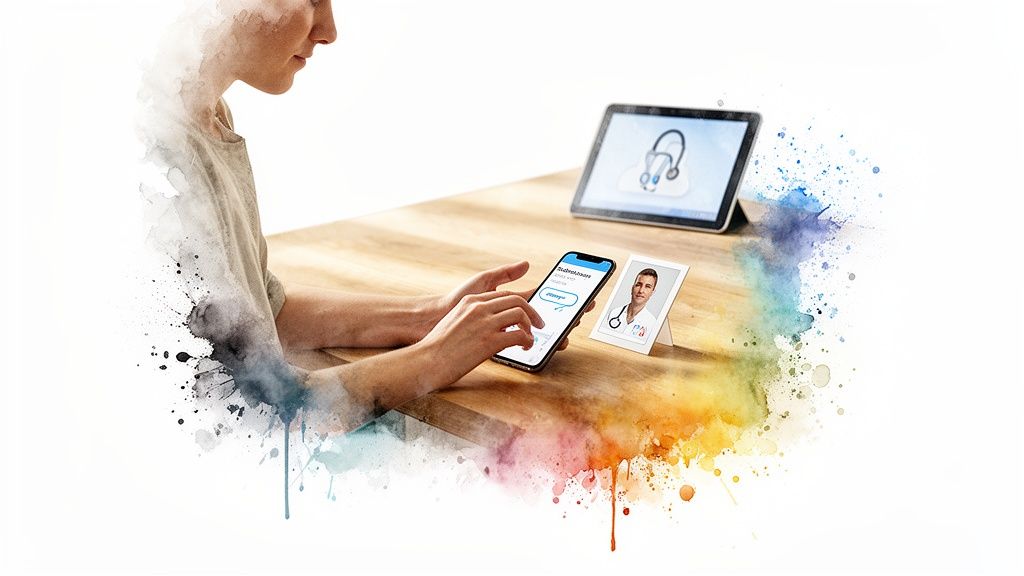
Unlike a live video chat, an asynchronous visit doesn’t require you and your doctor to be online at the same time. It’s a "store-and-forward" approach that lets you send your health information—like photos of a rash, a quick video, or a detailed description of your symptoms—through a secure platform whenever it’s convenient for you. A licensed physician then reviews your case and sends back a complete care plan.
This modern way of getting healthcare is quickly becoming the go-to for common health issues. It puts patients back in control of their time while still delivering high-quality medical care. Platforms like ChatWithDr are making this incredibly convenient model a reality for thousands of people every day.
Why This Method Is Growing
The appeal of asynchronous care is all about efficiency and accessibility. It just works, tearing down some of the most common roadblocks to getting medical help. The biggest advantages are clear:
- No Scheduling Needed: You can start a consultation at 2 AM or during your lunch break. No more playing phone tag with the receptionist.
- Enhanced Privacy: Discussing sensitive health issues feels a lot more comfortable through private, secure messaging than on a face-to-face video call.
- Reduced Wait Times: You can often get a diagnosis and a treatment plan within a few hours, not days or weeks.
This model is a huge reason the telemedicine market is expanding so quickly. In fact, its growth is expected to help push the global market from $146.9 billion in 2025 to a staggering $251.5 billion by 2030, reflecting an annual growth rate of 11.3%. This surge is happening because it makes care accessible in both busy cities and underserved rural areas. You can read the full research about telehealth market projections to see the data for yourself.
The core idea is simple but powerful: quality healthcare shouldn't depend on your ability to find a 15-minute slot in a packed schedule. Asynchronous care puts medical expertise right in your pocket, ready whenever you are.
The Three Simple Steps of an Asynchronous Visit
So, what does an asynchronous telehealth visit actually look like from your side of the screen? It's a surprisingly straightforward process built for real life, completely ditching the need to line up your schedule with a doctor's.
The whole thing boils down to three simple steps. It kicks off with you sharing your story, then a doctor dives into the details on their own time, and it all wraps up with a clear treatment plan sent right back to you. This is exactly what makes getting care so fast and hassle-free.
Step 1: Complete a Secure Intake Form
Your visit starts the moment you fill out a secure online intake form. Think of it as the digital version of the clipboard paperwork you get in a waiting room, only smarter and way more convenient. This is where you'll describe what’s going on, share any relevant medical history, and even upload photos if they help tell the story.
This first step is crucial because it gives your physician all the background they need to get things right. On platforms like ChatWithDr, these HIPAA-compliant forms are designed to ask the right questions from the get-go, making sure your doctor has a complete picture of your health concern before they even begin their review.
Step 2: A Licensed Doctor Reviews Your Case
Once you hit submit, your information goes to a board-certified, state-licensed physician for review. This happens on the doctor's schedule, which means they can give your case their full, uninterrupted attention without the pressure of a ticking clock or a packed waiting room.
The doctor carefully goes over your symptoms, medical history, and any photos you sent. This "store-and-forward" method allows for a thoughtful and meticulous review. If they need a little more information or have a clarifying question, they’ll simply follow up through the platform’s secure messaging.
The real magic here is focus. The doctor can concentrate solely on the details you've provided, which leads to a well-considered diagnosis and a treatment plan built specifically for you.
Step 3: Receive Your Diagnosis and Treatment Plan
Finally, the doctor sends back their professional medical assessment. You’ll get a clear diagnosis, a personalized treatment plan, and easy-to-follow instructions for your care.
If a prescription is medically necessary, the doctor will send it electronically to your favorite local pharmacy, ready for you to pick up. This final step closes the loop, giving you everything you need to start feeling better—often in just a couple of hours. To see this in action, you can check out the detailed flow of a ChatWithDr consultation. The whole experience is designed to deliver effective, no-nonsense care right to you, wherever you happen to be.
Why Patients Are Choosing Asynchronous Care
People are flocking to asynchronous telehealth, and it’s not just about convenience. This model is a fundamental shift in how we get medical care, putting flexibility, affordability, and privacy front and center in a way that traditional healthcare just can't.
For so many, the biggest win is the pure freedom it offers. An asynchronous visit completely does away with appointments. Instead of shuffling your workday around or scrambling for last-minute childcare, you can start a consultation whenever it works for you—whether that’s at the crack of dawn before the house wakes up or late at night after a marathon shift.
This on-demand access is a game-changer for everything from urgent needs to managing chronic conditions. A parent can upload photos of their child's angry-looking eye from home, and a busy professional can get a prescription refill sorted out without ever leaving their desk.
Unmatched Convenience and Speed
The entire process is built for speed and efficiency. By cutting out the need for a real-time, back-and-forth conversation, asynchronous platforms can deliver care incredibly fast.
You can see the simple three-step flow of a typical visit below. It's a "store-and-forward" model—you send your info, the doctor reviews it, and they send a plan back.
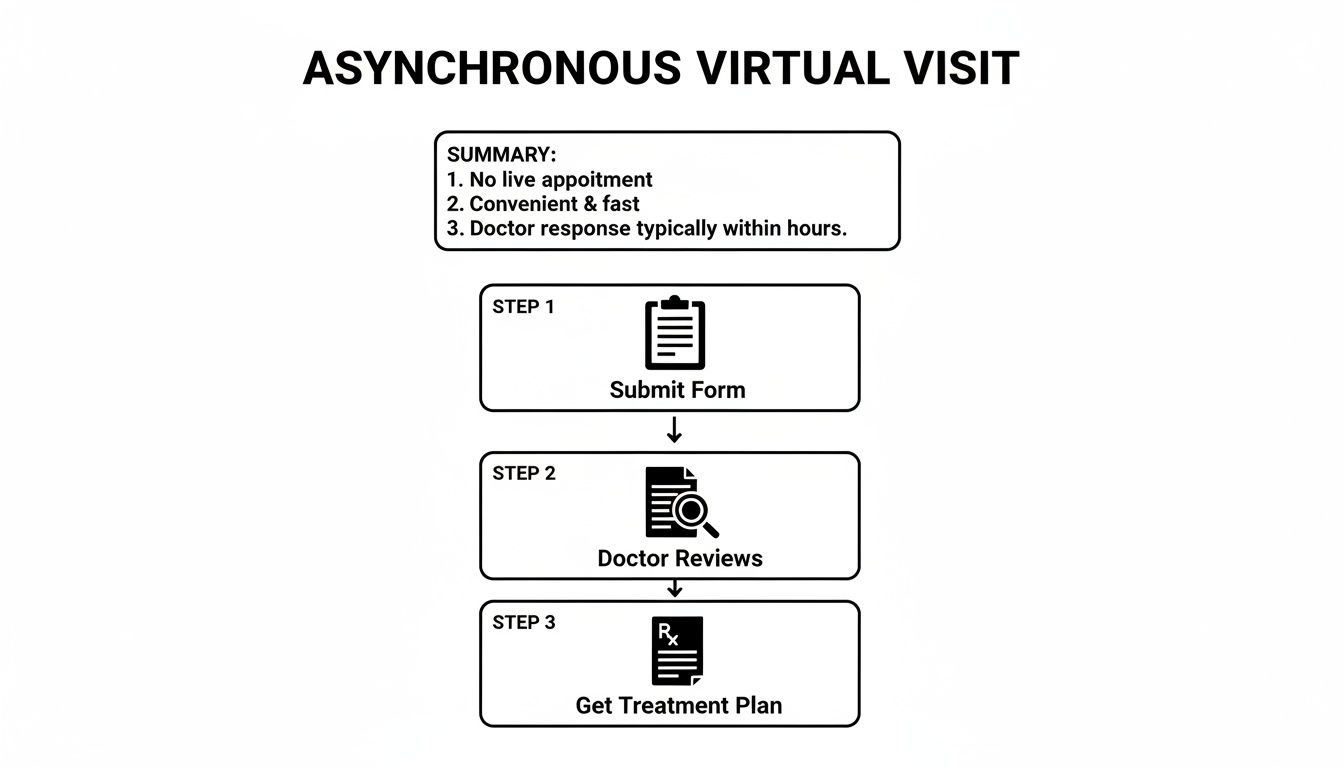
This straightforward approach means you can often get a diagnosis and a full treatment plan in just a couple of hours, completely bypassing the days or even weeks it might take to get in front of a doctor in person.
Significant Cost Savings
Another huge reason people are making the switch is cost. Asynchronous services like ChatWithDr typically run on a clear, flat-fee basis. You know exactly what you’re paying before you even start—no surprise bills or confusing insurance codes showing up in your mailbox later.
For one simple, affordable fee, you get a comprehensive medical consultation, a diagnosis, and a prescription if one is needed. This kind of transparent pricing makes high-quality healthcare accessible without the financial guesswork.
Many of these services also accept HSA and FSA payments, which is a great way to use your pre-tax health funds. And while the visit itself might not go through your insurance, any prescriptions are sent straight to your local pharmacy, where you can use your insurance just like you always do.
To see how these different models stack up, let's look at them side-by-side.
Comparing Healthcare Visit Types
| Feature | Asynchronous Telehealth (e.g., ChatWithDr) | Synchronous (Video) Telehealth | In-Person Visit |
|---|---|---|---|
| Scheduling | No appointment needed; available 24/7. | Requires a scheduled appointment. | Requires a scheduled appointment, often weeks in advance. |
| Wait Time | Minimal; response within a few hours. | Can have virtual "waiting room" delays. | Involves travel and clinic wait times. |
| Cost | Typically a low, flat fee; very transparent. | Varies; often billed like a standard office visit. | Highest cost; billed through insurance with copays/deductibles. |
| Convenience | Highest; consult from anywhere, anytime. | High; consult from anywhere, but at a specific time. | Lowest; requires travel and time off work. |
| Privacy | High; text-based format is discreet. | Moderate; requires a private space for a video call. | Varies; less private waiting rooms and check-in. |
Each approach has its place, but for common, straightforward issues, the asynchronous model offers a unique blend of speed, cost-effectiveness, and privacy.
Enhanced Privacy and Comfort
Finally, the text-based nature of an asynchronous visit provides a level of privacy and comfort that a video call or an in-person appointment can’t always match. It can feel much less intimidating to discuss sensitive health topics—from sexual health to mental well-being—through secure, private messaging.
This discretion empowers people to seek care for conditions they might otherwise put off discussing face-to-face. The global embrace of these services tells the story. The telehealth market is projected to rocket from USD 123.26 billion in 2024 to an incredible USD 455.27 billion by 2030. Within this massive expansion, asynchronous "store-and-forward" services are gaining serious traction for the precise, private care they provide. You can discover more insights about the telehealth market growth and see why this model is becoming such a dominant force.
What Conditions Are a Good Fit for This Model?
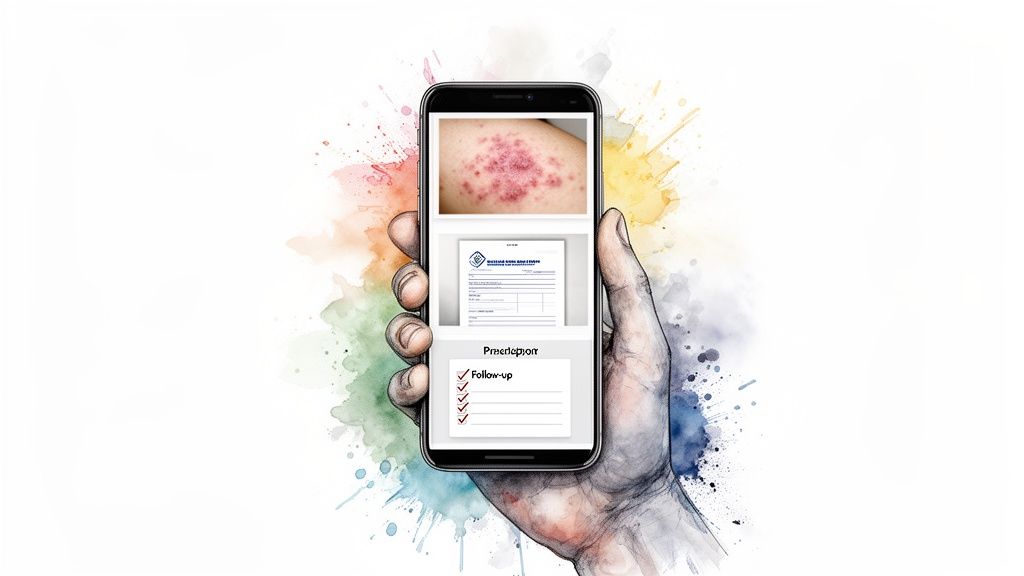
While an asynchronous telehealth visit isn't the answer for every medical situation—especially true emergencies—it’s a perfect match for a surprisingly wide range of common health problems. The whole model is built on a simple, effective principle: many conditions can be accurately diagnosed and treated with a detailed medical history and a few clear photos, no live video or physical exam required.
This "store-and-forward" approach is ideal for issues that are urgent but not life-threatening. Instead of rearranging your day for an appointment or losing hours in a waiting room, you can get a solid diagnosis and treatment plan quickly and on your own time.
Common Urgent Care Needs
Plenty of everyday illnesses fit perfectly into the asynchronous framework. These are the kinds of conditions where your symptoms, combined with a thorough intake questionnaire, give a doctor all the information they need to provide real, effective care.
Chances are, you’ve probably needed help for one of these before:
- Urinary Tract Infections (UTIs): The symptoms are usually distinct and easy to describe in a questionnaire, which allows a doctor to prescribe antibiotics right away.
- Sinus Infections: Describing that tell-tale sinus pressure, congestion, and other key symptoms is typically enough for a physician to diagnose the issue and get you on the path to recovery.
- Pink Eye (Conjunctivitis): It’s amazing how effective a clear photo of the affected eye, paired with your symptom history, can be for a remote diagnosis.
- Strep Throat or Sore Throat: Based on a detailed description of your symptoms, a doctor can assess the likely cause and recommend treatment or tell you the next steps to take.
Dermatology and Skin Conditions
Dermatology is one of the biggest success stories in asynchronous care. Because so many skin issues are visual, a set of high-quality photos can often be just as informative for an initial diagnosis as an in-person exam.
A study of VA telehealth found that asynchronous ("store-and-forward") dermatology consultations were highly effective, allowing specialists to review images and patient histories securely from different locations.
This makes it a fantastic option for managing things like:
- Acne: Dermatologists can look at photos to assess the type and severity of acne, then prescribe the right topical or oral medications.
- Rashes and Eczema: You can snap and upload images of a new rash to get a quick diagnosis and treatment recommendations.
- Rosacea Flare-Ups: Ongoing management gets a lot simpler when you can just share photos of your skin's condition to get your medication adjusted.
Routine Wellness and Prescription Refills
An asynchronous telehealth visit is also a game-changer for handling ongoing wellness needs and getting routine prescription refills without the hassle of a trip to the doctor's office. This is especially true for stable, non-complex conditions.
Providers like ChatWithDr make it simple to get care for:
- Birth Control Refills: A quick check-in using an online form is all it takes to get your prescription renewed without any interruption.
- Erectile Dysfunction (ED) Medication: This sensitive topic can be handled discreetly and privately through secure messaging with a doctor.
- Hair Loss Treatment: Consultations for conditions like male pattern baldness are straightforward and easy with a text-based visit.
The rapid patient adoption of telehealth has completely reshaped healthcare. Projections even suggest it could handle over 30% of all outpatient visits by 2025. This swift integration into mainstream medicine is fueled by its proven success in treating exactly these kinds of common conditions. You can discover more insights about telehealth consultation patterns to see the full scope of this shift.
How Your Privacy and Data Are Kept Safe
When it comes to your health, trust is everything. Handing over sensitive personal information online can feel a little unnerving, but any reputable asynchronous telehealth visit is built on a foundation of serious security and strict legal rules designed to protect you every step of the way.
Think of it like a bank vault, but for your medical data. Top-tier platforms operate under the Health Insurance Portability and Accountability Act (HIPAA), a federal law that sets the gold standard for protecting your health information. This isn’t just a suggestion; it's a legal requirement with serious consequences for any provider that doesn't comply.
The Technology Guarding Your Information
To meet these strict standards, telehealth services use some pretty sophisticated security. Every single piece of data you share—from the answers on your intake form to the photos you upload—is protected with powerful encryption. This process essentially scrambles your information into an unreadable code while it’s in transit, making it completely useless to anyone who isn't authorized to see it.
Once it arrives, your data is stored on secure, HIPAA-compliant servers that are monitored around the clock for any potential threats. This multi-layered approach is designed to make sure your personal and medical details stay confidential and locked down.
HIPAA compliance is the absolute baseline for any telehealth provider you should trust. It means the platform is legally bound to protect your privacy with the same seriousness as your local doctor's office or hospital.
State Licensing and Professional Standards
Beyond the tech, your safety is also guaranteed by professional regulations. The physician who reviews your case isn't just some random doctor on the internet. They must be a board-certified physician fully licensed to practice medicine in your specific state.
This is a critical safeguard. State licensing boards have tough standards that doctors must meet and maintain, ensuring they are qualified, in good standing, and up-to-date on the latest medical practices. This system ensures that the care you get through an asynchronous telehealth visit meets the same high professional standards you'd expect from any in-person appointment.
For a deeper dive into how a provider handles your data, you can always explore the details in their privacy commitment. For example, you can review the full ChatWithDr Privacy Policy to understand the specific measures we have in place. It's also helpful to see how different providers approach this; you can look at an example like Herafertility's Privacy Policy to see what details are typically covered.
At the end of the day, every legitimate telehealth service puts your privacy first through a combination of legal compliance, advanced technology, and strict professional licensing. These safeguards all work together to create a secure environment where you can confidently get the high-quality medical care you need.
Choosing the Right Asynchronous Telehealth Provider
Not all online health services are created equal, and when you choose an asynchronous telehealth visit, you’re putting a huge amount of trust in that platform and its doctors. Making the right call is absolutely critical to getting safe, effective, and high-quality care.
You have to look past the flashy ads and zero in on what really matters. Think of it like a quick quality check you run before handing over any personal information. A solid, trustworthy platform will be completely upfront about its standards and make it easy for you to see they're legitimate.
Your Quality Checklist for Providers
When you're comparing different services, a few things are non-negotiable. These are the markers that separate the dependable platforms from the ones you want to avoid, ensuring your health always comes first.
- Board-Certified, U.S.-Licensed Physicians: First things first, confirm the service only uses doctors who are board-certified and hold an active license in your state. This is your guarantee that they meet the highest professional standards.
- Transparent, Flat-Fee Pricing: Look for crystal-clear, upfront costs. There should be no hidden fees, period. A service like ChatWithDr keeps it simple with a single $39.99 flat fee for a consultation, so you know exactly what you’re paying every single time.
- Clear HIPAA Compliance: The provider’s website needs to state that it's HIPAA-compliant. This isn’t just jargon; it’s your legal assurance that they are required to protect your sensitive health data with serious security measures.
- Positive and Verifiable Patient Reviews: Real feedback from other patients is gold. Look for consistently high ratings and take a minute to read what people are saying about the service’s speed, the quality of care, and their customer support experience.
A trustworthy asynchronous telehealth provider operates with complete transparency. You should never have to guess about a physician's credentials, the final cost of your visit, or how your private data is being protected.
Making a Confident Choice
At the end of the day, the right provider is one that makes you feel secure. Platforms like ChatWithDr are built on this exact principle, pairing U.S.-licensed doctors with enterprise-grade security to create a healthcare experience you can actually depend on.
By running through this checklist, you can confidently pick a service that doesn't just offer convenience but puts your health and safety above everything else. A great asynchronous telehealth visit should leave you feeling better, not worried.
Got Questions? We’ve Got Answers
Even when something sounds straightforward, it’s completely normal to have a few questions before you dive in. If you're new to the idea of an asynchronous telehealth visit, you’re not alone. Let's clear up some of the most common questions people have.
Is This Type of Visit Really Safe and Effective?
Absolutely. For a long list of common medical issues, asynchronous care is just as safe and effective as seeing a doctor in person or over a video call. It all comes down to the quality of the information. Licensed physicians rely on the detailed medical history you provide and any photos you upload to make an accurate diagnosis.
Platforms like ChatWithDr follow strict clinical protocols to keep you safe. That means we only treat conditions that are a good fit for this text-based model. If your symptoms are serious or point to an emergency, you should always seek immediate in-person medical care.
Can I Use My Insurance for a Consultation?
Most asynchronous platforms, including ours, skip the insurance hassle to offer a simple, transparent flat fee for the consultation. This direct-pay approach keeps costs low and totally predictable. The good news is you can often use an HSA or FSA card to pay for it.
And while the visit fee itself might not go through your insurance, any prescriptions the doctor sends to your local pharmacy certainly will. You can use your insurance there to cover the medication, just like you always do.
A great asynchronous visit hinges on clear, secure communication. If a doctor needs more information to make the right call, they’ll reach out directly through the platform’s private messaging system.
This back-and-forth ensures they have everything needed to give you a complete and accurate treatment plan. It’s a key part of maintaining a high standard of care. For even more answers, feel free to check out our full list of frequently asked questions about asynchronous care.
Ready for healthcare that actually fits your schedule? With ChatWithDr, you can get a diagnosis and treatment plan from a U.S.-licensed doctor in just a few hours for a flat $39.99 fee. Start your convenient, text-based visit today.