

When you're facing a medical problem without insurance, it’s easy to feel stuck. But the good news is, affordable care is probably closer than you think. The trick is knowing where to look first. Your best bets are often low-cost community health centers, walk-in urgent care clinics, and even telemedicine services that tell you the price upfront.
Your First Steps for Medical Care Without Insurance
Figuring out the healthcare system when you're uninsured requires a smart, practical game plan. The whole point is to get the right care, right away, without ending up with a mountain of debt. This isn't about toughing it out until a minor issue becomes a major emergency; it’s about being resourceful and knowing which doors to knock on.
While the Affordable Care Act (ACA) helped cut the uninsured rate nearly in half, more than 26 million people in the U.S. were still without coverage in 2023. If you're one of them, you know a basic doctor's visit can run anywhere from $100 to $300 out-of-pocket, which is enough to make anyone hesitate. You can review the latest data on uninsured rates to see just how common this situation is. That financial reality makes knowing your options absolutely essential.
Community Health Centers: The Foundation of Affordable Care
Your first Google search should be for a Community Health Center or a Federally Qualified Health Center (FQHC) near you. These clinics are the bedrock of affordable healthcare. They receive government funding specifically to provide comprehensive primary care to everyone, regardless of their insurance status or ability to pay.
The magic here is their sliding-scale fee structure. This means what you pay is based directly on your income and the number of people in your household. If money is tight, your visit could cost next to nothing. To get this rate, you'll just need to bring proof of your income, like a couple of recent pay stubs or your last tax return.
Pro Tip: Don't just walk in cold. Give the clinic a call first and ask exactly what paperwork they need for their sliding-scale program. A quick phone call can save you a second trip and lock in the lowest possible price for your care.
Urgent Care vs. The Emergency Room: A Critical Distinction
When you're dealing with something that can't wait but isn't life-threatening, choosing between an urgent care clinic and the emergency room is one of the most important financial decisions you can make.
- Urgent Care: This is your spot for things like bad colds, the flu, minor cuts that might need a stitch, sprains, or infections like a UTI. A visit without insurance typically lands somewhere between $100 and $250.
- Emergency Room (ER): Save this for true emergencies—chest pain, severe injuries, trouble breathing, or anything that feels life-or-limb-threatening. An ER visit for the same minor issue you'd take to urgent care can cost ten times more, easily soaring past $2,000.
Seriously, making the right call here is the single most effective way to keep your medical costs from spiraling out of control.
To help you decide at a glance, here’s a quick breakdown of where to go.
Comparing Your Immediate Care Options Without Insurance
When you need care now, it helps to see your choices side-by-side. This table cuts through the confusion, comparing the most common walk-in and virtual options so you can pick the one that best fits your situation and your wallet.
| Care Option | Average Cost (Out-of-Pocket) | Best For | Key Benefit |
|---|---|---|---|
| Community Health Center | $0 – $50 (sliding scale) | Primary care, check-ups, chronic disease management | Lowest cost for comprehensive care |
| Urgent Care Clinic | $100 – $250 | Minor injuries, infections, flu, non-life-threatening issues | Fast, walk-in care for immediate problems |
| Emergency Room (ER) | $500 – $3,000+ | Severe injuries, chest pain, difficulty breathing, stroke symptoms | Life-saving care for true emergencies |
| Telemedicine | $40 – $80 | Colds, rashes, UTIs, prescription refills, mental health | Convenience and upfront, flat-rate pricing |
Each option serves a purpose. Knowing the right one to turn to not only saves you money but ensures you get the appropriate level of care without unnecessary stress or debt.
Telemedicine: Your Most Convenient First Stop
For a whole host of common, non-emergency issues, telemedicine is a game-changer for anyone paying out of pocket. Services like ChatWithDr offer a completely transparent, flat-fee model, so there are no financial surprises waiting for you. For one simple fee—often less than what you’d pay at an urgent care clinic—you can get a diagnosis and treatment plan from a real, board-certified doctor.
Think about it: you wake up feeling the telltale signs of a sinus infection. Instead of driving somewhere and waiting, you can just start a text-based chat from your couch. It’s the perfect approach for situations where you need:
- Predictable Pricing: You know the exact cost before you even start the conversation.
- Immediate Access: No appointments, no travel. Care is often available 24/7.
- Privacy and Comfort: Deal with routine or sensitive health issues from your own home.
This digital-first option gives you a fast, affordable, and stress-free way to get medical advice and prescriptions. It’s an essential tool to have in your back pocket when managing your health without insurance.
Finding Affordable In-Person Clinics in Your Community
Sometimes, a video chat just won't cut it. When you need a doctor to physically examine you, knowing where to turn in your own neighborhood is half the battle. The good news? A whole network of affordable clinics exists specifically for people in your situation.
Let's walk through your best bets for low-cost, in-person medical care when you're uninsured.
The single most important resource you should know about is the Federally Qualified Health Center (FQHC), often called a Community Health Center. These clinics get federal funding to provide comprehensive primary care, dental services, and mental health support to everyone, regardless of their ability to pay. They are the backbone of affordable healthcare in the U.S.
How to Locate Community Health Centers
Finding an FQHC is surprisingly simple. The U.S. Health Resources and Services Administration (HRSA) has a fantastic online tool built for exactly this purpose.
- Start with the HRSA "Find a Health Center" Locator: This is your ground zero. Just plug in your address or zip code, and it will pull up a map and a list of clinics right in your area.
- Filter Your Search: You can narrow down the results based on what you need—medical, dental, mental health, or substance abuse treatment.
- Check the Details: Each listing gives you the clinic's address, phone number, and a menu of their services. This lets you confirm they can handle your specific health concern before you even head out the door.
A few minutes on this site can connect you with a reliable, affordable doctor in your own backyard. It's the essential first move for anyone navigating healthcare without insurance.
Here’s a real-world example: Imagine you're a freelance graphic designer who just moved to a new city. You're between insurance plans and develop a nagging cough that won't go away. Instead of risking a massive bill at a private practice, you use the HRSA locator and find a Community Health Center a few miles away. You give them a call, confirm they're taking new patients, and book an appointment for the next day.
Understanding Sliding Scale Fees
The magic behind these clinics is the sliding scale fee. This isn't some vague discount; it's a structured payment system where the cost of your visit is directly tied to your income and the number of people in your household.
It’s simple: the lower your income, the less you pay. For some people, a visit might only cost a few dollars.
To get this rate, you'll need to provide some basic proof of your financial situation. This is a standard, respectful process, so don't feel intimidated.
What You'll Likely Need for a Sliding Scale Application:
- Proof of Income: This is the big one. Grab your two most recent pay stubs, your latest W-2 form, or last year’s tax return.
- Proof of Household Size: A utility bill with multiple names on it or birth certificates for your children can work to show how many people depend on your income.
- Photo ID: A driver's license or another government-issued ID is almost always required.
Pro-tip: Always call the clinic before your first visit and ask exactly what documents they need. This saves a ton of time and ensures you lock in the lowest possible fee without any hiccups.
Other Local Lifelines for Uninsured Patients
FQHCs are fantastic, but they aren't your only option. Other community-based resources can provide crucial services, often for free or at a rock-bottom price.
- Public Health Departments: Your city or county health department is an incredible resource. They often handle free immunizations, STD testing and treatment, and basic health screenings.
- Charity and Free Clinics: These are often run by volunteer doctors and nurses and funded by donations. They can be a true lifesaver for basic medical care, though their hours and services might be limited. A quick search for "free clinic near me" can uncover some hidden gems.
- University Health Centers: If you live near a university with a medical or nursing school, see if they operate a student-led clinic. All care is supervised by experienced doctors, and the costs are usually very low.
Think about it: a college student needing a physical for a part-time job could pop into their local public health department. They might get the exam done for a tiny fee—or even for free—saving them hundreds compared to a private doctor. By tapping into these community pillars, you can build a solid safety net to manage your health without breaking the bank.
Using Telemedicine for Fast and Affordable Consultations
When you're sick and don't have insurance, getting medical advice can feel like a choice between your health and your wallet. Telemedicine changes that. It's not just a convenience anymore; for many, it's a financial lifeline, turning your phone or laptop into a virtual clinic that’s ready when you are.
The single biggest advantage for anyone paying out-of-pocket is the transparent, flat-fee pricing. You know exactly what you're paying before the consultation even starts. This completely sidesteps the dread of getting a surprise bill in the mail weeks later, a common fear with traditional doctor visits.
This matters more than ever. In 2024, the national uninsured rate climbed to 8.2%, a figure that hits working-age adults especially hard. For millions of people, a simple sinus infection or UTI could spiral into an emergency room visit costing between $2,000 and $3,000. Telemedicine offers a powerful, sane alternative to that expensive cycle. You can dig deeper into the data with these key facts about the uninsured population from KFF.
How Online Doctor Services Work Without Insurance
Platforms like ChatWithDr are built to be incredibly straightforward. There are no hoops to jump through. You just select your condition, answer a few questions about your symptoms and medical history on a secure form, and a board-certified physician gets to work on your case.
The text-based model is a huge plus. It’s private and incredibly convenient—no need to find a quiet spot for a video call. A real doctor can diagnose your issue, map out a treatment plan, and send a prescription to your local pharmacy, often in just a couple of hours.
Key Takeaway: Telemedicine’s real power is its simplicity and predictability. For a single, low flat fee—often less than what an insured person pays for an urgent care co-pay—you get a full consultation for dozens of common conditions. It makes budgeting for healthcare actually possible, even without a plan.
When Telemedicine Is Your Best Option
Knowing when to turn to an online doctor can save you a ton of time and money. Here are a few real-world scenarios where telemedicine is the smartest move:
- You have a common, non-emergency illness. Think UTIs, sinus infections, pink eye, annoying rashes, bronchitis, or the flu. A doctor can confidently diagnose these from your symptoms and history alone.
- You need a simple prescription refill. For ongoing medications like birth control or blood pressure medicine (non-controlled substances), an online consult is the fastest way to get a refill without the hassle of an office visit.
- You're traveling and get sick. Nothing ruins a trip like getting sick. Telemedicine lets you connect with a U.S.-licensed doctor from anywhere and get a prescription sent to a pharmacy near you.
- It’s after hours, a weekend, or a holiday. Your kid spikes a fever on Friday night. You wake up with a killer sore throat on a Sunday. Instead of waiting until Monday or paying a fortune at the ER, you can get advice right away.
- You need a discreet consultation. For sensitive issues related to sexual health or dermatology, consulting a doctor from the privacy of your own home is far more comfortable.
For instance, a college student living away from home can get treated for a UTI without trying to navigate a new local healthcare system. A gig worker with no paid sick days can get a diagnosis for strep throat between jobs, grab a prescription, and get back to work. It delivers a level of access traditional clinics just can't match. Check out the wide range of conditions treated via telehealth to see if your issue is a good fit.
Managing Prescriptions from an Online Visit
Let's be honest—getting a prescription is often the whole point of seeing a doctor. Telemedicine platforms make this part seamless. If the doctor decides you need medication, they’ll send the prescription electronically straight to your pharmacy of choice.
Even without insurance, you can still find major savings on your medications.
- Use prescription discount cards. Seriously, never skip this step. Apps like GoodRx or SingleCare are free and offer coupons that can slash the cash price of generic drugs.
- Ask for generic versions. When you're filling out your online form, just add a note that you're paying out-of-pocket and prefer the generic version of any medication.
- Compare pharmacy prices. You'd be surprised how much the cost of the same drug can differ from one pharmacy to the next. Use your discount app to see who has the best price in your area.
By pairing a low-cost telemedicine visit with smart prescription savings, you can tackle many common health problems for a fraction of what an in-person visit would cost.
How to Handle Prescription Costs and Medical Bills
Getting a diagnosis is one thing. Figuring out how to pay for the treatment that follows? That's often the real challenge. When you don't have insurance, a prescription or a medical bill can feel like a financial dead end.
But you have more power than you might realize to get those costs under control. Think of this as your playbook for tackling healthcare expenses, from the pharmacy counter to the hospital billing office.
Slashing Your Prescription Medication Costs
That price the pharmacist shows you on the screen is almost never the final word. With a few smart moves, you can cut your out-of-pocket medication costs way down. The key is to be proactive instead of just accepting the first price you're quoted.
Start by telling your doctor you're paying yourself. A simple, "I'm a self-pay patient, so what's the most affordable option for this?" can completely change the conversation and the prescription they write.
Here are the essential steps to take:
- Always Ask for Generic Drugs: This is the single biggest money-saver. Generics have the exact same active ingredients as their brand-name versions but often cost 80-85% less. It's a no-brainer.
- Use Prescription Discount Cards and Apps: Services like GoodRx, SingleCare, and Blink Health are free and work like coupons for your meds. Before you fill anything, check their apps to see which local pharmacy has the lowest price. The difference can be huge.
- Look into Patient Assistance Programs (PAPs): Many drug manufacturers run their own programs to give free or low-cost medications to people who can't afford them. The PhRMA's Medicine Assistance Tool (MAT) is a fantastic resource for finding these programs.
Here’s how it works in the real world: Your doctor prescribes a common antibiotic that rings up at $90. Before you even leave the clinic, you pull up GoodRx on your phone and find a coupon that drops the price to $25 at a pharmacy just down the street. That's a $65 savings for two minutes of effort.
How to Negotiate Your Medical Bills
Never assume a medical bill is set in stone. The healthcare system actually has a lot of flexibility for self-pay patients, but you have to be the one to ask for it. If you approach it like a calm, informed negotiation, you could save yourself hundreds or even thousands.
Your first move is to always request an itemized bill. This gives you a detailed breakdown of every single charge, from a single Tylenol tablet to the surgeon's time. You’d be shocked how often errors pop up—things like being charged twice for a procedure or billed for a service you never even got. Go through it line by line.
Once you have that itemized bill, it's time to call the provider's billing department.
What to Say When You Call:
- State your situation clearly: "Hi, my name is [Your Name], and I'm calling about a recent bill. I'm paying for this myself without insurance."
- Ask for a discount: "I'm ready to pay today, but I was hoping you could offer a prompt-pay or self-pay discount." Many hospitals will knock 20-40% off the total just for asking.
- If you can't pay it all, ask for a plan: "I can't cover the full balance right now. Can we set up an interest-free payment plan?"
Being polite but firm is the key to a good outcome. Billing departments have these conversations all day, every day, and they're usually willing to work with you. You can find more information about how to get an online prescription and manage its costs in our detailed guide.
And for those without health insurance, medical bills from a car accident can be especially scary. It's worth understanding if your auto insurance can help. Learning about the role of Personal Injury Protection (PIP) in covering accident-related medical bills is a crucial step. It’s a specific but vital area where you might already have coverage you didn't know about.
Urgent Care Or The ER? Choosing The Right Place To Go
When you're sick or hurt and don't have insurance, deciding where to get help can feel like a high-stakes gamble. Picking the wrong place—an urgent care center versus a hospital emergency room (ER)—can be the difference between a bill you can handle and a debt that haunts you for years. It's a critical choice that affects your health and your finances.
The core difference is pretty simple: urgent care is for problems that need attention now but aren't life-threatening. Think of things like a nasty flu, a sprained ankle, a minor cut that needs a few stitches, or a raging ear infection.
The ER, on the other hand, is for true, severe emergencies. We're talking about chest pain, trouble breathing, major injuries from an accident, or signs of a stroke.
Why The Cost Difference Is So Massive
An urgent care visit without insurance will probably run you somewhere between $100 and $250. That same minor issue at an ER? It could easily cost ten times that, often rocketing past $2,000.
So, why the huge gap? ERs are staffed and equipped 24/7 to handle the most critical, life-or-death situations. That kind of readiness is incredibly expensive. All those overhead costs—from trauma surgeons on standby to advanced MRI machines—get baked into every single patient's bill.
It's easy to underestimate how financially damaging this can be. In fact, one study found that medical bills a chief cause of bankruptcy, which really drives home how important it is to be smart about these costs. Choosing urgent care for non-emergencies is one of the biggest moves you can make to protect your wallet.
A Scenario-Based Framework For Your Decision
Let's walk through a few real-world examples to make this choice crystal clear.
- You wake up with a killer sore throat, a fever, and a headache. Your best first move is an affordable telemedicine call. If the doctor thinks it might be strep, they'll likely send you to an urgent care clinic for a quick test. The ER would be a wildly expensive and unnecessary choice here.
- You slip while cooking and get a deep gash on your hand that just won't stop bleeding. This is a perfect job for urgent care. They can clean the wound and stitch you up for a fraction of what an ER would charge.
- You suddenly feel a crushing pain in your chest that spreads to your arm. Don't wait. Go to the ER or call 911 immediately. This is a classic heart attack symptom, and every single second is critical. In a life-threatening situation, the cost is a secondary concern.
This decision is especially tough for young adults, who are often hit the hardest by gaps in health coverage.
Projections show that a staggering 3.6 million young adults could be uninsured in 2025, which is an alarming 11.3% rate. The problem is even worse in states like Texas (20.9%) and Florida (17.0%). For students or gig workers dealing with common stuff like bronchitis or strep throat, an accidental ER visit can be a financial catastrophe.
Using Telemedicine As Your First Stop
Before you even think about grabbing your car keys, consider using telemedicine as your first line of defense. A quick, cheap online consultation can be the smartest first move you make.
For a simple flat fee, a doctor can assess your symptoms over video and tell you if it's something they can treat remotely, if you need to head to an urgent care, or if it's serious enough for the ER.
Services like ChatWithDr offer same-day urgent care consults for a flat $39.99, with no insurance needed. This is how you find out if that sinus infection just needs a prescription sent to your pharmacy, letting you skip an expensive and time-consuming in-person visit completely. You can get more details on how online urgent care works and see how it can save you real money.
This flowchart gives you a simple look at the first step you can take when that medical bill arrives.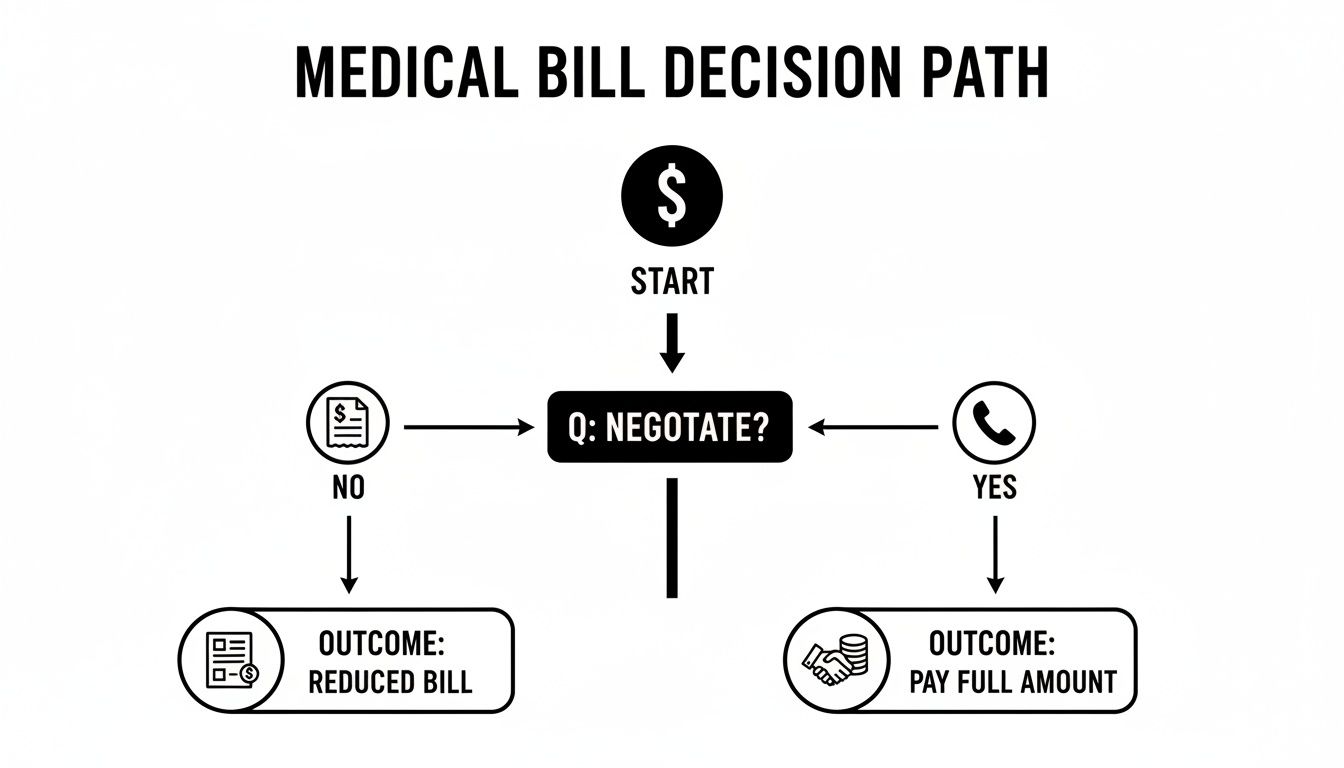
It’s a great reminder that you always have the option to negotiate—a powerful tool for anyone without insurance trying to lower their financial burden.
Common Questions About Getting Medical Care Without Insurance
Navigating healthcare on your own can feel overwhelming, and it's totally normal to have a ton of questions. You’re trying to think through different scenarios, and that's smart. Let’s tackle some of the most common concerns head-on to give you the clarity and confidence you need.
What Is the Absolute First Thing I Should Do if I Get Sick?
Okay, so you're feeling sick. The very first thing to do is a quick mental check: how serious is this? Your answer right here will determine your next move and, honestly, what your final bill looks like.
For anything that feels non-life-threatening—think a nagging cough, a weird rash, or that all-too-familiar UTI feeling—your best and cheapest bet is to jump on a telemedicine service or find a local urgent care clinic. This is the fast lane to getting a professional opinion without the sky-high costs of an emergency room.
But if you’re dealing with severe symptoms like chest pain, sudden weakness on one side of your body, trouble breathing, or a serious injury, don't hesitate. Head straight to the nearest ER or call 911. In a true emergency, your health is the only thing that matters.
Are Online Doctors Legitimate and Can They Prescribe Medication?
Yes, absolutely. This isn't some back-alley internet advice. The doctors you connect with on reputable telemedicine platforms are board-certified, state-licensed physicians. They operate under the same strict medical and HIPAA privacy standards as any doctor you’d see in a brick-and-mortar clinic. Your health information is secure.
These online doctors are great at diagnosing a wide range of common illnesses. They can put together a safe treatment plan and, if medically necessary, send a prescription straight to your preferred pharmacy.
One quick heads-up: While they can handle most primary and urgent care needs, online doctors cannot prescribe controlled substances like narcotics or certain anxiety medications. For just about everything else, they are a safe, incredibly convenient, and effective way to get care.
How Do I Find a Sliding Scale Clinic and What Do I Need to Bring?
Finding a clinic that bases its fees on your income is probably easier than you think. These places are often called Community Health Centers or Federally Qualified Health Centers (FQHCs), and they exist to be a community’s healthcare safety net.
Your best bet is to use the official search tool from the U.S. Health Resources and Services Administration (HRSA). It's designed for this exact purpose. To get their sliding scale rates, you’ll just need to prove your household income.
What to have ready:
- Proof of Income: Your last two pay stubs usually work perfectly. A W-2 or the previous year's tax return is also great.
- Photo ID: A standard driver's license or other government-issued ID.
- Proof of Address: A recent utility bill or a copy of your lease should do the trick.
Here’s a pro tip: always call the clinic ahead of time. A quick two-minute call to confirm exactly what documents they need can save you a whole lot of hassle and a wasted trip.
Can I Negotiate a Medical Bill After Receiving Treatment?
Not only can you, but you should. Negotiating medical bills is incredibly common, and most hospital billing departments are set up to work with patients paying out-of-pocket. Being proactive and a little persistent can make a huge difference.
First, always request an itemized bill. Go through it line by line and look for anything that seems off, like errors or duplicate charges. Once you have that, pick up the phone and call the provider’s billing department.
When you get someone on the line, state clearly that you are a self-pay patient. Ask directly if they offer a “prompt pay” or “self-pay” discount. Many facilities will knock a significant amount off the total if you can pay a lump sum quickly. If that’s not an option, ask to set up an interest-free payment plan. The trick is to be polite but firm in finding a solution that works for you.
When you need fast, affordable care without the hassle of insurance, ChatWithDr is ready to help 24/7. Get a diagnosis, treatment plan, and prescription from a board-certified doctor for a flat $39.99—no hidden fees, ever. Start your consultation now.
Related posts:
 Explore do you need insurance for urgent care and what it means for your visit
  How much does urgent care cost? A Practical Guide to Bills and Savings
  The 7 Best Online Doctor Services of 2025: A Detailed Review
  Best Telemedicine Platforms: best telemedicine platforms for 2025
  Your Guide to a Birth Control Prescription Without Insurance