
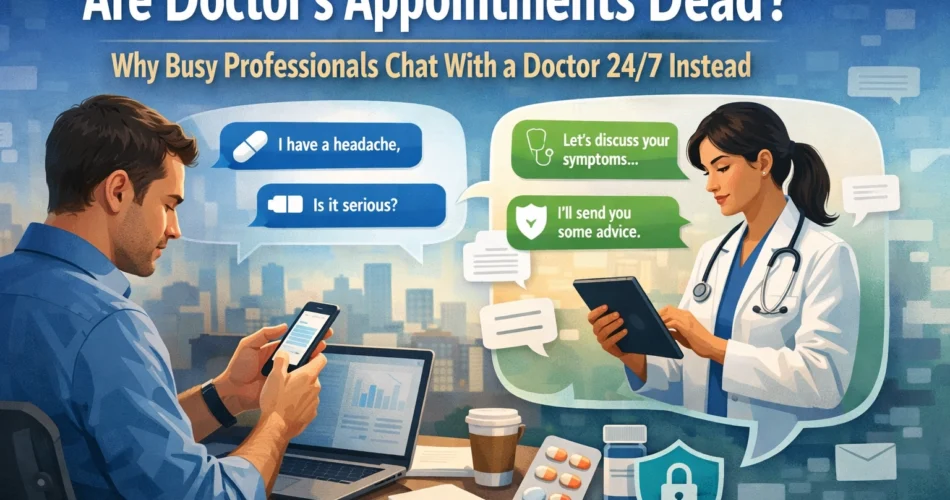
It's 2 AM on a Tuesday, and you've got a burning question about that rash that's been bothering you for days. Your pitch presentation is in six hours. Do you: A) Wait three weeks for a doctor's appointment, B) Spend five hours in an emergency room, or C) Pull out your phone and chat with a doctor right now?
If you picked C, you're part of a growing movement reshaping American healthcare. Traditional doctor's appointments aren't exactly dead, but they're looking increasingly outdated for the millions of professionals who can't schedule their health around a 9-to-5 medical system.
The Appointment Scheduling Crisis Nobody Talks About
Let's be honest: scheduling a doctor's appointment in 2026 still feels like trying to book a table at the world's most exclusive restaurant. According to recent healthcare research, difficulty scheduling appointments and long phone hold times rank among the top frustrations that make patients switch providers.
The irony? When primary care physicians reduce their appointment availability, they don't actually work less. Studies show their electronic health record tasks increase by nearly 40% per visit, meaning the administrative burden simply shifts rather than disappears. You're stuck waiting, and your doctor is drowning in paperwork.
For busy professionals: whether you're a consultant traveling between cities, a parent juggling kids' schedules, or a truck driver crossing state lines: this traditional system simply doesn't work anymore.

Why "Just Make an Appointment" Isn't an Option Anymore
The gap between when health concerns arise and when you can actually see a doctor creates a cascade of problems. That potential sinus infection you suspect on Friday? Good luck getting an appointment before Monday. And if you're traveling for work, forget about finding a local doctor who'll see you without being an established patient.
The healthcare industry projects that 25-30% of U.S. medical visits could be virtual by the end of 2026. But here's what most headlines miss: virtual care isn't expanding total access: it's primarily replacing in-person visits. The underlying problem of physician shortages and appointment bottlenecks remains largely unsolved.
This is where the ability to chat with a doctor 24/7 becomes more than just convenient: it becomes essential.
The Text-Based Solution Busy Professionals Are Choosing
Unlike video telehealth platforms that still require scheduled appointments, text-based medical messaging platforms like ChatWithDr operate on your schedule, not a doctor's calendar. No appointment windows. No waiting rooms. No account creation barriers.
Here's what makes this approach different:
Immediate Access When You Need It
Whether it's 3 PM or 3 AM, you can start a secure conversation with a licensed physician. This matters especially for time-sensitive issues like potential UTI symptoms, pink eye before an important meeting, or migraine headaches that strike at inconvenient times.
No Geographic Boundaries
Business trip to Denver? Weekend in Miami? Text-based consultations travel with you. Unlike traditional practices limited by physical location and state licensing complexities, online medical chat platforms can serve you across state lines.

Asynchronous Communication
You don't need to block out 30 minutes for a phone call during your workday. Send your question between meetings, during your commute, or whenever you have five minutes. Doctors respond within their availability, and you reply when convenient: all while maintaining medical-grade security.
Real Scenarios Where 24/7 Medical Chat Saves the Day
The Traveling Consultant
Sarah manages client accounts across three states. Last month, she developed symptoms of a potential sore throat and cold while in Phoenix for a conference. Rather than searching for urgent care in an unfamiliar city or trying to schedule with her primary doctor back home, she used her phone to consult with a doctor via text. Within an hour, she had guidance on whether she needed a prescription and how to manage her symptoms before her presentation.
The Working Parent
Marcus juggles two kids, a demanding career, and volunteer commitments. When his daughter showed signs of possible nausea and vomiting on a Saturday night, he didn't have to decide between emergency room costs and waiting until Monday. A quick chat with a doctor helped him determine it was likely a stomach bug and provided care instructions for monitoring her overnight.
The Long-Haul Professional
Truck driver communities face unique healthcare challenges: they're rarely in one place long enough to establish traditional care, and appointments don't sync with delivery schedules. Access to 24/7 telehealth services means drivers can address concerns about hair loss, chronic conditions, or acute issues without routing their entire schedule around a medical office.

What You Can Actually Address Through Online Medical Chat
Text-based consultations work remarkably well for a wide range of health concerns. Licensed physicians can evaluate symptoms, recommend treatment plans, and prescribe medications when appropriate for conditions including:
- Acute infections like UTIs and sinus infections
- Skin concerns requiring dermatologist evaluation
- Preventive care like birth control or emergency contraception
- Sexual health concerns including STD testing guidance
- Minor injuries and wound care advice
- Medication refills and prescription management
- Men's health issues like premature ejaculation
Browse the complete list of conditions that can be addressed through secure medical messaging.
The "No Account Required" Advantage
Here's something that frustrates busy professionals about most healthcare technology: before you can address your actual medical concern, you need to create an account, verify your email, set up a profile, input insurance information, and navigate a clunky patient portal.
When you're dealing with an urgent health question, every extra step between you and a doctor feels like an unnecessary barrier. Platforms offering immediate access without account creation requirements remove that friction entirely: you go straight from concern to conversation with a medical professional.

What This Means for the Future of Healthcare Access
Traditional doctor's appointments aren't disappearing: nor should they. Comprehensive physical exams, complex diagnostics, and hands-on procedures will always require in-person care. But the assumption that every medical question requires a scheduled office visit? That's outdated thinking.
The most significant shift isn't technology: it's expectations. Professionals who can order dinner, book travel, and manage their finances instantly from their phones are no longer willing to accept that healthcare must operate on a 1990s appointment model.
This evolution addresses a real gap in the American healthcare system. While virtual care hasn't dramatically expanded total patient visits (it's primarily replaced in-person appointments), it has improved accessibility for those whose schedules, locations, or circumstances make traditional appointments impractical.
Regulatory barriers rather than technology limitations remain the primary obstacle to broader adoption, but as policies evolve to match how people actually live and work, expect text-based medical consultation to become increasingly standard.
Making Healthcare Work Around Your Life, Not the Other Way Around
The ability to chat with a doctor 24/7 represents more than just convenience: it's a fundamental rethinking of how medical care can fit into modern professional life. When you're managing client deadlines, parenting responsibilities, travel schedules, or shift work, having on-demand access to medical expertise via secure messaging becomes essential rather than optional.
Whether you need guidance on symptoms you're experiencing right now, have questions about a medication, or want professional medical advice before deciding if an in-person visit is necessary, online urgent care through text messaging offers a practical middle ground between "wait and see" and "go to the emergency room."
Doctor's appointments aren't dead: but the idea that they're the only way to access medical care certainly should be. For the millions of busy professionals who need healthcare that works around their schedule rather than dominating it, 24/7 text-based consultations aren't just an alternative. They're becoming the new standard.
Disclaimer: This information is not a substitute for professional medical advice, diagnosis, or treatment. Always seek the advice of your physician or qualified health provider with questions regarding medical conditions or treatments.
Related posts:
 Best Telemedicine Platforms: best telemedicine platforms for 2025
  The 7 Best Online Doctor Services of 2025: A Detailed Review
  Top Platforms Offering Real-Time Health Consultations for Busy Professionals
  Online Medical Chat: Why Busy Professionals Are Ditching Waiting Rooms for Instant Doctor Access
  Can’t Get a Primary Care Appointment? Chat With a Doctor 24/7 Instead