
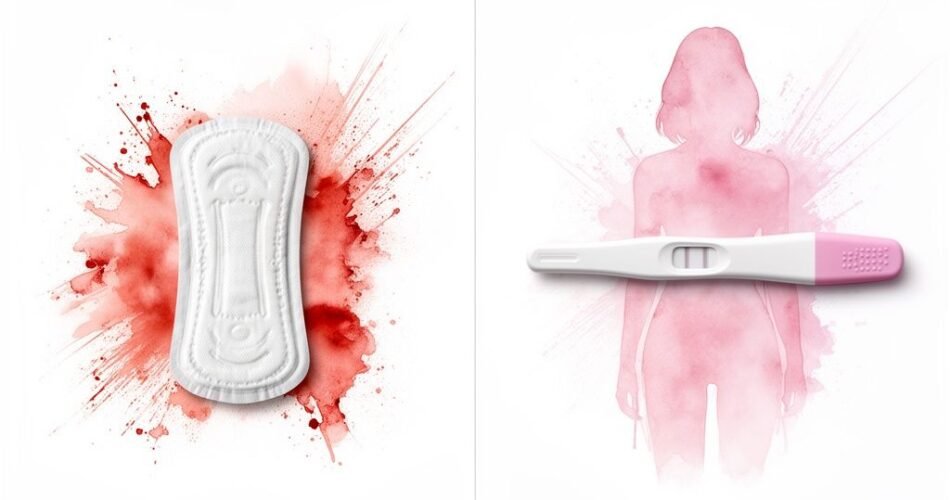
Waiting to find out if you're pregnant can feel like it takes forever, especially when your body starts sending you mixed signals. It’s a frustrating guessing game. Is that cramping and fatigue just your period on its way, or is it the very first sign of pregnancy?
The confusion is completely normal. Many of the symptoms of premenstrual syndrome (PMS) and early pregnancy overlap, thanks to a hormone called progesterone. It rises after ovulation and stays high if you conceive but drops if you don't, triggering your period.

This shared hormonal backdrop is why it's so easy to mistake one for the other. A side-by-side look at the subtle differences in timing, intensity, and nature of the symptoms is often the best way to get a clearer picture of what's really going on.
Quick Symptom Comparison Period vs Early Pregnancy
This table gives you a high-level overview of the most common overlapping symptoms and their key differences when comparing a menstrual period to early pregnancy.
| Symptom | Typical for a Period | Typical for Early Pregnancy |
|---|---|---|
| Bleeding | Starts light, becomes a steady flow of bright red blood lasting 4-7 days. | May have very light spotting (implantation bleeding) that is pink or brown and lasts only 1-2 days. |
| Cramps | Can be moderate to intense uterine contractions, often peaking just before or during the heaviest flow. | Usually milder, described as a pulling or tingling sensation in the lower abdomen or sides. |
| Breast Changes | Cyclical soreness or heaviness that typically resolves once your period starts. | Tenderness and sensitivity often increase and persist, and areolas may darken. |
| Fatigue | General tiredness or a slump that improves after your period begins. | Profound, often overwhelming exhaustion that doesn't go away with rest. |
| Nausea | Mild queasiness is possible but uncommon; usually not accompanied by vomiting. | "Morning sickness" can occur at any time of day and may include vomiting. |
| Food Cravings | Often for salty, sweet, or carb-heavy foods right before your period. | Strong aversions to certain smells or tastes, along with specific, sometimes unusual, cravings. |
This at-a-glance guide is a solid starting point for figuring out what your body might be telling you. Of course, the most significant indicator remains a missed period. If your period is late and you're noticing some of these early pregnancy signs, it’s a strong signal that it’s time to take a pregnancy test.
A Detailed Sympt-om-By-Symptom Analysis
Sorting through the subtle signals your body sends can be a real headache, especially when so many early pregnancy symptoms look exactly like premenstrual syndrome (PMS). The trick is to look past the symptom itself and dig into the specifics—things like timing, how intense it feels, and how long it lasts. This side-by-side breakdown will help you compare these confusing signs.
The overlap between period and pregnancy signs is a classic source of confusion. Both are fueled by hormonal shifts that can trigger fatigue, breast tenderness, and mood swings. Before modern medicine, women relied on their last menstrual period (LMP) to track a potential pregnancy, but we now know this method has its flaws. One key study found that women often misremember their LMP, which can skew estimates. On average, LMP-based calculations suggest a gestation that is 2.8 days longer than what more accurate ultrasound scans show.
Bleeding and Spotting Nuances
The biggest point of confusion is almost always bleeding. It might seem straightforward—bleeding means a period, right? Not always. The nature of the bleeding offers some of the best clues.
A menstrual period usually starts with light spotting before ramping up to a steady, moderate-to-heavy flow of bright red blood. It typically lasts anywhere from four to seven days and requires pads or tampons. This is your body shedding the uterine lining because pregnancy didn't happen.
Early pregnancy bleeding, known as implantation bleeding, is a completely different story. It occurs when the fertilized egg burrows into the uterine wall, which happens about 6 to 12 days after conception—often right around when you’d expect your period to start.
Here are the key differences:
- Color: Implantation spotting is usually light pink or a rusty brown, not the bright red of a period.
- Flow: It’s incredibly light. Think more like faint spotting or a tiny streak you might only see when you wipe.
- Duration: It’s very brief, lasting anywhere from a few hours to a couple of days at most.
Key Takeaway: A real period involves a consistent flow that gets heavier. Implantation spotting is faint, brief, and never turns into a full-blown flow.
Decoding Cramps and Discomfort
Cramping is another symptom that can leave you second-guessing. But the actual feeling and location can be quite different between a period and early pregnancy.
Menstrual cramps (dysmenorrhea) are caused by the uterus contracting to shed its lining. They often feel like a persistent, throbbing ache in your lower abdomen and can even radiate to your lower back and thighs. The intensity usually peaks a day or two before your period and during your heaviest flow.
Early pregnancy cramps feel much milder. Women often describe them as a pulling, tingling, or stretching sensation. This is your uterus starting to expand and the ligaments stretching to support the growing embryo. The discomfort is usually sporadic and might be felt more on one side or very low in the abdomen.
Breast Changes Compared
Both PMS and pregnancy can make your breasts feel sensitive, but how this symptom develops over time is a dead giveaway.
Before your period, your breasts might feel sore, heavy, or lumpy. This is a cyclical soreness tied to hormones, and it almost always vanishes once your period starts.
In early pregnancy, breast tenderness is often one of the very first signs, and it tends to be much more intense. The sensitivity doesn't fade; it actually gets worse. You might also notice more visible veins on your chest and a darkening of the areolas (the area around your nipples).
The Difference Between Tired and Exhausted
Feeling tired before your period is normal. It's a premenstrual slump that’s usually manageable and goes away once your period arrives.
Pregnancy fatigue is on a whole other level. It's often described as a profound, overwhelming exhaustion that a good night's sleep can't fix. This is caused by a massive spike in the hormone progesterone, which is essential for sustaining the pregnancy. Many women report feeling completely wiped out in the first trimester.
Nausea: Period vs. Pregnancy
While some women feel a bit queasy with PMS, it's usually mild and rarely involves actual vomiting.
"Morning sickness," on the other hand, is a hallmark of early pregnancy—even though it can strike at any time of day. It can range from a nagging, low-grade nausea to frequent vomiting. This symptom is often triggered by certain smells or foods and is far more common in pregnancy than with a period. If you are experiencing persistent nausea, you can explore potential causes and treatments for nausea and vomiting.
Understanding Spotting in Early Pregnancy
Bleeding that pops up when you're not expecting your period is one of the biggest sources of confusion when you're trying to figure out if you're pregnant. And let's be honest, any unexpected bleeding can be alarming. But not all spotting in early pregnancy means something is wrong. Knowing the difference between what's normal and what's a red flag is the key to understanding what your body is trying to tell you.

Let's walk through the three most common reasons you might see blood or spotting in the very early days of pregnancy so you can get a clearer picture of what you might be experiencing.
Implantation Bleeding: A Normal Early Sign
One of the most frequent—and totally harmless—causes of early spotting is implantation bleeding. This happens when the fertilized egg burrows into your uterine lining to get comfortable for the next nine months. That little nesting process can disturb some tiny blood vessels, causing a small amount of bleeding.
This usually occurs about 6 to 12 days after conception, which, frustratingly, is often right around the same time you’d be expecting your period to show up. This timing is exactly why it’s so easy to mistake it for a light period. However, if you look closely, the characteristics are pretty different.
Implantation bleeding is almost always very light and doesn't last long.
- Color: It’s typically a light pink or a rusty brown color, not the bright, fresh red you see with a period.
- Flow: The flow is super minimal. We’re talking a few spots or streaks you might only notice when you wipe. It's never going to be enough to soak a pad or tampon.
- Duration: It’s here and then it’s gone, lasting anywhere from a few hours up to two days at the most—unlike a period that sticks around for several days.
A key differentiator is that implantation bleeding is a one-time event that stops. A menstrual period, in contrast, starts light and progressively gets heavier before tapering off.
To help you sort through the visual cues, here’s a quick breakdown of what to look for when comparing different types of bleeding you might see.
Types of Bleeding: Period vs Early Pregnancy
| Bleeding Type | Typical Timing | Color and Consistency | Flow and Duration | Associated Symptoms |
|---|---|---|---|---|
| Menstrual Period | Every 21–35 days, predictable cycle | Bright red to dark brown, can contain clots | Starts light, gets heavier for 2–3 days, then tapers. Lasts 3–7 days. | Cramps, bloating, mood swings, breast tenderness |
| Implantation Bleeding | 6–12 days after conception (around expected period) | Light pink or rusty brown, watery, no clots | Very light spotting or streaks, lasts a few hours to 2 days max | Mild, fleeting cramps (or none at all), fatigue |
| Threatened Miscarriage | First 20 weeks of pregnancy | Can be pink, red, or brown | Varies from light spotting to a heavier, period-like flow. Can be on-and-off. | Mild to moderate abdominal cramping, lower back pain |
| Ectopic Pregnancy | 4–12 weeks of pregnancy | Dark, watery, brown or red | Can be light and intermittent or heavy and continuous | Sharp, one-sided abdominal pain, shoulder tip pain, dizziness, fainting |
Remember, this table is a guide. Your experience might not fit perfectly into one category, which is why it's so important to listen to your body and reach out for medical advice if something feels off.
Threatened Miscarriage: A Cause for Concern
Sometimes, bleeding can be the first sign of a potential complication, like a threatened miscarriage. This term sounds scary, but it refers to any vaginal bleeding that happens in the first 20 weeks of pregnancy without the cervix opening. It doesn't mean a pregnancy loss is inevitable—in fact, about half of the people who experience this go on to have a healthy pregnancy.
Unlike the barely-there spotting from implantation, bleeding from a threatened miscarriage is often more noticeable and may come with other symptoms.
- Heavier Flow: The bleeding might look more like a light period and can be red or brown.
- Cramping: You may feel mild to moderate cramps in your lower abdomen, a lot like period cramps.
- Duration: The bleeding can be spotty or continuous over several days.
If you have a positive pregnancy test and then start bleeding more than just light spots, it's really important to get in touch with a healthcare provider. They can run tests to check on the pregnancy and give you the right guidance.
Ectopic Pregnancy: A Medical Emergency
An ectopic pregnancy is a rare but very serious condition where a fertilized egg implants somewhere outside the uterus, usually in a fallopian tube. This is a life-threatening medical emergency that needs immediate attention because a growing embryo can rupture the tube.
The symptoms of an ectopic pregnancy can start out looking a lot like a normal early pregnancy, but they quickly become more severe and specific.
Key warning signs include:
- One-Sided Abdominal Pain: This isn't just a dull ache; it's often a sharp, stabbing pain focused on one side of your lower abdomen.
- Shoulder Tip Pain: This is a strange but classic symptom caused by internal bleeding that irritates a nerve connected to your shoulder.
- Dizziness or Fainting: These are serious signs that could point to significant internal blood loss.
- Vaginal Bleeding: This might be lighter or heavier than a normal period and can sometimes look dark and watery.
If you have any suspicion of an ectopic pregnancy, especially if you're dealing with sharp, one-sided pain, you need to seek emergency medical care right away. Knowing how to tell these types of bleeding apart is critical for your health and peace of mind as you navigate the early stages of a potential pregnancy.
How Your Cycle Impacts Pregnancy Detection
Your menstrual cycle is your body's internal clock, and learning its unique rhythm is one of the most powerful tools you have in the "period vs. pregnancy" guessing game. A missed period is the classic first sign, but how much you can rely on it depends entirely on how predictable your periods are to begin with.

If you have a consistent, clockwork cycle—say, every 28 to 30 days—a late period is a big deal. It’s a clear detour from your established pattern, making it a strong and reliable indicator that you might be pregnant. This predictability gives you a clear timeline for when to take a pregnancy test for the most accurate results.
The Challenge of Irregular Cycles
But let's be real, not everyone's body runs on such a tight schedule. If your periods are irregular, the whole idea of a "late" period gets a lot fuzzier. An irregular cycle is one where the length varies by more than a few days each month, making it a real challenge to pinpoint when your period is actually due.
This unpredictability can create a lot of confusion and anxiety. You might find yourself second-guessing every cramp or wave of fatigue because you don't have that reliable missed period benchmark to guide you. In this scenario, paying closer attention to other early pregnancy symptoms becomes absolutely essential.
For some inspiration, it's worth reading about women who managed to get pregnant without ever having regular cycles.
Why Tracking Your Cycle Is Essential
This is where diligent cycle tracking becomes your best friend. Whether your cycle is as regular as a metronome or completely unpredictable, logging your periods helps you establish what's normal for your body. Consistently tracking gives you invaluable data, helping you:
- Establish a Baseline: You can figure out your average cycle length, even if it varies.
- Identify Deviations: It becomes way easier to notice when something is truly off, rather than just a normal fluctuation.
- Pinpoint Ovulation: Tracking can help you estimate your fertile window, giving you important context if you start experiencing symptoms around that time.
Key Insight: Tracking your menstrual cycle transforms a missed period from a vague guess into a meaningful data point. It's the difference between navigating with a map versus navigating in the dark.
Menstrual cycle length isn't just a fertility marker; it can also be a window into your overall health. One study found that while 74.3% of women had normal cycles (26-34 days), those with short (≤25 days) or long/irregular cycles (≥35 days) faced higher risks for preterm birth.
Ultimately, knowing your cycle’s patterns provides the context you need to interpret your body’s signals correctly. It helps you understand whether a late period is a genuine reason to grab a pregnancy test or simply a reflection of your body's unique rhythm. This personal health knowledge is fundamental in distinguishing between a period and pregnancy.
How and When to Take a Pregnancy Test
After you’ve gone back and forth analyzing every little symptom, a pregnancy test is the only way to get a clear answer. Home tests are designed to pick up on a specific hormone called human chorionic gonadotropin (hCG), which your body only starts making after a fertilized egg has implanted in your uterine wall.
The absolute best time to test for an accurate result is the day after your first missed period. By then, hCG levels are usually high enough for a standard home urine test to detect. Using your first-morning urine is another smart move because it’s more concentrated, giving the test the best possible chance of picking up the hormone.
Testing too early is an incredibly common mistake, and it often leads to a false negative. Even if you are pregnant, your body needs some time to build up enough hCG to be detected. Waiting just a few more days can be the difference between a confusing result and a definite answer.
Getting the Most Accurate Results
When it comes to getting a reliable result, timing and technique are everything. It’s tough to wait, I know, but being patient can save you from the emotional rollercoaster of a false negative.
- Wait for a Missed Period: Your most reliable result will come one day after your expected period was supposed to start. Testing before this dramatically increases the chance of an inaccurate result.
- Follow the Instructions Carefully: Every test is a little different. Take a minute to actually read the instructions on the box and follow them exactly to avoid any user error.
- Understand Test Sensitivity: Some tests are more sensitive than others and can detect lower levels of hCG. If you’re tempted to test a day or two early, check the packaging for information on the test's sensitivity.
Key Insight: A negative test before your missed period doesn't automatically mean you aren't pregnant. If your period still doesn't show up, the best thing to do is wait a few days and test again.
Urine Tests vs. Blood Tests
The two main types of pregnancy tests are urine tests and blood tests. The home pregnancy tests you buy at the store are urine-based, and they’re about 99% accurate when you use them correctly after a missed period.
A blood test, which has to be done at a doctor's office, is even more sensitive. It can detect a pregnancy much earlier than a urine test—sometimes as early as 6 to 8 days after you’ve ovulated. Blood tests can also measure the exact amount of hCG in your blood, which helps doctors track how a pregnancy is progressing.
This is especially important for certain groups. For instance, adolescents often have irregular menstrual cycles, which can make it hard to tell a late period from a potential pregnancy. While global adolescent birth rates have gone down, knowing your cycle and when to test is still critical for getting an accurate result. You can read more about these adolescent pregnancy statistics on who.int.
If you’ve had unprotected sex and you're worried, it’s also a good idea to understand your options for emergency contraception. Talking to a healthcare professional is always the best way to get clarity and the most accurate confirmation.
When to Seek Professional Medical Advice
While playing the symptom-spotting game at home is a natural first step, there are times when you absolutely need a professional medical opinion to protect your health. Trying to distinguish between period and pregnancy symptoms gets complicated, and some red flags should never, ever be ignored.
Knowing when to call a doctor can give you peace of mind, but more importantly, it ensures you get timely care if something is wrong. When it comes to your reproductive health, it’s always better to be safe than sorry.
Key Signs You Need a Doctor
Certain symptoms go way beyond the typical period vs. pregnancy debate and signal it’s time to get a real medical evaluation. Don’t wait it out if you experience any of these:
- A Missed Period with Negative Tests: If your period is more than a week late and you’re still getting negative results on home pregnancy tests, a doctor can help figure out what’s going on. It could be anything from a hormonal imbalance to high stress.
- Severe, One-Sided Abdominal Pain: This is a critical one. Sharp, localized pain could be a sign of an ectopic pregnancy, which is a medical emergency that needs immediate attention.
- Unusually Heavy Bleeding: If you're soaking through more than one pad or tampon an hour, or if the bleeding makes you feel dizzy or faint, you need to seek care right away.
- High Fever with Pelvic Pain: When these two symptoms show up together, it could point to an infection that needs prompt medical treatment.
As you navigate early pregnancy discomfort, you might have questions about what’s safe for pain relief. It's smart to consult reliable sources to learn about things like Are Heating Pads Safe During Pregnancy before trying any at-home remedies.
This flowchart lays out the best timeline for taking a home pregnancy test if your period is late.

As the visual shows, waiting at least one day after your period was due gives you the most accurate results and reduces the chance of a false negative.
Get Answers Quickly and Privately
Worrying about these symptoms can be incredibly stressful, but getting professional advice doesn't have to be a huge ordeal. Instead of waiting days or weeks for an in-person appointment, modern telehealth offers a much faster path to clarity.
For anyone who wants a quick, confidential, and professional medical opinion, telehealth services are an immediate and accessible option. You can get answers without the stress of scheduling, traveling, or sitting in a waiting room.
Platforms like ChatWithDr provide same-day evaluations from board-certified physicians for a simple flat fee of $39.99. Through a secure, text-based chat, you can privately discuss your symptoms, get a diagnosis, and even have a prescription sent to your local pharmacy if needed. It’s the perfect solution for anyone who needs answers about their period vs. pregnancy questions right away.
This kind of convenient service removes the usual barriers to healthcare, offering a fast, private, and nationwide solution. If you need answers now, you can learn more about getting a same-day evaluation with an online doctor and move forward with confidence.
Frequently Asked Questions
When you're trying to figure out if it's your period or early pregnancy, a lot of specific questions can pop up. Let's get straight to the answers for some of the most common ones.
Can I Have My Period and Still Be Pregnant?
In short, no. It's not possible to have a true menstrual period while you're pregnant. A period is your body shedding the uterine lining, but that very lining is needed to nourish a developing embryo. Once pregnancy begins, your body puts a stop to that process.
However, it's incredibly common to experience some light bleeding or spotting in early pregnancy. Many women mistake this for a light period, but it’s usually caused by something else entirely, like implantation bleeding.
If you get a positive pregnancy test but then see bleeding that's lighter, shorter, or a different color than you're used to, it's a good idea to check in with a doctor. They can help rule out any potential issues and make sure everything is on track.
How Soon After Implantation Bleeding Is a Pregnancy Test Positive?
Implantation bleeding typically shows up about 6 to 12 days after conception. Home pregnancy tests work by detecting hCG, a hormone your body only starts making after the embryo has successfully implanted into the uterine wall.
While a super-sensitive test might pick up hCG a day or two after spotting starts, you’ll get a much more reliable result if you wait. The best plan is to wait at least 3 to 4 days after the spotting has completely stopped, or until the day your period was due. Giving it that extra time allows hCG levels to build up, which seriously lowers your chances of getting a false negative.
Are Any Pregnancy Symptoms Different From PMS Symptoms?
Yes, absolutely. While there’s a ton of overlap, a few signs are much more unique to pregnancy than PMS. The most obvious one, of course, is a missed period.
Beyond that, here are a few distinct clues that point more strongly toward pregnancy:
- Darkening Areolas: The area around your nipples might get noticeably darker and larger.
- Heightened Sense of Smell: A sudden, almost super-human sensitivity or aversion to certain smells is a classic early pregnancy sign.
- Persistent Nausea: PMS might make you feel a little queasy, but the "morning sickness" that comes with pregnancy is often more intense and can strike at any time of day.
- Metallic Taste: Some women report a strange, metallic taste in their mouth—a symptom that has nothing to do with menstruation.
What if My Pregnancy Test Is Negative but My Period Is Late?
A late period with a negative pregnancy test can be confusing and stressful, but it doesn't automatically mean you're pregnant. A whole host of other things can throw your menstrual cycle off track.
Common culprits include high stress levels, big changes in your diet or exercise routine, recent travel, or an underlying illness. Certain medical conditions, like Polycystic Ovary Syndrome (PCOS) or thyroid issues, are also well-known for causing irregular cycles.
Actionable Advice: If your period is over a week late and your test is still negative, take another one in a few days. If that's also negative and your period is still missing in action, talking to a healthcare provider can help you figure out what's going on.
When you need clear, confidential answers about your health without the wait, ChatWithDr offers same-day evaluations from board-certified physicians. Get a diagnosis, treatment plan, and prescriptions sent to your local pharmacy—all from the privacy of your phone. Visit https://chatwithdr.com to start your consultation.
Related posts:
 Period delay pill: Your Complete Guide to Timing, Types, and Safety
  Your Guide to Birth Control Pill Side Effects
  Birth Control Options and Side Effects: Your Complete, Click-Worthy Guide
  Yeast Infection Symptoms in Women: How to Spot Signs and Find Relief
  Erectile Dysfunction Causes and Treatments Explained