
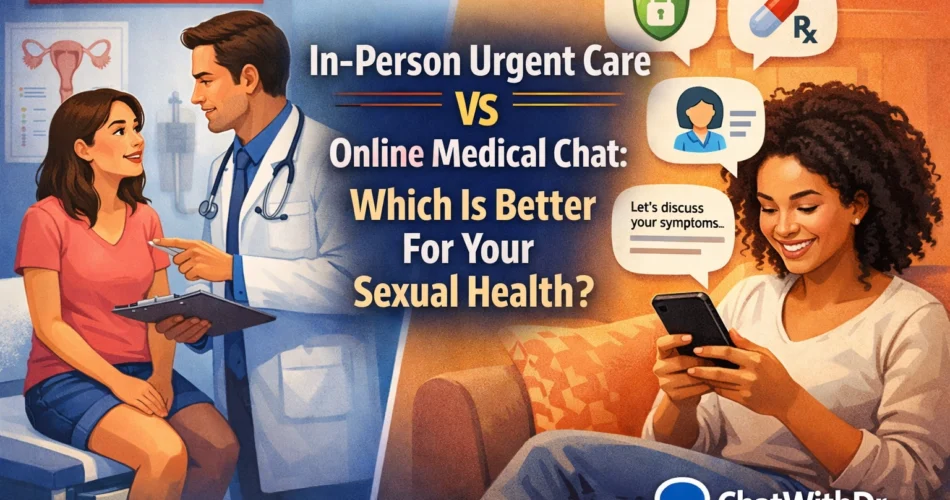
When it comes to sexual health, discretion and speed are often the two most important factors for patients. Whether you are dealing with the sudden discomfort of a urinary tract infection (UTI) or seeking a long-term solution for erectile dysfunction, the way you access care matters. Traditionally, a trip to an in-person urgent care center was the only way to get a quick diagnosis and prescription. However, the rise of online medical chat platforms has changed the landscape entirely.
Choosing between a physical clinic and a secure medical messaging service depends on your specific symptoms, your need for privacy, and how quickly you need relief. In this guide, we will break down the pros and cons of both options to help you decide which path is right for your sexual health needs.
The Privacy Factor: Why Anonymity Matters
For many, the biggest hurdle to seeking sexual health care is the "waiting room anxiety." Discussing sensitive topics like erectile dysfunction online or symptoms of a sexually transmitted infection (STI) can feel daunting when you are sitting in a crowded lobby.

One of the most significant benefits of virtual care for sexual health is the layer of anonymity it provides. Online platforms eliminate the discomfort of parking lot interactions or potentially running into someone you know while waiting to see a doctor. When you use a service like ChatWithDr, you are engaging in a secure medical messaging session from the privacy of your own home. There is no need to speak out loud in a busy clinic or explain your symptoms to a receptionist. This level of confidentiality often encourages patients to be more honest and thorough about their symptoms, leading to better care outcomes.
Speed and Accessibility: No Appointments Required
In-person urgent care centers are often touted for their convenience, but "urgent" is a relative term. Depending on the time of day, you might face a two-hour wait just to get into an exam room. For conditions that cause significant discomfort, such as a UTI or a yeast infection, every minute counts.
Telehealth services have revolutionized the speed of delivery. Research suggests that virtual visits provide faster access to care, allowing patients to begin treatment more quickly, which helps prevent symptoms from worsening and reduces the risk of community transmission for certain infections. At ChatWithDr, the response time is typically within 30 mins – 4 hrs, and because there is no account required, you can start your consultation immediately without jumping through administrative hoops.
Common Sexual Health Conditions Managed via Chat
Many patients are surprised to learn how many sexual health issues can be effectively managed through a text-based consultation. Licensed healthcare providers are trained to diagnose conditions based on detailed patient histories and symptom descriptions.
1. Urinary Tract Infections (UTIs)
UTIs are incredibly common and often require immediate antibiotic treatment. An online UTI treatment can be handled quickly via chat. By describing your symptoms: such as frequency, urgency, or burning: a doctor can determine if a prescription is necessary. According to the American Sexual Health Association, quick intervention is key to preventing the infection from spreading to the kidneys.
2. Erectile Dysfunction (ED)
Seeking help for ED is a sensitive matter. Utilizing a service for erectile dysfunction online allows men to discuss their concerns with a professional without the pressure of a face-to-face encounter. Doctors can review medical histories and prescribe appropriate medications to be sent to a local pharmacy. You can learn more about this on our online ED treatment page.
3. Birth Control
Managing reproductive health should be seamless. Getting a birth control prescription online eliminates the need for annual physical exams just to renew a standard prescription. This increases adherence and prevents gaps in protection. Explore your options at online birth control.
4. Yeast Infections and Bacterial Vaginosis (BV)
While these conditions have similar symptoms, they require different treatments (antifungals vs. antibiotics). A text-based doctor can help differentiate between the two through a series of targeted questions, providing a yeast infection treatment online or BV medication quickly and discreetly.

When In-Person Urgent Care is Necessary
While online medical chat is powerful, it is not a replacement for all medical scenarios. There are specific "red flags" where an in-person evaluation is essential for your safety.
According to medical experts, you should seek in-person care if:
- A Physical Exam is Required: If you have new genital rashes that require a visual inspection or if you are experiencing undiagnosed lumps or lesions.
- Imaging is Needed: If there is suspicion of internal issues that require an ultrasound or X-ray.
- Severe Pain: Intense abdominal pain, especially when accompanied by fever or flu-like symptoms, could indicate a more serious condition like Pelvic Inflammatory Disease (PID).
- Pregnancy or Immunocompromised Status: Patients in these categories often require more intensive monitoring that virtual platforms cannot provide.
- Injections: Certain treatments for STIs, such as syphilis, require an intramuscular injection that must be administered by a healthcare professional in person.
In these cases, a virtual doctor may provide an initial consultation and then recommend an immediate follow-up at a local clinic or online urgent care facility.
Comparing the Costs
The financial aspect of healthcare is a major concern for many. In-person urgent care visits can be expensive, especially if you have a high-deductible insurance plan or no insurance at all. Facility fees, lab fees, and co-pays can quickly add up to hundreds of dollars.
In contrast, ChatWithDr offers a transparent, $39.99 flat rate for a consultation. This predictable pricing makes sexual health care accessible to more people. By choosing a text-based consultation, you are not only saving time but often a significant amount of money compared to the overhead costs of a brick-and-mortar clinic.

Why Text-Based Care is Winning
Some might wonder if a video call is better than a text chat. However, for sexual health, secure medical messaging often wins out. It allows patients to take their time to explain symptoms clearly, refer to their own notes, and keep a written record of the doctor's advice. It also removes the "stage fright" that can happen during a live video stream.
Text-based telehealth services are highly efficient. Doctors can manage multiple queries simultaneously, which is why response times are so much faster than waiting for a video slot to open up in a provider's schedule.
How to Get Started
If you are experiencing symptoms or need a prescription refill, the process is simple:
- Visit the Site: Go to ChatWithDr.com.
- Start a Chat: Describe your symptoms or your request (like birth control prescription online).
- Consult with a Licensed Doctor: A professional will review your information within 30 minutes to 4 hours.
- Receive Your Plan: If appropriate, a prescription will be sent directly to your preferred pharmacy.
This streamlined approach ensures that your health is prioritized without the stress of traditional medical appointments.

Final Thoughts: Choosing What’s Best for You
Neither option is universally "better": the choice depends on your unique situation. If you need a diagnostic test that involves a swab or a blood draw, online STD testing can often be coordinated online, but the sample collection might happen at a lab. If you are dealing with a standard UTI, ED, or need a routine prescription, the speed and privacy of an online medical chat are hard to beat.
Both virtual and in-person care follow the same high standards for patient privacy and safety, with your health information protected by licensed professionals under HIPAA regulations. By understanding the strengths of each, you can take control of your sexual health with confidence.
For more information on the conditions we treat, visit our conditions page or learn more about how it works.
Disclaimer: This information is not a substitute for professional medical advice, diagnosis, or treatment. Always seek the advice of your physician or qualified health provider with questions regarding medical conditions or treatments.
Related posts:
 Online Doctor Vs Urgent Care: Which Is Better For Your Sexual Health Needs?
  Online Doctor vs. Urgent Care: Which Is Better For Your Sexual Health?
  Online Medical Chat vs. In-Person Clinics: Which Is Better for Your Sexual Health Privacy?
  Online Chat vs. In-Person Clinics: Which Is Better For Your Sexual Health?
  Text-Based Sexual Health Consultations 101: A Beginner’s Guide to Getting Treatment Privately