

Of course. Here is the rewritten section, crafted to sound completely human-written, natural, and expert-driven.
Yes, you absolutely can get a birth control prescription without insurance. The two fastest routes are using a same-day telemedicine service for a flat fee or visiting a community health clinic that offers sliding-scale payment options. Both paths offer quick, affordable access to care without needing an insurance plan.
Your Immediate Options for Getting Birth Control
When you need birth control and don't have insurance, it can feel overwhelming, but you have two solid pathways for immediate help: telemedicine and local clinics. Each has its own vibe and benefits, catering to different needs for speed, privacy, and cost.
Your best choice really boils down to what matters most to you right now—getting a prescription from your couch in an hour or having an in-person chat that might open up more services.
This decision tree gives you a quick visual to help you pick the best path forward.
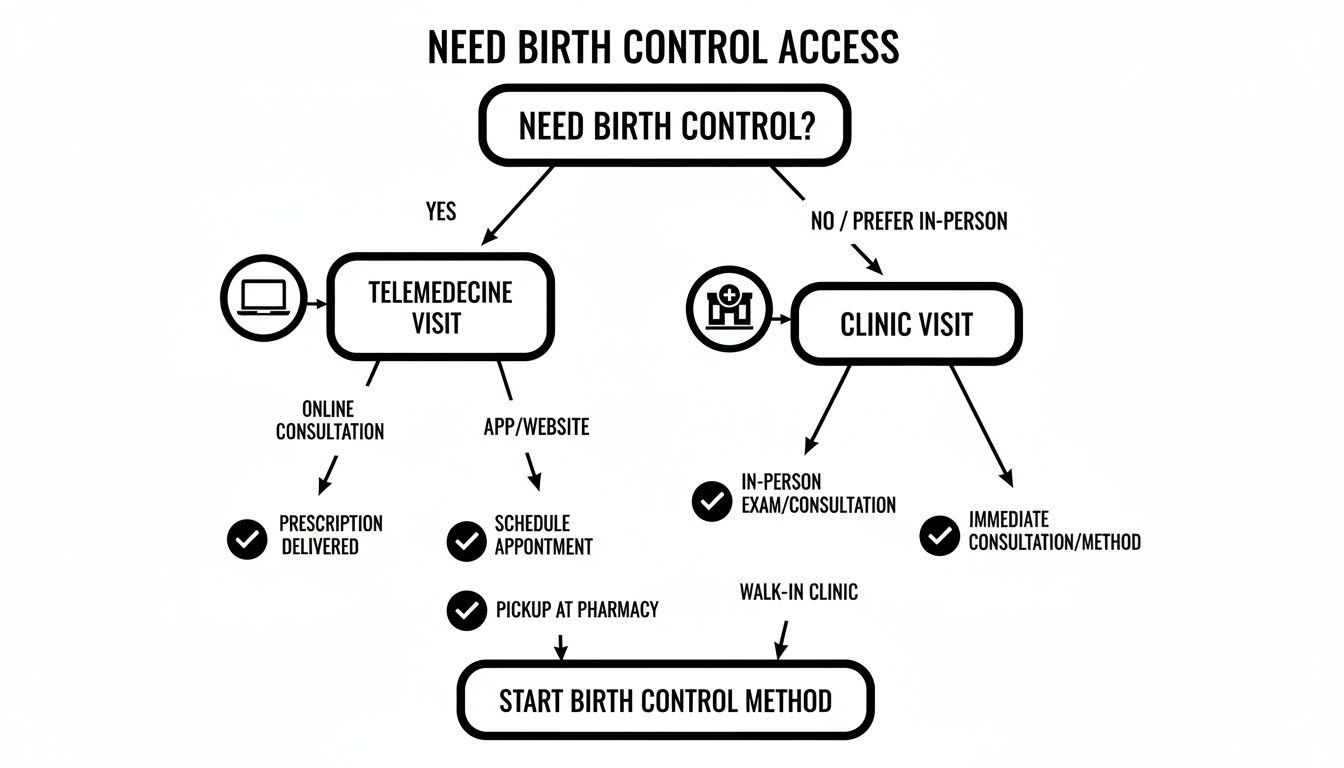
The flowchart keeps it simple: telemedicine is your go-to for speed and privacy, while clinics are the better choice for comprehensive, low-cost care.
Quick Comparison of Birth Control Access Points
Feeling stuck between the digital and the in-person route? This table breaks down the key differences between telemedicine, community clinics, and grabbing something over-the-counter to help you decide which option fits your immediate needs.
| Method | Typical Cost (Consultation + Meds) | Speed | Privacy Level | Best For |
|---|---|---|---|---|
| Telemedicine | $30 – $70 (consultation fee) + pharmacy cost | Same-day, often within 1-2 hours | High (secure, private platforms) | Quick pill/patch/ring prescriptions, convenience |
| Community Clinic | $0 – $150 (sliding scale) | Days to weeks for an appointment | Moderate (private visit, shared waiting) | IUDs, implants, shots, comprehensive exams, lowest cost |
| Over-the-Counter | $20 – $50 per pack (no consultation cost) | Immediate (walk into a pharmacy) | High (anonymous purchase) | Emergency contraception, condoms, spermicide |
Each path gets you what you need, but the right one depends on your budget, timeline, and what method you’re considering.
Telemedicine: Same-Day Prescriptions From Your Phone
Online doctor platforms are hands-down one of the fastest ways to get a birth control prescription without insurance. These services connect you with a licensed physician through a secure text chat or an online form. You can complete the whole process from anywhere and have a prescription sent to your pharmacy, often in just a few hours.
This option is perfect if your main goals are:
- Speed: Get a prescription the very same day, sometimes in under an hour.
- Convenience: No need to travel, find a babysitter, or take time off work.
- Privacy: The entire thing is handled discreetly through a secure, private platform.
The cost is usually a flat fee for the consultation, which makes it a predictable expense you can plan for.
Community Clinics and In-Person Care
For anyone who prefers a face-to-face visit or needs more than just a pill prescription, community health centers and Planned Parenthood are absolute lifesavers. These clinics almost always operate on a sliding-scale fee model, which means what you pay is based on your income.
This is a fantastic choice if you:
- Want to discuss different birth control methods, like IUDs, the implant, or the shot.
- Need a physical exam or other reproductive health services at the same time.
- Are looking for the lowest possible out-of-pocket cost for your care.
The challenge of affordability is very real. In the US, about 7.6 million uninsured women need access to contraception. Without coverage, one in five of these women have had to stop using their method because of cost, which shows just how critical these clinics are. You can read the full report about affordability on thepillotc.org.
Navigating your options is the first step toward empowerment. Whether you choose the digital convenience of telemedicine or the personalized support of a local clinic, accessible birth control is absolutely within your reach, even without insurance.
Ultimately, your decision is a balance between how fast you need it and the type of care you’re looking for. And if you're ever in a situation that requires urgent attention, you can also learn more about emergency contraception options.
Get a Fast, Private Prescription With Telemedicine
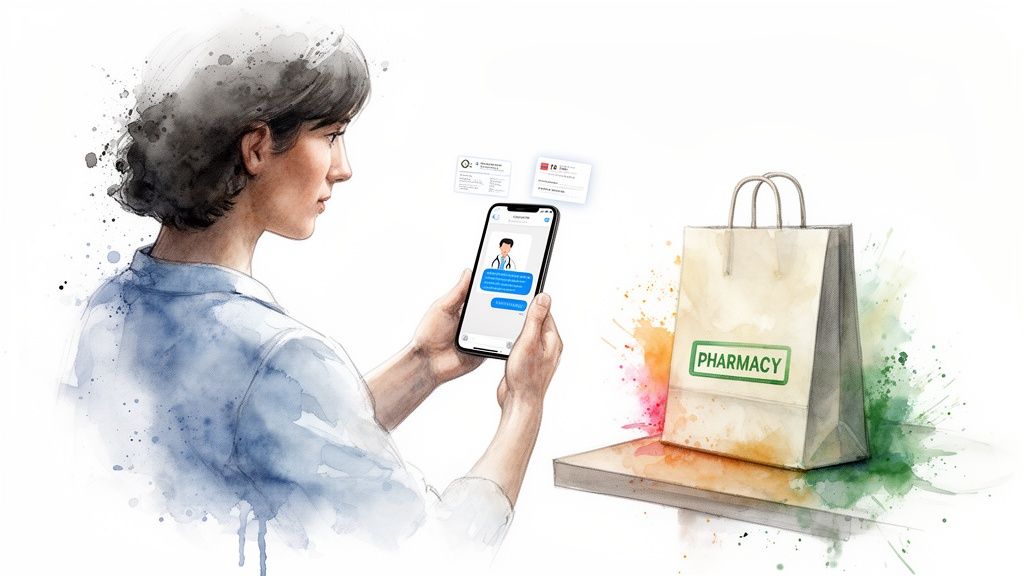
Telemedicine offers a seriously straightforward and private way to get a birth control prescription without insurance. Forget waiting weeks for an in-person appointment. You can connect with a licensed doctor online, often through a simple text chat or by filling out a secure online form.
This modern route cuts through a lot of the old-school red tape. You don’t have to travel to a clinic, hang out in a waiting room, or take a day off work. The whole process, from the doctor's review to the prescription, is handled right from your phone or computer for one flat, upfront fee.
What to Expect From an Online Consultation
The process is designed to be incredibly fast and simple. You'll start by picking your reason for the visit—in this case, birth control—and then you'll fill out a detailed but easy-to-follow health questionnaire.
Think of this online intake form as your actual consultation. It's where you'll share your medical history, any medications you're on, allergies, and your blood pressure. Having a recent blood pressure reading is a great idea, as it's almost always required to safely prescribe hormonal birth control. You can usually get a free reading at a kiosk in any major pharmacy.
Once you hit submit, a board-certified physician reviews your information. As long as everything looks good and it's safe for you to take birth control, they’ll approve and electronically send your prescription straight to the pharmacy you picked.
A huge advantage of text-based telemedicine is the privacy. You can ask personal questions and share your health details in a secure, written format without the pressure of a face-to-face or video call.
How to Prep for Your Digital Visit
To make your online visit go as smoothly as possible, it helps to gather a few key details beforehand. This simple prep work helps the doctor make a quick, informed decision and gets your prescription sorted out that much faster.
Have this info ready to go:
- Your Medical History: Be ready to list any major health conditions you have (or have had), like migraines with aura, blood clots, or high blood pressure.
- Current Medications: Write down every single thing you take, including vitamins and over-the-counter supplements. This helps the doctor check for any potential drug interactions.
- A Recent Blood Pressure Reading: Like I mentioned, this one’s crucial. If you don't have a cuff at home, a quick stop at a local pharmacy is all it takes.
When you're looking into telemedicine, a big part of it is understanding how to get an online doctor prescription. Luckily, the process is pretty consistent across good platforms.
After the doctor gives your case the green light, you'll get a notification that your prescription is ready. The platform sends it directly to your pharmacy, so all you have to do is swing by and pick it up. The entire experience—from starting the form to having the prescription in your hands—can often be done in just a couple of hours. That kind of speed is a massive win for anyone who needs contraception right away. To learn more, you can check out the full range of available telehealth services and see how they can work for you.
How to Find Affordable In-Person Care at Local Clinics
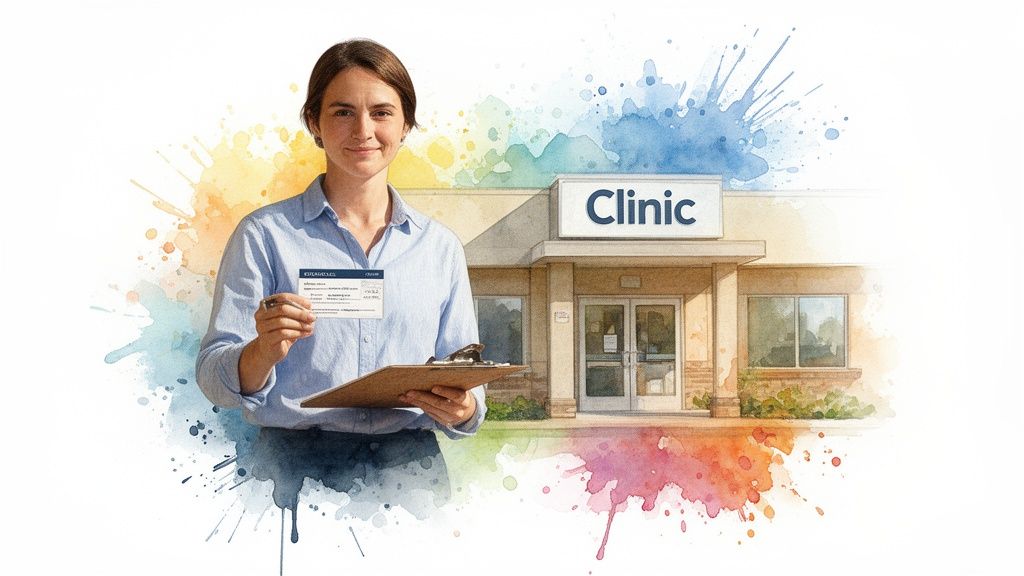
While telemedicine is incredibly convenient, sometimes you just need an in-person visit. This is especially true if you’re thinking about long-acting birth control methods, like an IUD or the implant, which require a hands-on procedure.
That’s where community health clinics and Planned Parenthood come in. They are the cornerstones of affordable care, specifically set up to help people get a birth control prescription without insurance. These clinics are more than just affordable; they’re places where you can have a real conversation, ask all your questions, and get a physical exam if needed.
Finding a Clinic Near You
Okay, first things first: you have to find a clinic. This part is simpler than you might think, and a few fantastic resources can point you in the right direction.
To track down a clinic that offers the reproductive healthcare you need, start here:
- National Family Planning & Reproductive Health Association (NFPRHA): Use their clinic finder tool to search for federally funded Title X clinics. These places are required to offer confidential services on a sliding scale. It’s their whole purpose.
- Planned Parenthood: Their website has a straightforward search feature to locate the nearest health center. They are absolute experts in reproductive care and know exactly how to help patients without insurance.
- Local Health Department: A quick search for your city or county’s public health department website will often lead you straight to local clinics offering low-cost care.
Once you have a list of a few options, give them a call. It's a crucial step to confirm they offer the specific services you’re looking for and to ask about their policies for uninsured patients.
How Sliding-Scale Fees Work
The term sliding-scale fee is about to become your best friend. It simply means the clinic adjusts the cost of your visit based on your income and how many people are in your household. If you make less, you pay less. It's that simple.
To get the best possible price, you'll likely need to show some proof of income. This could be a recent pay stub, a tax return, or even a letter from your boss. It’s always a good idea to call the clinic ahead of time and ask what specific documents they need you to bring.
This system is designed to make sure money doesn't stand in the way of you getting essential healthcare. Depending on your situation, your visit—and even your birth control—could be completely free or cost very little. For example, you could pay anywhere from $0 to $50 for a month’s supply of birth control pills at one of these clinics.
Showing up prepared with the right documents will make your visit smooth and stress-free. Along with your proof of income, bring a photo ID if you have one. Arriving a little early for your first appointment also gives you a buffer to fill out any paperwork without feeling rushed. By tapping into these local resources, you can get access to a full range of birth control options in a supportive and affordable environment.
How to Pay for Birth Control Without Insurance
Getting the prescription is one thing, but paying for your birth control month after month without insurance is a completely different challenge. That final price tag at the pharmacy can feel like a major roadblock.
Don't let it be. There are some really practical ways to make your contraception affordable, and it all starts with understanding the costs and knowing where to look for savings.
The price you'll pay out-of-pocket swings wildly depending on the method you and your doctor choose. Birth control pills can run anywhere from $15 to over $50 per month, while things like the patch or the ring often land in the $30 to $200 monthly range. If you go for the shot, which is given every three months, a single injection can cost up to $250. And remember, those numbers don't even include what you paid for the doctor's visit itself.
Smart Ways to Lower Your Costs at the Pharmacy
Once you have that prescription in hand, your next mission is to get the best possible price at the pharmacy counter. Never just accept the first price you're quoted. You have more power here than you think.
One of the easiest and most effective things you can do is ask your doctor for a generic version of your birth control. Seriously, this is a game-changer. Generic pills have the exact same active ingredients and work just as well as the brand-name versions, but they cost a fraction of the price. We're talking about the difference between a $20 monthly cost for a generic and $150 for its brand-name equivalent.
Another fantastic tool is using pharmacy discount cards or apps. Services like GoodRx or SingleCare are completely free and can slash your costs in a big way. All you have to do is search for your prescription on their app or website, find the pharmacy with the best price, and show the coupon to the pharmacist. It’s that simple.
A quick tip from experience: Always compare prices. I've seen a quick search on a discount app show that one pharmacy is charging $45 for a prescription while another one just down the street has the exact same medication for only $18. It pays to check.
Before we dive into what these costs look like annually, let's break them down in a table so you can get a clearer picture of what to expect over the long term.
Estimated Annual Out-of-Pocket Costs for Birth Control (Uninsured)
This table gives you a realistic overview of the potential annual costs for different birth control methods if you're paying completely out of pocket.
| Method | Estimated Annual Cost Range (Without Insurance) | Notes on Affordability |
|---|---|---|
| Birth Control Pills | $180 – $600+ | Generic versions are significantly cheaper and can bring this cost down to the lower end of the range. |
| The Patch (e.g., Xulane) | $360 – $2,400 | Costs can vary widely. Using pharmacy discount cards is key to making this method affordable without insurance. |
| The Ring (e.g., NuvaRing) | $360 – $2,400 | Similar to the patch, brand-name versions are expensive. Look for generics and use coupons to save. |
| The Shot (Depo-Provera) | $320 – $1,000 | Since it's administered every 3 months, the annual cost includes 4 injections plus any clinic administration fees. |
| IUD (Hormonal or Copper) | $500 – $1,300+ (Upfront) | The initial cost is high, but it lasts for 3-12 years, making the long-term annual cost very low. |
| Implant (e.g., Nexplanon) | $500 – $1,300+ (Upfront) | Similar to the IUD, this is a high one-time cost that provides contraception for up to 5 years. |
| Emergency Contraception | $25 – $50 (Per dose) | This is a one-time cost. Generics are available and much cheaper than brand names like Plan B. |
As you can see, the upfront investment for methods like an IUD or implant is steep, but they can be the most cost-effective options over time. For monthly methods, your best bet is always to seek out generics and savings programs.
Digging Deeper for Serious Savings
Beyond generics and coupons, there are a few other resources that can make a huge difference, especially if you're planning on using a particular method long-term.
- Patient Assistance Programs (PAPs): A lot of pharmaceutical companies have programs to help uninsured or low-income folks get their medications for free or at a steep discount. Just go to the manufacturer's website for your specific birth control and see if they have a PAP you can apply for.
- 3-Month Supplies: Ask your doctor to write your prescription for a 90-day supply instead of the standard 30-day one. Buying in larger quantities can often lower your overall monthly cost and save you a few trips to the pharmacy.
Even people with insurance run into cost issues. A KFF survey found that 24% of women with private insurance still ended up paying for their contraception out-of-pocket. While the ACA made a big difference in reducing costs, gaps are still there—especially for emergency contraception, where 83% of insured women still pay up to $50.
For more great strategies on navigating medication expenses, check out this guide on how to get medication without insurance and lower costs. When you combine these financial tips with an affordable way to get your online prescription, you're creating a complete, sustainable plan to manage your reproductive health on your own terms.
Exploring Over the Counter and Pharmacy Options

Getting birth control isn't just about a traditional doctor's office visit anymore. The game has changed, and new options are making it much easier and faster to get what you need—even if you’re trying to figure out a birth control prescription without insurance.
Two of the biggest shifts are the arrival of over-the-counter pills and the ability to get a prescription directly from a pharmacist. These routes can be a perfect fit if a full clinic visit or even a telemedicine call isn’t the right move for you right now.
Over the Counter Birth Control: The New Reality
The FDA's approval of Opill, the first over-the-counter (OTC) birth control pill, was a massive step forward for accessibility. You can now walk into most major pharmacies or hop online to buy this progestin-only pill with no prescription at all.
This is a huge win. No appointments, no consultations—just direct access.
But there are a few things to keep in your back pocket with this option:
- Method Limitation: For now, the only thing on the shelf is a specific progestin-only pill. If you need a combination pill or prefer another method like the patch or ring, you’ll still need to get a prescription.
- Self-Screening is Key: Since there's no doctor to screen you, it’s all on you. You have to read the packaging carefully to make sure you don’t have any health conditions that would make it unsafe to take.
- Cost Factor: With no insurance to help out, you’re covering the full price. That usually lands somewhere between $20 to $50 for a one-month pack.
The impact has been immediate. One nationwide study found that Opill’s approval boosted contraceptive access by 31 percentage points, giving a major lift to people without insurance or a regular doctor. You can learn more about the OHSU study findings and see the data for yourself.
Getting a Prescription Directly From a Pharmacist
In a growing number of states, you've got another incredibly convenient option: getting your birth control prescribed right at the pharmacy counter. This is a great middle ground between a full doctor's appointment and just grabbing a box off the shelf.
This service allows a specially trained pharmacist to review your health history, take your blood pressure, and write a prescription for various types of birth control, including combination pills, the patch, and the ring, right there in the pharmacy.
It’s the best of both worlds—you get the speed and convenience, but with the oversight of a healthcare professional making sure the method is safe for you. The whole process is much quicker than a standard clinic visit.
The list of states offering this is always expanding. Just do a quick search for "pharmacist prescribed birth control [Your State]" to see if it’s an option where you live. It’s one more barrier torn down, making contraception more accessible than ever before.
Your Questions Answered: Getting Birth Control Without Insurance
Navigating healthcare without insurance can feel like you're full of questions, especially for something as personal as birth control. You’re probably wondering about privacy, what you actually need for an online visit, or how you’re supposed to pay for it all. Getting straight answers helps you move forward with total confidence.
Let's clear up some of the most common concerns people have when they need a birth control prescription without insurance.
Will My Medical Information Be Kept Private?
Absolutely. Whether you go with a telemedicine service or walk into a community clinic, your health information is protected by law. Reputable online platforms use HIPAA-compliant technology with secure encryption to guard your data, just like a traditional doctor's office would.
Clinics like Planned Parenthood are also bound by strict confidentiality policies. Your visit, your records, and any services you get are kept completely private.
What Do I Need for an Online Consultation?
Getting ready for a virtual doctor visit is surprisingly simple. The goal is just to give the physician a clear snapshot of your health so they can safely prescribe your medication.
To make sure your consultation goes off without a hitch, have these three things handy:
- A valid photo ID: This is standard practice to verify your identity and age, just like at any clinic.
- A recent blood pressure reading: This is a crucial safety check for prescribing hormonal birth control. You can usually get a free reading at a self-service kiosk in most major pharmacies. It only takes a minute.
- Basic medical history: Be ready to answer questions about any existing health conditions (like migraines with aura), allergies you have, and other medications you take—including vitamins and supplements.
Having this info ready helps the doctor make a quick, informed decision, which means your prescription gets sent to the pharmacy that much faster.
Can I Use an HSA or FSA Account?
Yes, you can and you absolutely should! Using your Health Savings Account (HSA) or Flexible Spending Account (FSA) is one of the smartest ways to manage expenses when you're uninsured.
Your HSA/FSA funds can be used to cover the cost of the doctor's consultation—both for telemedicine visits and in-person clinic appointments. The funds can also be used to purchase your prescribed birth control at the pharmacy.
This tax-advantaged money is specifically designed for qualified medical expenses, and contraception fits squarely in that category. It makes handling the out-of-pocket costs much more predictable. Most telemedicine platforms and pharmacies accept HSA/FSA cards right at checkout, making the whole process seamless.
Ready to get your birth control prescription quickly and privately? ChatWithDr offers same-day, text-based consultations with board-certified doctors for just $39.99. Get a diagnosis, treatment plan, and prescription sent to your pharmacy in hours, all from your phone. Start your secure consultation with ChatWithDr today.
Related posts:
 Birth Control Options and Side Effects: Your Complete, Click-Worthy Guide
  How to Get Emergency Contraception Online in Under 2 Hours (Fast & Private)
  Can You Get Birth Control Online? Your Guide to Telehealth
  How to Get Emergency Contraception Online, Fast, Private, and Affordable (2026 Guide)
  Your Quick-Start Guide to Emergency Contraception: Do This First (Available 24/7)