
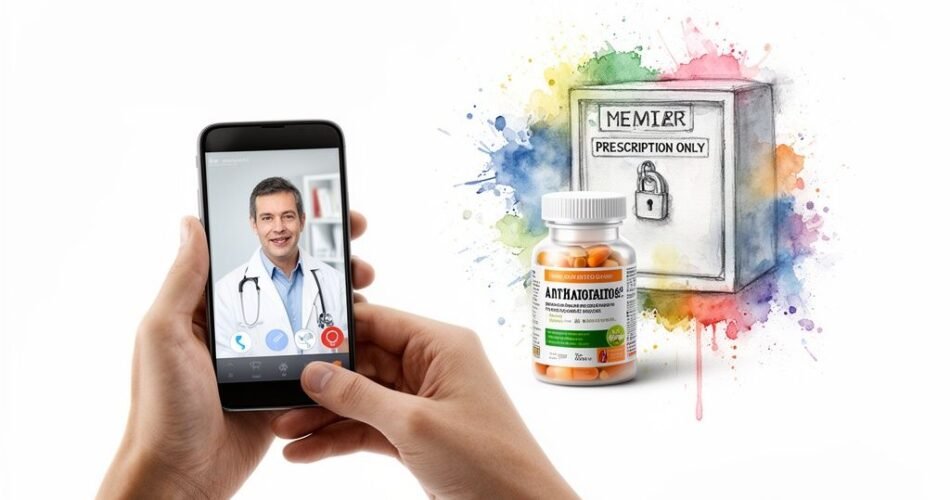
Feeling sick and just hoping for a quick fix? It's a question we hear all the time: can you get antibiotics over the counter?
Let's cut right to it. In the United States, the answer is a straightforward no. With a few minor exceptions for some topical creams, you absolutely need a prescription from a licensed healthcare provider to get oral antibiotics.
The Short Answer Is No, Not in the United States

Think of antibiotics as highly specialized, powerful tools. You wouldn't try to operate a crane without an expert guiding you, and you shouldn’t take these potent medicines without a doctor's diagnosis. This isn't just a bureaucratic hoop to jump through; it's a critical safety measure designed to protect both you and the public.
A doctor’s prescription is your assurance that you're getting the right tool for the job—the correct antibiotic for your specific bacterial infection. Using the wrong one is ineffective at best and can be genuinely harmful at worst.
U.S. Prescription Rules vs Global Over-The-Counter Access
The strict, prescription-only system in the U.S. often surprises people, especially those who have traveled abroad where rules can be much more relaxed. This quick comparison shows just how different the approaches are.
| Aspect | In the United States | In Many Other Countries |
|---|---|---|
| Accessibility | Strictly prescription-only for oral antibiotics. | Can often be purchased directly from a pharmacy without a prescription. |
| Primary Goal | To prevent antibiotic resistance, ensure correct diagnosis, and manage side effects. | To provide immediate access to medication, especially in areas with limited doctors. |
| Public Health Risk | Lower risk of widespread antibiotic resistance due to controlled use. | Higher risk of creating "superbugs" from overuse and misuse. |
| Patient Safety | A doctor screens for allergies, drug interactions, and confirms a bacterial (not viral) infection. | Patients self-diagnose, which can lead to taking the wrong drug or masking a serious condition. |
This table really highlights why the U.S. takes such a firm stance. It’s all about long-term public health and individual safety.
Why the US System Is Different
Unlike countries where you might just walk into a pharmacy and buy antibiotics, the U.S. enforces this prescription-only system as a key strategy in the global fight against antibiotic resistance.
Every time someone self-diagnoses and takes antibiotics for something they don't treat—like a common cold or the flu, which are viral—it gives bacteria a free opportunity to adapt and evolve into "superbugs."
The prescription requirement acts as a crucial firewall. It prevents the overuse and misuse of these life-saving drugs, ensuring they remain effective for serious infections when we truly need them.
This controlled approach is vital for a few key reasons:
- Ensuring the Right Diagnosis: Only a doctor can reliably tell the difference between a bacterial infection that needs antibiotics and a viral one that doesn't.
- Preventing Nasty Side Effects: Antibiotics are strong medicines that can cause significant side effects and serious allergic reactions. A physician weighs these risks before writing a script.
- Combating Resistance: Limiting access helps slow down the evolution of antibiotic-resistant bacteria, which is one of the biggest public health threats we face today.
While systemic antibiotics are locked behind a prescription, it's worth noting that many effective non-prescription acne treatments are available right on the shelf. But for any internal infection, getting professional medical guidance is completely non-negotiable.
Why Antibiotics Are a Prescription-Only Medication
Have you ever stood in the pharmacy aisle, feeling awful, and wondered why you can’t just grab an antibiotic off the shelf like you do with painkillers? It’s a fair question. The reason isn't about red tape; it’s about protecting one of modern medicine’s greatest weapons from becoming useless. That prescription requirement is a critical safeguard, making sure these powerful drugs are used correctly so they keep working for everyone.
Think of bacteria like a team of enemies in a video game. Every time you use an antibiotic the wrong way—like for a viral cold where it does absolutely nothing—you're giving those enemies a free training session. They get a chance to study your weapon, find its weaknesses, and "level up." Eventually, they can evolve into superbugs that our best antibiotics can't touch.
The Threat of Antibiotic Resistance
This process is called antibiotic resistance, and it's one of the biggest public health threats we face today. When bacteria become resistant, infections that were once simple to treat can suddenly become life-threatening. A routine urinary tract infection or a case of strep throat could escalate into a major medical crisis.
That's why a doctor's diagnosis is so important. They're trained to confirm your illness is actually caused by bacteria. Viruses, which are responsible for the common cold and flu, are completely immune to antibiotics. Using them for a viral infection doesn’t help you get better one bit—it just fuels the rise of these dangerous superbugs.
A doctor’s prescription is the front line of defense in the global fight against antibiotic resistance. It ensures the right drug is used for the right reason, preserving the effectiveness of these life-saving medicines for future generations.
This careful, gatekept approach is why the antibiotics market is so unique. Even though the global demand is massive, strict regulations in places like the United States keep growth channeled through prescriptions. The global antibiotics market was valued at $43.17 billion and is projected to hit $64.38 billion by 2034, driven by a rising number of bacterial infections and an aging population. You can explore more about the trends shaping the antibiotics market on fortunebusinessinsights.com.
Protecting Yourself and the Community
When a doctor writes you a prescription for an antibiotic, they’re making several critical calculations that you simply can’t make on your own. They have the training to identify the specific type of bacteria likely causing your illness and pick the best antibiotic to target it.
This professional oversight is absolutely essential for a few key reasons:
- Accurate Diagnosis: Is it a bacterial infection, a viral one, or something else entirely? A doctor's evaluation stops you from taking a potent medication for no reason.
- Correct Dosing: The right dose and the full length of treatment are crucial. If you stop taking the pills early just because you feel better, you can leave the tougher bacteria behind to multiply and spread.
- Patient Safety: A doctor will check for potential allergies or dangerous interactions with other medications you might be taking, protecting you from harmful side effects.
Every time you follow a doctor's prescription exactly as written, you aren’t just helping yourself get better. You're also playing a small but vital part in a much larger public health effort to keep these essential medicines working for everyone, for years to come.
The Dangers of Unregulated Antibiotic Access

While the U.S. keeps antibiotics strictly behind the pharmacy counter, it’s a totally different story in many other parts of the world. In countless countries, you can walk into a pharmacy and buy powerful antibiotics over the counter, no questions asked. But this convenience comes with a massive, hidden cost.
This easy-access approach serves as a powerful cautionary tale. It shows us why the American system, as frustrating as it can sometimes feel, acts as a critical firewall against a much bigger problem. When people can self-prescribe these drugs, they often get it wrong—diagnosing a viral cold as a bacterial infection, picking the wrong antibiotic, or stopping the course too soon. It’s like giving bacteria a global training gym to bulk up and get stronger.
And this isn't some minor issue. A massive review found that more than 62% of antibiotics around the globe are handed out without a prescription. The problem is especially bad in developing nations, where easy OTC access is one of the main reasons for overuse and skyrocketing resistance rates. You can dig into the global scope of non-prescription antibiotic sales on frontiersin.org to see just how widespread this is.
The Rise of Deadly Superbugs
Every single time an antibiotic is used the wrong way, it fuels the global crisis of antimicrobial resistance (AMR).
Think of it this way: imagine bacteria as a huge crowd of burglars trying to pick a lock. Most are amateurs, but a few are master lockpickers. An antibiotic is like a specific key that should open the lock and take them all out. But when you use the wrong key (or not for long enough), you only eliminate the amateurs. The masters survive, learn from the attempt, and then teach all the other burglars their new-and-improved trick.
This is exactly how we create "superbugs"—bacteria that have evolved to shrug off our most powerful medicines. The consequences are terrifying, turning simple infections that were once easily treated into life-threatening emergencies.
The connection is painfully clear: easier access leads to more frequent misuse, which directly speeds up the creation of drug-resistant bacteria. This puts every single one of us at risk, no matter where we live.
Common Mistakes from Easy Access
Unregulated access creates a domino effect of bad decisions, each one giving bacteria another shot at survival.
- Wrong Diagnosis: Someone with the flu takes antibiotics. The drugs do nothing to the virus but kill off the good, helpful bacteria in their system, giving resistant strains more room to thrive.
- Incorrect Dosing: A person starts to feel better after just two days of a week-long prescription and stops taking it. The weakest bacteria were wiped out, but the toughest ones are left behind to multiply and spread.
- Using Leftovers: Taking that old amoxicillin from a past sinus infection for what you think is a UTI is a total shot in the dark. It’s likely the wrong drug, and all it does is help breed more resistance.
The strict U.S. prescription model is designed to stop these exact scenarios. It puts a doctor in the driver's seat to confirm the infection is bacterial, choose the right drug for the job, and give you clear instructions on how to use it safely. This is why trying to get antibiotics over the counter by importing them or borrowing someone else's is such a dangerous gamble—not just for you, but for all of us.
Understanding the Exceptions for Topical Antibiotics

So, while the rule against buying oral antibiotics without a prescription is pretty much set in stone, there's one major exception you'll find in every single pharmacy: topical antibiotics. These are the creams and ointments like Neosporin that you apply directly to your skin.
Why are these perfectly fine to grab off the shelf when all the others are locked behind the pharmacy counter? It all comes down to how and where they work in your body.
Think of it this way: a serious internal infection like pneumonia or a UTI is a problem deep inside your body's system. To fix it, you need a powerful, systemic solution—an oral antibiotic—that travels through your entire bloodstream to hunt down and eliminate the bacteria. It’s an inside-out job.
Localized Treatment for Minor Issues
A topical antibiotic, on the other hand, works on a completely different scale. It’s designed for surface-level problems like minor cuts, scrapes, and burns. Instead of flooding your whole system, it acts locally, right where you put it, to stop an infection before it can even start.
Because it isn't absorbed into your bloodstream in any significant amount, it stays on the surface. This is the key.
This localized action is precisely why you can buy topical antibiotics over the counter. Their effect is confined to the skin, which massively reduces the risk of creating widespread antibiotic resistance or causing the serious side effects that can come with systemic drugs.
Regulators see these two types of antibiotics completely differently because their impact is so different. Topical creams are designed to be a limited, targeted tool for first aid.
Of course, for deeper skin infections that go beyond a simple scrape—like severe acne, boils, or cellulitis—a surface-level cream won't cut it. That's when you need to step up to a prescription-strength solution, which often means speaking with an online dermatologist to get the right treatment.
Prescription vs. Over-The-Counter Antibiotics Explained
To make it even clearer, let's break down the fundamental differences between the antibiotics you need a prescription for and the ones you can just buy.
| Type of Antibiotic | How It Works | Common Uses | Availability |
|---|---|---|---|
| Systemic (Oral) | Circulates through the entire body via the bloodstream to fight internal infections. | UTIs, strep throat, pneumonia, sinus infections. | Prescription-Only |
| Topical (Creams) | Applied directly to the skin to prevent or treat localized, surface-level infections. | Minor cuts, scrapes, and burns. | Over-the-Counter |
As you can see, it’s all about scope. Oral antibiotics are the heavy-duty tools for internal problems, while topical antibiotics are your go-to for patching up minor issues on the outside.
How to Get a Safe and Fast Antibiotic Prescription Online
So, if you can’t just grab antibiotics off the shelf, does that mean you’re stuck waiting for hours at a clinic? Not anymore. The rise of telemedicine has created a safe, legitimate, and remarkably fast way to get a diagnosis and prescription from a real doctor without ever leaving your home.
This modern approach bridges the gap between the need for a prescription and the desire for convenience. It's the official, regulated alternative to buying from risky, unregulated sources, and it’s designed to fit into a busy life while upholding medical safety standards.
The Simple Path to Online Care
Getting an antibiotic prescription online is surprisingly straightforward. Reputable telehealth platforms have boiled the process down to a few key steps. You don’t even need to schedule a video call or wait around for an appointment.
The entire consultation is typically text-based, which means you can communicate with a doctor on your own schedule. This method is not only incredibly convenient but also offers a layer of privacy that many people appreciate, especially for more sensitive health issues.
Here’s a breakdown of how it usually works:
- Select Your Condition: You start by choosing the health issue you’re dealing with from a list of common ailments, like a urinary tract infection (UTI), sinus infection, or pink eye.
- Complete a Secure Medical Form: Next, you’ll fill out a detailed but easy-to-follow online intake form. This is your virtual consultation. Be honest and thorough here—describe your symptoms, medical history, and any medications you’re taking. This is the information the doctor will use to make a diagnosis.
- A Doctor Reviews Your Case: Once you hit submit, a U.S. board-certified, state-licensed physician reviews your information. They’ll assess your symptoms to figure out if your condition is likely bacterial and if an antibiotic is the right move.
- Receive Your Treatment Plan: The doctor then provides a diagnosis and a personalized treatment plan. If they decide an antibiotic is necessary, they’ll write an e-prescription.
This entire process often takes just a couple of hours from start to finish. It’s a powerful example of how technology can make healthcare more accessible without cutting any corners on safety.
Receiving and Filling Your E-Prescription
If your doctor prescribes medication, the e-prescription is sent directly and electronically to the pharmacy of your choice. You just go and pick it up like you would with any other prescription from an in-person visit. Honestly, it's far more efficient than waiting in a clinic just to get a piece of paper to take across town.
Once you have your online prescription, you can use a verified service like doctordoc's pharmacy services to fill it safely. The seamless integration makes the final step just as easy as the consultation itself. This is the legitimate, modern way to get the care you need quickly, ensuring you receive a valid prescription from a real doctor, every single time.
When to Seek In-Person Urgent Medical Care
While getting an antibiotic prescription online is safe and efficient for many common infections, it’s definitely not the right choice for every situation. Your safety is always the top priority. Certain "red flag" symptoms are clear signals that you need an immediate, hands-on medical evaluation from a professional.
Think of it this way: an online consultation is like a scout assessing a situation from a distance. It's perfect for recognizing familiar patterns and creating a plan for common scenarios. But when that scout sees signs of a major, complex issue—like a fire that's spreading too quickly—they call in the emergency response team for direct, in-person help.
When to Go to Urgent Care or the ER
If you experience any of the following symptoms, skip the online service and head directly to an urgent care clinic or an emergency room. These absolutely require a physical examination to properly diagnose and treat.
- Difficulty Breathing or Shortness of Breath: This is always a sign to seek immediate care.
- A Very High Fever: A fever that is persistently high (like above 103°F or 39.4°C) and doesn't come down with fever-reducing medication.
- Severe Pain: Intense pain anywhere in your body, such as severe abdominal pain, chest pain, or a debilitating headache.
- Confusion or Disorientation: Any sudden changes in your mental state, like confusion or difficulty staying awake, are serious.
- Vomiting and Inability to Keep Fluids Down: This can quickly lead to dangerous levels of dehydration.
These symptoms often point to a more severe condition that a doctor cannot safely assess through a text-based consultation alone. A hands-on exam is absolutely necessary to rule out serious issues and give you the appropriate level of care.
For less severe but still pressing medical needs, you can explore options like online urgent care as a first step.
This simple flowchart helps visualize when to choose online care versus heading to an in-person facility.

The key takeaway is clear: convenience should never come at the cost of safety. Understanding these critical distinctions empowers you to make the smartest and safest choice for your health.
Your Questions About Online Antibiotics, Answered
Jumping into online healthcare can feel a little new, so it's natural to have questions. Let's walk through some of the most common ones to help you feel confident about getting care this way.
Can an Online Doctor Really Treat My Sinus Infection?
Yes, absolutely. Sinus infections are one of the most common reasons people see an online doctor. By reviewing your symptoms and medical history, a physician can usually tell if the infection is bacterial and, if so, prescribe the right antibiotic.
The same goes for other common issues like UTIs, pink eye, and even some cases of bronchitis. For these straightforward problems, a virtual consultation is incredibly effective.
How Can a Doctor Diagnose Me Without a Physical Exam?
It's a fair question. While a hands-on exam is crucial for complex issues, many common infections show up with a very clear and distinct set of symptoms. Telemedicine doctors are experts at diagnosing these conditions based on the detailed information you share.
They’re trained to analyze your symptom patterns, how long you've had them, and how severe they are to build a clear clinical picture. Think of it like a structured interview where your answers paint a detailed story, allowing them to confidently tell the difference between a virus and a bacterial infection.
A doctor's diagnostic skill isn't just about what they can see or touch; it's also about interpreting the story your symptoms tell. This is where telemedicine really shines for common illnesses.
What if the Doctor Says I Don't Need Antibiotics?
This is actually a sign of great medical care. If the doctor figures out your illness is probably viral (like a common cold) or just doesn’t need an antibiotic, they'll explain exactly why.
Instead, they will give you a solid plan to manage your symptoms, which might include specific over-the-counter medications, rest, or hydration. This careful approach makes sure you only get powerful medicines when they are truly necessary, which protects your health and helps keep antibiotics effective for everyone in the future.
Ready for fast, convenient care from the comfort of your home? ChatWithDr provides same-day consultations with U.S. board-certified doctors for just $39.99. Get a diagnosis, treatment plan, and prescription if needed, often in just a few hours. Start your consultation now at ChatWithDr.com.
Related posts:
 Understanding yeast infection after antibiotics treatment: Quick remedies
  A Complete Guide to OTC UTI Treatment Options
  UTI Meds Over The Counter Your Practical Guide to Relief
  Yeast Infection vs BV: How to Tell the Difference
  Discover over the counter medicine for uti: Quick guide to relief and safety