
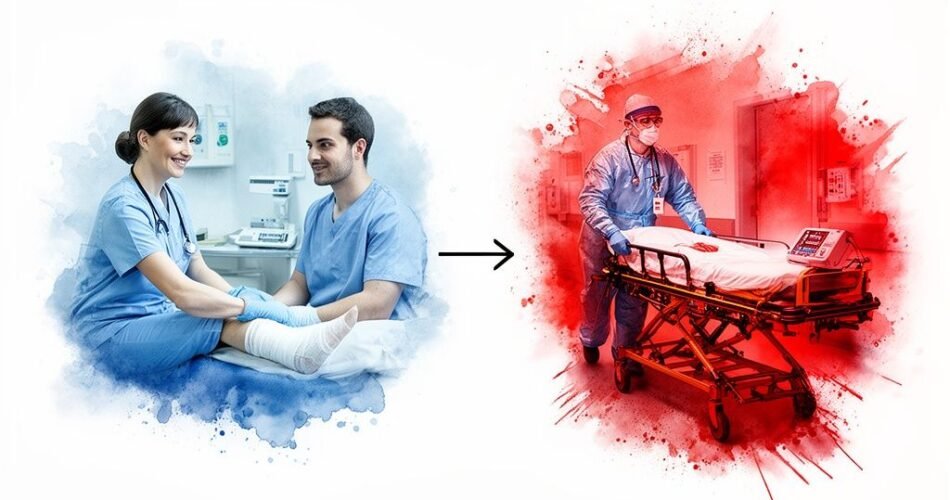
When you or someone you love needs medical help, and needs it now, figuring out where to go can be a stressful blur. That split-second decision between heading to an urgent care clinic or an emergency room (ER) is a big one. It's not just about convenience; it shapes your wait time, your bill, and the kind of care you'll get.
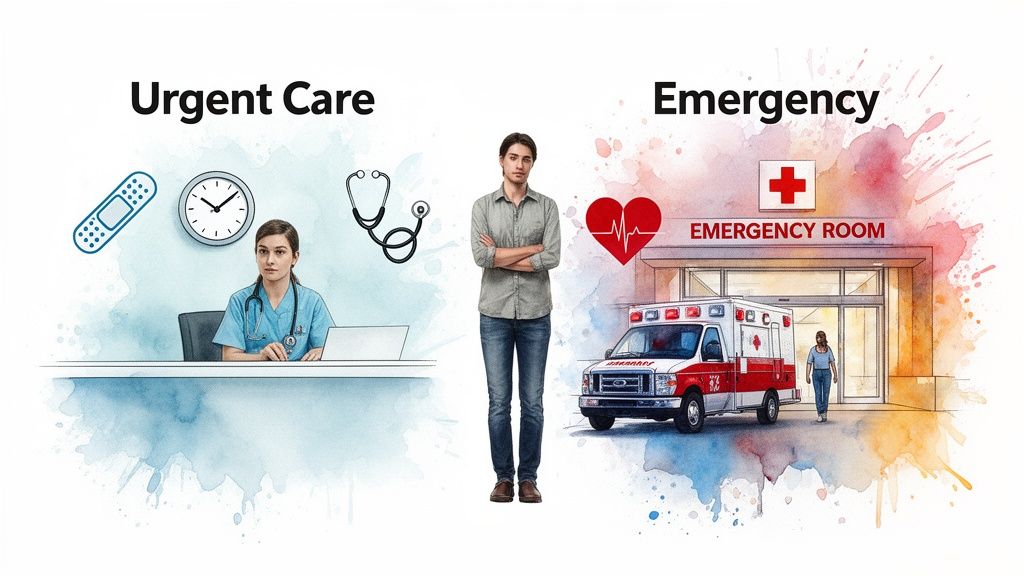
The primary difference between urgent care and emergency rooms boils down to one simple thing: the severity of the medical issue.
Think of urgent care centers as the essential middle ground between your family doctor and the hospital ER. They're built for those health problems that just can't wait for a scheduled appointment but aren't putting your life or a limb at immediate risk.
The ER, on the other hand, is equipped for true, life-threatening crises. It’s staffed 24/7 with specialists in emergency medicine and has the advanced equipment needed for the most critical situations. Making the right choice under pressure is crucial, and it's a distinction that applies across different medical fields, like when choosing between emergency dental services and urgent care.
Key Differences at a Glance: Urgent Care vs. Emergency Room
When you’re trying to decide where to go, a quick side-by-side look can make all the difference. This table breaks down the core functions of each facility to help you make a smart, informed choice in the moment.
| Factor | Urgent Care | Emergency Room (ER) |
|---|---|---|
| Severity of Conditions | Non-life-threatening illnesses and minor injuries (flu, sprains, minor cuts). | Severe, life-threatening conditions (heart attack, stroke, major trauma). |
| Wait Times | Typically shorter, often less than an hour for walk-ins. | Can be very long; patients are seen based on severity, not arrival time. |
| Cost | Significantly lower, with co-pays similar to a specialist visit. | Much higher due to specialized staff and 24/7 readiness; often 5-10 times more expensive. |
| Services Offered | X-rays, lab tests, stitches, and treatment for common illnesses. | Comprehensive diagnostics, surgery, advanced life support, and access to specialists. |
| Operating Hours | Extended hours, including evenings and weekends, but not always 24/7. | Always open, 24 hours a day, 365 days a year. |
At the end of the day, urgent care is for the inconvenient but manageable problems of life. The ER is for the moments you can’t afford to wait. Knowing which is which saves you time, money, and ensures you get the right level of care exactly when you need it.
When Is the Emergency Room the Right Choice?
The line between urgent care and the emergency room boils down to one simple thing: severity. While an urgent care clinic is perfect for problems that are pressing but not critical, the emergency room (ER) is built—and legally required—to handle true, life-or-limb-threatening situations. It's a community resource reserved for the most serious medical crises.
ERs are staffed 24/7 with physicians and nurses who specialize in emergency medicine, ready to deliver immediate, life-saving care. They have instant access to surgical specialists, advanced imaging like CT scanners and MRIs, and labs that are essential for diagnosing and treating severe conditions. This level of readiness is what sets the ER apart from every other medical facility.

Understanding the ER Triage System
Unlike an urgent care clinic where you're typically seen in the order you arrive, an ER runs on a triage system. This is a medical protocol that prioritizes patients based on how urgently they need care. Someone showing signs of a heart attack will be seen immediately, well before someone who arrived earlier with a sprained ankle.
This system ensures that those in the most danger get help first, which is why ER wait times can feel unpredictable and often long for less severe issues.
Key Takeaway: The ER is not a first-come, first-served facility. Care is prioritized based on medical necessity to save lives, meaning those with non-critical conditions should expect to wait while more severe cases are addressed.
The sheer number of patients puts an immense strain on these departments. In 2022, U.S. emergency departments handled a staggering 155.4 million visits. However, only about 11.5% of those visits actually led to a hospital admission, and just 40.6% of patients were seen within 15 minutes. These numbers highlight the intense pressure on these critical services. You can discover more insights about emergency department statistics from the CDC.
When to Go to the Emergency Room Immediately
Knowing which symptoms demand an ER visit is absolutely essential. If you or someone else is experiencing any of the following, call 911 or get to the nearest emergency room without a second thought. Time is a critical factor in the outcome of these conditions.
Signs and Symptoms Requiring Emergency Care:
- Chest Pain or Difficulty Breathing: These are classic signs of a heart attack or pulmonary embolism.
- Sudden Weakness, Numbness, or Vision Loss: Symptoms like a drooping face, arm weakness, or slurred speech are red flags for a stroke.
- Severe, Uncontrolled Bleeding: Deep wounds or any bleeding that won't stop with direct pressure needs immediate medical help.
- Loss of Consciousness or Seizures: Any fainting, unresponsiveness, or seizure activity requires an ER visit.
- Major Trauma or Injury: This includes severe head injuries, broken bones where the bone is visible, or injuries from a serious accident.
- Severe Abdominal Pain: Sudden, intense pain in your abdomen could signal a serious issue like appendicitis or an aortic aneurysm.
- High Fevers with Confusion: A high fever paired with a stiff neck, rash, or mental confusion could mean a dangerous infection like meningitis.
- Severe Burns: Extensive burns—or any burn to the face, hands, feet, or genitals—are considered medical emergencies.
Choosing the ER for these situations ensures you get the highest level of care when it matters most. Using it for non-emergent problems not only means higher costs and longer waits for you, but it also diverts critical resources from patients who are in a true crisis.
Defining the Role of Urgent Care Centers
Urgent care centers fill a huge gap in our healthcare system. They're the essential bridge between a scheduled visit with your primary doctor and the high-stakes environment of an emergency room.
Think of them as the perfect solution for medical problems that pop up unexpectedly and need attention now, but aren't life-threatening. It's like the "check engine" light on your car—it needs to be looked at soon, but you don't have to pull over on the highway this very second. That’s the core idea that separates urgent care from a true emergency.
The Sweet Spot for Medical Attention
Urgent care clinics are built for one thing: getting you treated quickly and conveniently. Their entire model is designed to get you in, diagnosed, and on your way without the massive bills and hours-long waits you'd expect at an ER.
Most are open on evenings and weekends when your regular doctor's office is closed, and you can almost always just walk in. This makes them a lifesaver for busy families and professionals.
Plus, they're not just talk. Most urgent care centers are equipped with the tools needed to handle a lot on-site, including:
- X-ray machines to check for fractures, sprains, or pneumonia.
- Basic lab services for rapid tests like strep swabs, urinalysis, and some blood work.
- Procedure rooms for things like stitches for a minor cut or draining an abscess.
Having these resources means they can give you a definitive answer and treatment in one visit, instead of sending you somewhere else. And while most centers handle a broad range of issues, some clinics focus on specific needs, like those offering specialized urgent vision care needs.
Conditions Perfectly Suited for Urgent Care
Knowing the difference between urgent care and an emergency really comes down to looking at real-world examples. If you're dealing with something that's uncomfortable or painful but not disabling or life-altering, urgent care is almost always the right call.
Here are some of the most common reasons people head to an urgent care clinic:
- Cold, flu, and fever
- Sore throat or suspected strep
- Ear infections and sinus pain
- Minor cuts that might need a few stitches
- Sprains, strains, or simple fractures
- Mild allergic reactions and rashes
- Urinary tract infections (UTIs)
- Minor burns or bug bites
Key Insight: Urgent care is fantastic for acute, one-off illnesses and injuries. It is not designed to replace your primary care doctor for managing chronic conditions like diabetes or high blood pressure, and it's definitely not the place for life-threatening emergencies.
For many of these non-critical issues, you can get help even more conveniently now. Learning how online urgent care works can connect you with a doctor right from home, which is perfect when you're pretty sure your condition doesn't need a hands-on physical exam.
Ultimately, choosing an urgent care center when it's appropriate saves you a ton of time and money. It also does the entire community a favor by helping keep emergency rooms free for the people who are facing true medical crises.
The Financial Fallout: ER vs. Urgent Care
Let’s be honest: beyond the medical side of things, the biggest difference between an urgent care clinic and an emergency room is the hit to your wallet. Your decision can be the difference between a manageable co-pay and a medical bill that causes genuine financial stress. Knowing how these costs break down is a huge part of making a smart healthcare choice.
Emergency rooms are built to handle the absolute worst. They run 24/7 and are staffed with specialists, on-call surgeons, and a full suite of high-tech diagnostic gear like CT scanners and MRIs. Keeping that level of readiness going creates massive operational costs, and you’re the one who ultimately pays for it.
Breaking Down the Bill: Why the ER Costs So Much More
An urgent care center, on the other hand, is built for efficiency. They have the essentials—like X-ray machines and basic lab services—but they skip the expensive, high-level infrastructure of a hospital ER. It’s a leaner model, and it’s why their prices feel a lot more like a regular doctor’s visit than an emergency one.
The numbers don't lie. Research shows that a single, simple ER visit will cost you $1,646 on average. That same issue handled at an urgent care clinic? Just $171. That's nearly 10 times cheaper. This staggering difference is a big reason why healthcare experts are pushing to get non-emergency cases out of the ER. You can dig into these healthcare cost findings from Health Affairs to learn more.
Key Financial Takeaway: The "facility fee" is the secret driver behind sky-high ER bills. It’s a charge for just walking in the door, designed to cover the hospital's overhead. You won’t find this on an urgent care bill.
This massive price gap shows up in your insurance plan, too. Your co-pay for an ER visit can easily be $250, $500, or even higher—and that’s before your deductible even kicks in. An urgent care co-pay is usually closer to what you’d pay for a specialist, often well under $100.
What This Means for Your Deductible and Out-of-Pocket Costs
If you have a high-deductible health plan, the financial risk is even bigger. An ER visit for something an urgent care could have easily handled—like a sinus infection or a minor sprain—could leave you on the hook for that entire, inflated bill. That $1,646 average cost could come straight out of your pocket.
Let's walk through a real-world scenario to see how this plays out.
Scenario: A Sprained Ankle
- Urgent Care Visit: You pay a $75 co-pay. They take an X-ray and give you a walking boot. Your total out-of-pocket cost after insurance might land somewhere between $150-$300.
- Emergency Room Visit: You pay a $300 co-pay up front. The ER does the same X-ray and gives you the same boot. But because of the facility fees and jacked-up service charges, your final bill after insurance could easily top $1,500.
The medical outcome is exactly the same, but the financial one is worlds apart. Choosing the right place for care isn't just about saving the healthcare system money; it’s about protecting yourself from unnecessary medical debt. Knowing that urgent care is the smart financial move for non-life-threatening problems empowers you to get the right treatment at a price that won’t create a whole new crisis.
How 24/7 Telemedicine Fits In as a Smart Alternative
The choice between urgent care and the ER often feels like a compromise—trading off cost and convenience for comprehensive care. But there's a powerful third option that's changing the game for many common health issues: 24/7 telemedicine. It isn't a replacement for all in-person care, but it's a remarkably smart and efficient first stop for non-emergency conditions.
Text-based platforms like ChatWithDr give you a direct line to board-certified physicians from your couch, at any time of day. This approach is perfectly suited for conditions that don't need a hands-on physical exam but still demand a professional diagnosis and a real treatment plan. It brings a new level of accessibility that traditional clinics just can't match.
Bridging the Gap in Healthcare Access
The real magic of telemedicine is its ability to handle common, low-stakes health problems quickly and affordably. Instead of driving to a clinic and thumbing through old magazines in a waiting room, you can start a consultation right from your phone. This is a lifesaver for busy professionals, parents with sick kids, or anyone living in a rural area where the nearest clinic is an hour's drive away.
The whole process is built for simplicity and speed. A typical interaction goes something like this:
- Select Your Condition: You start by picking your symptoms from a list of common issues like sinus infections, UTIs, or pink eye.
- Complete a Secure Intake: Next, you’ll answer a few questions about your symptoms, medical history, and allergies through a HIPAA-compliant form.
- Receive a Doctor's Review: A licensed physician reviews your case, makes a diagnosis, and puts together a personalized treatment plan.
- Get an E-Prescription: If you need medication, a prescription is sent straight to your preferred local pharmacy for pickup.
This entire process can take just a couple of hours, completely cutting out travel time, waiting rooms, and the risk of catching something else while you're there. For many people, this is the most logical place to start their care journey.
When Telemedicine Is the Smartest First Move
Knowing the difference between urgent care and emergency care also means knowing when neither is your best first choice. Telemedicine really shines for a specific slice of health concerns where a conversation and a review of your medical history are enough for a solid diagnosis.
Think about these common scenarios where a service like ChatWithDr is the perfect fit:
- Urinary Tract Infections (UTIs): The symptoms are distinct, and a doctor can typically diagnose and prescribe antibiotics based on the information you provide.
- Sinus Infections: Your description of facial pressure, congestion, and other classic symptoms is often all a physician needs to recommend treatment.
- Medication Refills: Getting a refill for a stable, pre-existing condition (for non-controlled substances) is safe and straightforward through telemedicine.
- Pink Eye (Conjunctivitis): Based on your symptoms and maybe a photo, a doctor can prescribe medicated eye drops and get you on the road to recovery.
Key Insight: Telemedicine provides an efficient fix for a huge chunk of healthcare needs that currently clog up in-person clinics. It acts as a triage system, handling simple issues remotely so that urgent care and ERs are free for more complex cases.
The overuse of emergency rooms for non-critical problems is a massive drain on our healthcare system. Studies show that nearly 40% of the 140+ million annual ER visits in the U.S. are for low-urgency issues. This misuse costs an estimated $80 billion and ties up critical resources needed for actual life-threatening emergencies. You can read the full research about these non-urgent ER visits to grasp the scale of the problem.
By opting for a virtual consultation for the right conditions, you’re not just saving yourself time and money—you’re helping create a more efficient healthcare system for everyone. If you're ready to explore this modern approach to immediate medical needs, learning more about how a 24/7 telehealth doctor can help is a great next step.
A Simple Framework for Making the Right Decision
When you’re feeling sick or hurt, trying to decide between the ER, urgent care, and telemedicine can feel overwhelming. But it all boils down to a simple, step-by-step thought process. By asking yourself a few key questions, you can cut through the confusion and confidently pick the safest, fastest, and most cost-effective path.
The whole decision starts with one critical question: Is this condition potentially life-threatening or could it lead to a permanent disability? If the answer is yes—or even a hesitant maybe—the choice is already made for you.
Start With The Most Important Question
Before you even think about cost or convenience, you have to assess the severity of the situation. Are you dealing with symptoms like chest pain, difficulty breathing, sudden weakness on one side of your body, a severe head injury, or uncontrolled bleeding? These are all red flags for a true medical emergency.
When life or limb is at stake, there is no substitute for an emergency room. The ER is the only place with the specialized staff, advanced imaging tools, and immediate surgical capabilities to handle these critical events. Trying to “wait it out” or going to a lower level of care first can have devastating consequences.
The Golden Rule of Healthcare Decisions: If you even think your condition might be life-threatening, it is. Always err on the side of caution and call 911 or get to the nearest ER immediately. Don't waste precious seconds debating the difference between urgent care and emergency when every moment counts.
If It’s Not An Emergency, Ask About Physical Needs
Once you’ve ruled out a life-threatening situation, the next question helps you choose between in-person and virtual care. Just ask yourself: Does this condition require a hands-on physical exam, a procedure, or an imaging test like an X-ray?
If the answer is yes, an urgent care center is your best bet. A sprained ankle needs an X-ray to check for a fracture. A deep cut that won't stop bleeding needs stitches. An ear infection in a small child often requires a doctor to look inside the ear with an otoscope. Urgent care is perfectly set up for these scenarios, giving you the diagnostics you need without the ER’s high cost and long waits.
But what if your issue doesn't need a physical touchpoint? Then you have an even more convenient option.
For Simple Issues, Choose The Most Convenient Path
If your condition isn't an emergency and doesn't need a physical procedure, the last question is simple: Can this be diagnosed and treated based on my symptoms and medical history? For a huge number of common health problems, the answer is a resounding yes.
This is where text-based telemedicine like ChatWithDr becomes the smartest choice. Conditions like UTIs, sinus infections, pink eye, and requests for medication refills are ideal for virtual care. A board-certified physician can review your information, provide a diagnosis, and send a prescription to your pharmacy, often within just a couple of hours.
This decision tree gives you a simple way to visualize your options based on how severe your symptoms are.
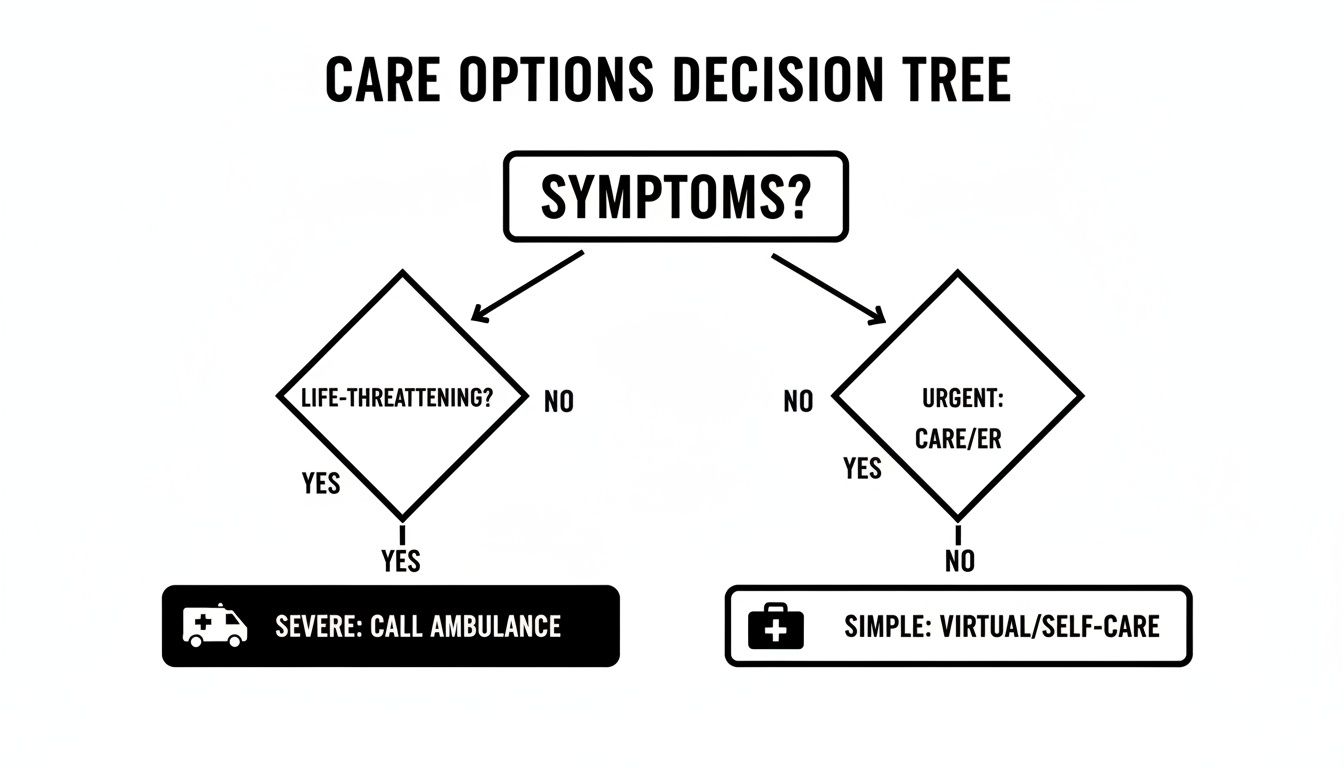
This visual guide reinforces the core principle: match the severity of your medical issue to the right level of care. By following this simple framework, you can move from uncertainty to action, empowered to make the right call every single time.
Common Questions About Medical Care
Trying to figure out healthcare options can leave your head spinning. When it comes down to choosing between urgent care and the emergency room, a few key questions always come up. Here are the straight answers you need to make the right call.
Can an Urgent Care Center Prescribe Medication?
Yes, absolutely. The doctors and nurse practitioners at an urgent care center can definitely write prescriptions. They frequently prescribe antibiotics for things like strep throat or UTIs, anti-inflammatory drugs for sprains, and even short-term pain relievers.
However, they generally won't prescribe long-term medications for chronic conditions or controlled substances like opioids. That’s a job for your primary care physician, who knows your full health history. Urgent care is there to fix the immediate problem, not to manage your ongoing health.
What Should I Do If Urgent Care Sends Me to the ER?
If an urgent care provider tells you to go to the emergency room, you need to go—right away. This isn't just a friendly suggestion; it's a professional medical judgment that your condition is more serious than it seems or requires a level of care they can't provide on-site.
An urgent care clinic might stabilize you first, but they’ll send you directly to the ER for critical issues like:
- Symptoms that point to a heart attack or stroke.
- A complex bone break that needs immediate surgery.
- An illness that requires you to be admitted to the hospital.
- The need for advanced diagnostic tests, like a CT scan, that are only available at a hospital.
Trust their assessment. Their top priority is your safety, and they are trained to recognize the signs of a true medical emergency.
Is It Safe to Use Telemedicine for a Diagnosis?
For the right kinds of conditions, telemedicine is an incredibly safe and effective way to get care. Text-based services are perfect for common, low-risk issues where a hands-on physical exam isn't necessary for an accurate diagnosis. Think urinary tract infections, sinus infections, pink eye, and certain skin rashes.
Telemedicine platforms are built around strict safety protocols. Doctors use detailed patient intake forms and their own clinical expertise to decide if a problem can be handled remotely. If there’s any doubt or a hint of something more serious, they will immediately tell you to go get in-person care.
Essentially, telemedicine is fantastic at filtering out the straightforward stuff, which helps free up clinics for people with more complex issues.
Do I Need an Appointment for Urgent Care?
Nope, you almost never need an appointment for urgent care. One of its biggest advantages is the walk-in model, which lets you get help right when you need it without having to schedule ahead. While some centers let you check in online to save your spot in line, it's rarely required. For a deeper dive into other common questions, check out our detailed frequently asked questions about online medical care.
Still have questions or need immediate care for a non-emergency issue? ChatWithDr offers 24/7 text-based consultations with board-certified physicians for just $39.99. Get a diagnosis, treatment plan, and prescriptions sent to your pharmacy in hours, not days. Visit https://chatwithdr.com to start your consultation now.
Related posts:
 Best Telemedicine Platforms: best telemedicine platforms for 2025
  How Does Telemedicine Work Your Guide to Virtual Care in 2026
  How to Get Medical Care Without Insurance Your Practical Guide
  The 7 Best Online Doctor Services of 2025: A Detailed Review
  Explore do you need insurance for urgent care and what it means for your visit