

If you don't have insurance, the idea of getting a prescription can feel overwhelming. You might be picturing long waits at a walk-in clinic and unpredictable, sky-high bills. But the truth is, telehealth has completely changed the game, offering a much simpler and more affordable path forward.
Telehealth services are built to serve people directly, especially those paying out of pocket. For a simple, flat fee, you can connect with a licensed U.S. doctor for a virtual consultation and have a prescription sent straight to your local pharmacy. It’s a secure, legal, and private way to get the care you need, no insurance card required.
Online vs Traditional Prescriptions When Uninsured
When you're paying yourself, every dollar and minute counts. It's helpful to see just how different the two paths—online telehealth versus a traditional in-person visit—really are.
Here’s a quick look at the differences:
| Factor | Online Telehealth Consultation | Traditional In-Person Visit |
|---|---|---|
| Cost | Typically a flat, upfront fee (e.g., $30-$75) | Varies widely; can be $100-$300+ for the visit alone |
| Time Commitment | A few hours from start to finish | Can take half a day (travel, waiting room, appointment) |
| Convenience | Consult from anywhere, anytime (24/7) | Requires travel to a clinic during business hours |
| Process | Secure online form or text-based chat | Paperwork, waiting room, in-person exam |
| Privacy | Discreet and private, from your own home | Less private due to public waiting areas |
As you can see, the online route cuts out the biggest pain points for uninsured patients: surprise costs and wasted time. It puts you back in control of your healthcare experience.
The Modern Way to Get a Prescription
So, how does it actually work? Instead of trying to schedule an appointment, you simply fill out a secure online intake form where you describe your symptoms and medical history. A board-certified physician reviews your information, confirms a diagnosis, and—if it's the right call—sends an e-prescription to whatever pharmacy you choose.
The whole thing is often done through text, which is great for privacy and lets you get on with your day. This efficiency is exactly why the online prescription market is booming.
Globally, the online prescription refill market hit USD 25.3 billion in 2023 and is on track to nearly double, reaching almost USD 54.7 billion by 2032. This isn't just a niche trend; it’s a major shift driven by people—especially those without insurance—who are looking for smarter, more convenient ways to manage their health.
This flowchart shows just how much simpler the online process is.
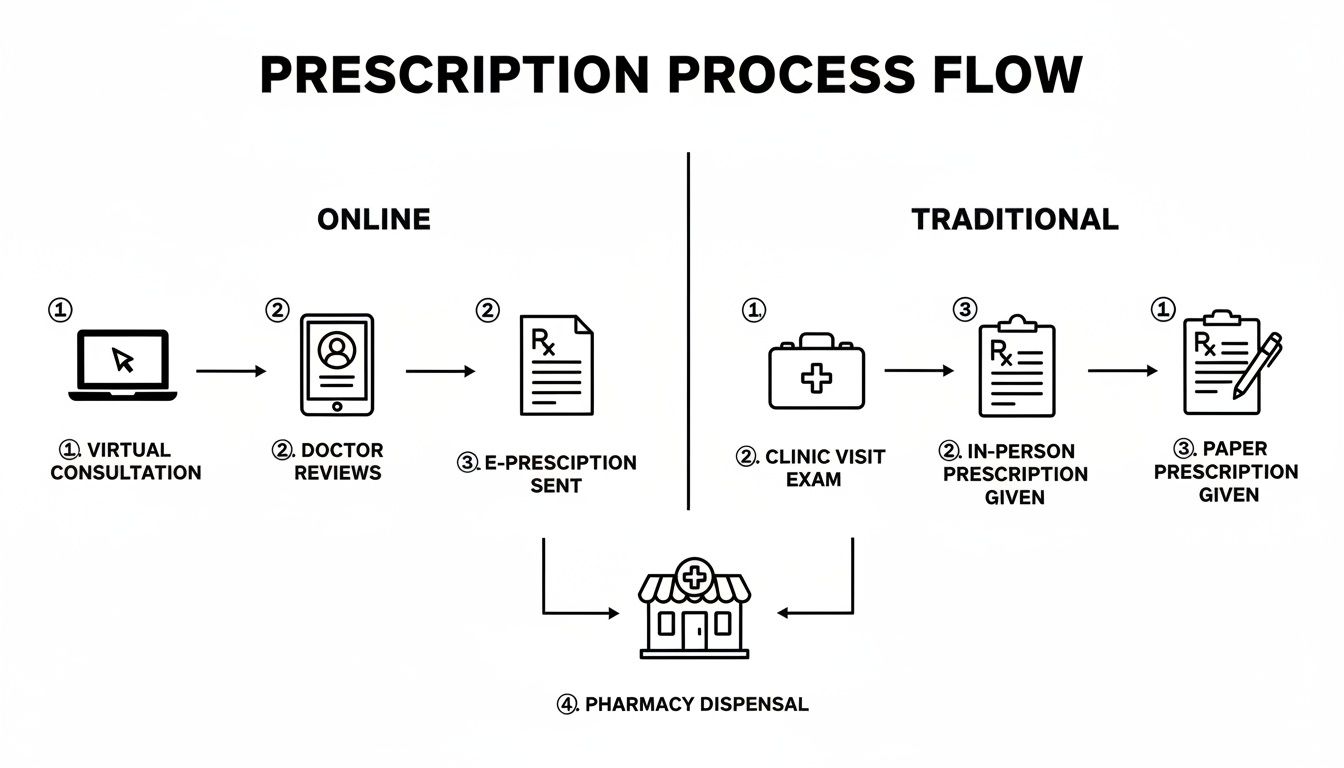
As the visual makes clear, the online route cuts out several time-consuming steps, connecting you directly from consultation to prescription pickup.
Knowing All Your Options
While telehealth is an incredible tool for many common conditions, it’s always smart to be aware of all your options. When you’re navigating healthcare without insurance, exploring readily available non-prescription treatments can be a great first step to manage your needs and keep costs down.
It also helps to understand the full scope of various telehealth services to see what works best for your specific situation. That way, you can be sure you’re getting the right care at the right time.
Finding The Right Online Prescription Service

With dozens of telehealth platforms out there, figuring out where to even start can feel like a job in itself. When you're paying out of pocket, the stakes are even higher. You need a service that’s not just effective, but also transparent and genuinely affordable. The real goal is to find a platform that offers clear, flat-fee pricing so you can sidestep the surprise bills that are all too common in traditional healthcare.
Ultimately, the right service depends entirely on what you need right now. Are you looking for a quick, one-time consultation for something straightforward like a sinus infection? Or do you just need a simple refill for an ongoing, stable condition like high blood pressure? Different platforms excel in different areas, so matching the service to your situation is the key to a good experience.
Key Factors For Uninsured Patients
When you don’t have an insurance company vetting providers for you, that responsibility lands squarely on your shoulders. It's up to you to look for specific markers of quality and legitimacy to ensure you’re getting safe, effective care. This is about more than just saving money; it’s about your health.
Here are the critical things I always tell people to check:
- State Licensing and Credentials: This is non-negotiable. Make sure the service uses U.S. board-certified and state-licensed physicians. A legitimate platform will always make this information easy to find.
- Transparent Pricing: Look for a simple, one-time consultation fee. Be very wary of services that try to push you into a subscription you don't need or have vague, hidden charges. For example, ChatWithDr offers a flat $39.99 consultation fee, so you know the exact cost before you even start.
- Conditions Treated: Take a minute to check the platform’s website to see if they handle your specific health concern. Most services clearly list the conditions they treat, which can range from urgent care issues like UTIs to ongoing needs like birth control refills.
Important Takeaway: The best online prescription services for uninsured patients prioritize clarity above all else. They make it easy to understand the cost, the process, and the qualifications of their medical team before you ever have to pull out your wallet.
Matching a Service to Your Needs
Let's walk through a real-world scenario. Imagine you wake up with the classic, tell-tale signs of pink eye. You don’t have a primary care doctor, and you know an urgent care visit without insurance could easily cost over $150. This is a perfect situation for a direct-to-consumer telehealth service. You need a platform that specializes in common, non-emergency conditions and promises a fast turnaround.
In this case, a service like ChatWithDr is an ideal fit. You can fill out a secure online form describing your symptoms, and a doctor can review your case and send a prescription for medicated eye drops straight to your local pharmacy—often within just a couple of hours. This is worlds more efficient than spending half your day and a big chunk of money at a walk-in clinic. Learning more about how an online doctor can treat specific conditions is a great next step.
This shift toward online healthcare isn't just a small trend. A recent U.S. survey found that 38% of adults have bought prescription medicines online, and a whopping 55% of them now get most or all of their prescriptions this way. This is largely driven by uninsured individuals, who find that telehealth services—used by 29% of online buyers—are an absolute lifeline. You can explore more data on these consumer habits in the full ASOP Foundation survey.
Telehealth Evaluation Checklist
To make the process of choosing a platform a little less daunting, I've put together a simple checklist. It focuses on what truly matters when you need to get a prescription online without insurance. Use this to compare different services side-by-side.
| Feature To Check | Why It Matters For Uninsured Patients | What To Look For |
|---|---|---|
| Consultation Fee | This is your main cost. You need it to be predictable and affordable, with no surprises. | A single, flat fee with no recurring charges or hidden costs. |
| Physician Licensing | This ensures you are receiving care from a qualified, legal, and accountable medical professional. | Clear statements that all doctors are U.S.-based and board-certified in their state. |
| HIPAA Compliance | This federal law protects your sensitive personal health information from being exposed. | A privacy policy that explicitly mentions HIPAA compliance and secure data handling. |
| Turnaround Time | When you're feeling sick, you need a prescription quickly, not days from now. | Services that promise a diagnosis and prescription within a few hours. |
| Customer Support | If there’s an issue with your consultation or prescription, you need a way to get help fast. | Easy-to-find contact information, a phone number, or a responsive support chat. |
By systematically running through these points, you can confidently pick a service that fits your budget, addresses your health needs, and provides a safe, legitimate medical experience from start to finish.
Making Your Virtual Consultation A Success
Your virtual consultation is the most important part of getting a prescription online without insurance. The key is to think of it less like a traditional doctor's visit and more like you're preparing a clear, concise case for the physician. A few minutes of prep work before you even log on can make all the difference in the quality of care you receive.
The foundation of any good diagnosis, online or off, is your medical history and a solid description of your symptoms. Most telehealth platforms, including ChatWithDr, use secure, HIPAA-compliant intake forms to gather this info. Don't just rush through them. Be specific and be honest—this is your primary channel of communication with the doctor.
Preparing Your Information For The Doctor
Before you even start typing in that intake form, a little prep work goes a long way. I have a personal checklist I run through anytime I use a telehealth service, and it makes the entire experience smoother and far more effective.
My pre-consultation checklist always includes:
- A timeline of your symptoms: When did they start? Have they gotten worse, better, or stayed the same? For example, instead of just saying "I have a cough," try "My dry cough started three days ago, was worst at night, and is now producing yellow mucus."
- A list of your current medications: This means everything—prescriptions, over-the-counter drugs, vitamins, and supplements. Dosages are critical, so it helps to have the bottles handy.
- A note of any allergies: This is non-negotiable for your safety. Make sure you list any known medication allergies.
- A list of your specific questions: Worried about side effects? Wondering how long you'll be contagious? Write your questions down so you don’t forget to ask in the moment.
Even if you're just doing a text-based chat, find a quiet, private space. You need to be able to focus without distractions to give accurate information and fully understand the doctor's treatment plan.
Understanding What Telehealth Treats Best
It's also crucial to have realistic expectations about what can be handled effectively online. Telehealth is an incredible tool, but it's not a silver bullet for every medical issue. Knowing the difference ensures you get the right level of care for your specific problem.
Online doctors are perfectly suited for diagnosing and treating a huge range of common, non-emergency conditions—basically, any issue where a hands-on physical exam isn't absolutely necessary for an accurate diagnosis.
Key Insight: The success of an online consultation hinges on whether the condition is right for a remote evaluation. For many routine health concerns, a detailed history and a clear description of your symptoms give a licensed physician more than enough information to make an expert diagnosis.
Here are just a few examples of conditions that are ideal for an online consultation, especially when you need to get a prescription without insurance:
- Urgent Care Issues: Sinus infections, urinary tract infections (UTIs), pink eye, bronchitis, and sore throats.
- Skin Conditions: Acne, rashes, eczema, and mild skin infections where a photo can help the doctor see exactly what's going on.
- Medication Refills: Getting a new prescription for ongoing, stable conditions like high blood pressure, asthma, or birth control.
- Women's & Men's Health: Yeast infections, erectile dysfunction, and hair loss are all common issues that can be managed effectively through telehealth.
When To Seek In-Person Care Instead
Just as important is knowing when an online consultation is not the right move. Your safety is always the top priority, and some symptoms are red flags that demand an immediate, in-person evaluation. Telehealth platforms are ethically and legally required to direct you to emergency services if your symptoms point to a serious condition.
You should head straight to an urgent care clinic or an emergency room for any of the following:
- Severe chest pain or difficulty breathing
- Sudden weakness, numbness, or difficulty speaking
- Major injuries, like deep cuts or suspected broken bones
- A high fever that isn't responding to medication
- Severe abdominal pain
By understanding which conditions are a good fit for telehealth, you set yourself up for a successful and safe experience, making sure you get the right care, right when you need it.
How To Manage Prescription Costs Out Of Pocket
When you're getting a prescription online without insurance, you basically become the CFO of your own healthcare. Every dollar counts, and every decision hits your wallet directly. It all boils down to tackling two main expenses: the doctor's consultation fee and the actual price of the medicine.
The first part, the consultation fee, is where telehealth really shines. Forget the mystery bill that shows up weeks after a traditional clinic visit. The best online platforms give you a single, flat fee right up front. That transparency is a total game-changer.
Take a service like ChatWithDr, for example. They charge a simple, straightforward $39.99 for a consultation. No hidden fees, no surprise charges, and no mandatory subscriptions. It puts you in the driver's seat, letting you get care exactly when you need it without getting locked into recurring payments.
Strategies For The Consultation Fee
Your main goal should be to find that kind of one-time, predictable pricing. Be wary of services that push you into a monthly membership unless you have a chronic condition that actually requires frequent check-ins. For most people who just need a one-off prescription, a flat-fee service is hands-down the smartest financial move.
Before you commit, always spend a minute on the platform’s pricing page. Make sure they clearly spell out the total cost and what you get for it. This simple check helps you dodge any surprises and budget with confidence. For anyone navigating their own medical expenses, understanding these different pricing models and strategies for managing healthcare costs is absolutely essential.
Slashing Costs At The Pharmacy Counter
Once you have your e-prescription in hand, you'll face the second—and often bigger—cost: the medication itself. This is where a little bit of smart shopping can save you a ton of cash. Never, ever assume the first price you're quoted is the only one.
The retail price of a drug can be wildly different from one pharmacy to the next, even for the exact same medication. A prescription that costs $50 at a big-name chain might be just $20 at the supermarket pharmacy right down the street.
Pro Tip: Your single most powerful tool for saving money is price comparison. Don't just send your prescription to the closest pharmacy out of habit. A few minutes of research can easily cut your medication costs in half.
Start by using a free prescription discount app or website like GoodRx, SingleCare, or Blink Health. These services instantly show you the discounted price for your specific medication at different local pharmacies. All you have to do is show the pharmacist the coupon code on your phone to get the lower price. It's that easy.
Practical Savings In Action
Let's walk through a common scenario. Imagine your online doctor prescribes a 30-day supply of amoxicillin for a bacterial infection. The standard cash price without insurance might be around $25.
But with a quick search on a discount app, you could find a coupon that drops the price to $10 at Walmart or maybe $12 at a local grocery store pharmacy. That’s an instant savings of over 50% for about a minute of your time.
Here are a few more actionable tips to really maximize your savings:
- Always Ask for Generic: When you talk to your online doctor, make a point to request the generic version of any medication if one exists. Generics are the same exact active ingredient as their brand-name counterparts but often cost 80-85% less.
- Compare Big Box Stores: Don't forget to check pharmacies inside stores like Walmart, Costco, and Sam's Club. They often have some of the lowest cash prices on common generics, and you don't always need a membership to use their pharmacy services.
- Look into 90-Day Supplies: If you're on a long-term medication, ask your doctor if a 90-day prescription would work for you. Buying in larger quantities can often lower the per-dose cost significantly, saving you both money and trips to the pharmacy.
By pairing a low-cost, flat-fee consultation with savvy shopping at the pharmacy, you can make the entire process of getting a prescription online without insurance both affordable and predictable.
How To Safely Receive And Fill Your E-Prescription
Once your online doctor gives your treatment the green light, you’re on the home stretch. The last step is getting your electronic prescription—or e-prescription—sent from the telehealth platform straight to your pharmacy. This whole process is designed to be quick, smooth, and get your medication into your hands as fast as possible.
You'll typically get a heads-up via email or text from the telehealth service confirming your prescription is on its way. At the exact same time, the pharmacy’s system gets the order. This digital handshake completely sidesteps old-school problems like losing a paper script or trying to figure out a doctor's handwriting.
The Secure Journey Of Your E-Prescription
Think of an e-prescription as a locked digital message. It travels through a protected network called Surescripts, which is the industry standard connecting doctors and pharmacies all over the country. The entire system is HIPAA-compliant, making sure your personal health information stays private from start to finish.
When you finish your consultation with a service like ChatWithDr, you just pick your local pharmacy from a dropdown list. The second the doctor finalizes your prescription, it’s encrypted and zapped directly to that pharmacy's computer. The order then just pops up in the pharmacist's queue, ready to be filled.
This modern system is a huge part of why online healthcare is booming. The global online pharmacy market, which includes these convenient prescription services, was valued at USD 112.46 billion in 2024. It's projected to skyrocket to USD 464.17 billion by 2033, which is a massive signal that patients—especially those paying out of pocket—are all-in on this model. You can see the full breakdown in this in-depth market analysis from Straits Research.
What If You Choose The Wrong Pharmacy?
It happens more than you’d think. In the rush to get your consultation done, you might accidentally click on a pharmacy across town or an old one you haven’t used in years. Don’t panic—it’s a common mix-up and easy to fix.
Your first move is to contact the telehealth service's customer support right away. Don't call the pharmacy first. By law, they can’t transfer a prescription to another location until it’s been filled at least once. The telehealth provider, on the other hand, still has control of the original order.
Just explain what happened and give them the correct pharmacy's name and address. Most good services can cancel the first e-prescription and resend it to the right spot in just a few minutes. The key is to act fast to avoid any delays.
Crucial Tip: Before you head out, it's always smart to call the correct pharmacy to confirm they’ve received the new e-prescription. A quick 30-second call can save you a completely wasted trip.
How To Spot And Avoid Prescription Scams
The convenience of online healthcare has, unfortunately, attracted some shady operators. To safely get a prescription online without insurance, you have to know how to tell a legitimate telehealth platform from a dangerous scam. The single biggest red flag is any website that offers to sell you prescription drugs without a real consultation with a licensed medical professional.
Legitimate online doctor services are legally required to have a licensed physician review your medical information and make a real diagnosis. Sketchy "online pharmacies" often skip this vital step, which isn't just illegal—it’s incredibly dangerous for your health.
Here are the warning signs of a fraudulent site:
- No Consultation Required: If a site lets you add prescription medicine to a shopping cart like you're buying a pair of socks, get out of there.
- Vague or Missing Doctor Information: Reputable platforms are proud of their medical teams and make it easy to find their credentials and state licenses.
- Promises of "Miracle Cures": Scammers love using over-the-top claims to sell their products. Real medicine doesn’t work like that.
- Lack of a U.S. Address or Phone Number: If you can’t find clear contact info for a U.S.-based company, it's almost certainly a rogue pharmacy operating from overseas.
By staying vigilant and sticking to trusted, established services, you can navigate the final steps of getting your medication with confidence, making sure your experience is not only affordable but, most importantly, safe.
Common Questions About Online Prescriptions
When you’re thinking about getting a prescription online without insurance, it’s natural to have a few questions. You want to know if it's safe, legal, and truly going to save you time and money.
Let's cut through the noise. Here are the clear, direct answers to the questions we hear most often, so you can move forward with total confidence.
Is It Legal To Get A Prescription Online Without Insurance?
Yes, absolutely. Getting a prescription online is 100% legal and safe, as long as you use a legitimate telehealth service that works with U.S.-licensed medical professionals.
The whole system is built on a simple, non-negotiable rule: a real doctor must conduct a genuine medical consultation before issuing any prescription. These aren't online pill mills; they are real healthcare providers held to the same strict HIPAA privacy standards as your local doctor's office. Your health information is always kept secure.
The key is to stick with services that require a medical review and avoid any website that offers to just sell you medication outright.
What Kinds Of Medications Can I Get Online?
Telehealth is a game-changer for a huge range of common, non-emergency medications. It’s perfect for getting quick access to treatments that don't require a hands-on physical exam.
You can typically get prescriptions for conditions like:
- Refills for Chronic Conditions: Stable, ongoing medications for high blood pressure, asthma, or thyroid issues.
- Common Infections: Annoying but treatable problems like UTIs, sinus infections, bronchitis, and pink eye.
- Lifestyle & Personal Health: Prescriptions for birth control, hair loss, erectile dysfunction, and skin conditions like acne or eczema.
It’s just as important to understand what you can't get. By law, online doctors are prohibited from prescribing controlled substances. This includes narcotics, certain stimulants like Adderall, and some anti-anxiety medications like Xanax. These drugs have a high potential for abuse and require a thorough, in-person evaluation.
Key Takeaway: The goal of telehealth is safe and appropriate care. If a doctor decides your condition is too complex, needs a physical exam, or might be an emergency, they won't write a prescription. Instead, they will tell you to seek in-person care.
A trustworthy service will not charge you for a consultation if they are unable to treat you. That patient-first approach is the sign of a platform you can rely on.
How Do I Get The Prescription To My Preferred Pharmacy?
This part is surprisingly simple and built right into the process. When you're filling out your information, the platform will ask you to choose your local pharmacy.
You can usually search by zip code to find a list of nearby options—from major chains like CVS and Walgreens to the pharmacy inside your grocery store or your local independent drugstore. Just pick the one you want, and the e-prescription is sent there automatically once the doctor approves it.
Here’s a pro tip I always share: use a price comparison tool like GoodRx before you start your consultation to see which local pharmacy has the best price for your medication. Once you know, you can select that specific pharmacy in the telehealth app. If you accidentally pick the wrong one, don't worry. A quick message to customer support can usually get the prescription resent to the right place.
If you have more questions, a good telehealth FAQ page is your best friend. It often covers everything from payment details to how the consultation works, clearing up any final uncertainties.
Ready for fast, affordable care without the hassle? ChatWithDr offers 24/7 online consultations with board-certified U.S. doctors for a flat $39.99 fee. Get a diagnosis, treatment plan, and prescription sent to your pharmacy in hours, not days.
Start your consultation now.