
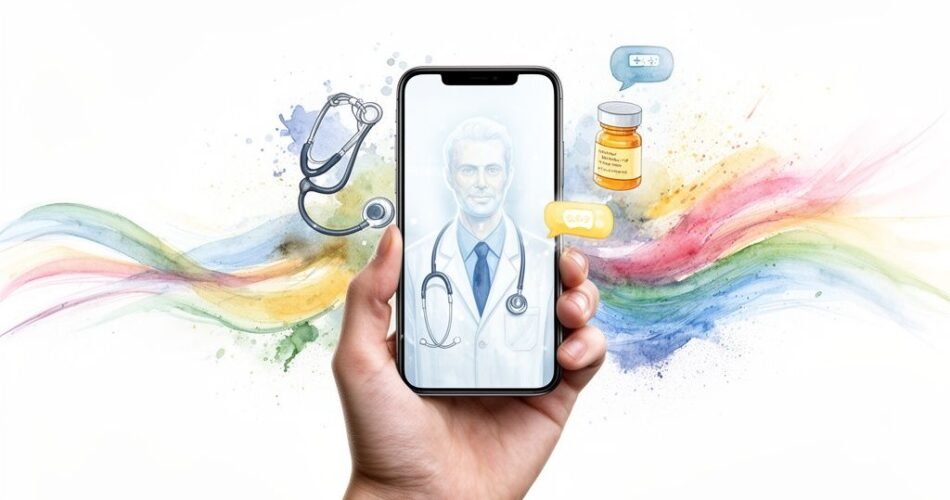
Ever wondered if getting medical care could be as easy as sending a text? That's the simple idea behind modern telemedicine. Instead of scheduling an appointment and driving to a clinic, you’re connecting with a doctor through a secure digital platform right from your phone or computer.
The Modern Doctor Visit Explained
Think of telemedicine as having a doctor in your pocket, ready to help when you need it. The whole process is designed to be simple and user-friendly, getting you care faster without ever leaving home.
A huge part of making this work smoothly is handling patient intake and scheduling efficiently. Many platforms rely on specialized medical appointment scheduling software to keep virtual care organized and accessible for both patients and providers.
How It Works From Start to Finish
At its core, telemedicine uses secure digital platforms to connect you with licensed physicians remotely. This setup gets rid of the need for in-person visits while still ensuring all your medical information is exchanged in a HIPAA-compliant way.
With a service like ChatWithDr, for example, you start by selecting your condition—maybe a UTI or a migraine—and filling out a quick online form about your symptoms and medical history. Within 1-2 hours, a board-certified U.S. doctor reviews your info, makes a diagnosis, creates a personalized treatment plan, and sends an e-prescription straight to your favorite pharmacy.
The real magic of this model, especially with text-based services like ChatWithDr, is its asynchronous nature. This means you and the doctor don't have to be online at the exact same time, giving you total flexibility to get care on your own schedule.
Key Steps in a Telemedicine Visit
The patient journey is usually broken down into a few clear steps that are all about speed and convenience. It generally follows this flow:
- Initial Intake: You start by filling out a secure online form, which is a lot like the paperwork you’d complete at a clinic.
- Physician Review: A licensed doctor reviews all the information you submitted, including your symptoms and medical history.
- Diagnosis and Treatment: The doctor provides a clear diagnosis and a personalized treatment plan designed just for you.
- Prescription Fulfillment: If you need medication, a prescription is sent electronically to your chosen pharmacy for easy pickup.
Your Step-by-Step Patient Journey
So, what does a telemedicine visit actually look like from your side of the screen? It's one thing to talk about the concept, but it's much easier to grasp when you can see the whole journey from start to finish. Let’s walk through a common scenario to show you just how simple and direct it can be.
Imagine waking up with those tell-tale signs of a sinus infection: facial pressure, congestion, and a headache that just won't quit. Instead of blowing up your whole day calling a clinic, waiting for an appointment, and then driving to an office, you just open a web browser and go to a platform like ChatWithDr. The whole thing unfolds in a few logical steps built for speed and simplicity.
Step 1: The Initial Intake
First things first, you’ll select your condition from a list of common ailments. From there, you're guided to a secure online intake form. Think of this as the digital version of the clipboard you get at a doctor's office, but much faster.
You’ll provide the essential details about your symptoms, your medical history, any medications you’re currently taking, and known allergies. This structured information gives the physician a complete, clear picture of what's going on before they even start their review, which is crucial for a safe and accurate diagnosis.
Step 2: The Physician Review
Once you hit submit, the real magic of asynchronous telemedicine kicks in. Your case is securely sent to a board-certified, state-licensed physician. They will meticulously review all the information you provided—this isn't just a quick glance.
The doctor assesses your symptoms in the context of your medical history to form a professional opinion, just as they would if you were sitting in their office.
This “store-and-forward” model is the secret sauce that makes this kind of telemedicine so efficient. It respects both your time and the doctor's, allowing for a thoughtful, unhurried medical review without the pressure of a scheduled appointment slot.
This simple, three-step process is the backbone of how many text-based telemedicine platforms work.

As you can see, it’s a straight shot from your input to a professional review and a clear outcome.
Step 3: Diagnosis and Prescription
Within a surprisingly short time—often just 1-2 hours on services like ChatWithDr—you get a notification. The doctor provides a diagnosis, a personalized treatment plan explaining their recommendations, and, if it’s medically necessary, sends an e-prescription straight to your preferred local pharmacy.
You simply get a text or email when your prescription is ready for pickup. The entire journey, from feeling sick to having medication ready, happens without you ever having to leave home. For anyone with a packed schedule, it’s a total game-changer.
To really put the convenience in perspective, let’s compare this new way of getting care with the traditional song-and-dance of an in-person visit.
Telemedicine Visit vs Traditional In-Person Visit
| Stage | Telemedicine (e.g., ChatWithDr) | Traditional In-Person Visit |
|---|---|---|
| Scheduling | No appointment needed; start anytime. | Call the office, find an open slot, potentially wait days. |
| Travel & Wait Time | 0 minutes. | 30-90+ minutes (travel, parking, waiting room). |
| Consultation | ~5-10 minutes to fill out a form on your own time. | 10-20 minute appointment slot, plus check-in/out. |
| Total Time Spent | ~15 minutes of active time. | 2-3 hours from start to finish. |
| Outcome | Diagnosis and prescription sent to pharmacy within 1-2 hours. | Leave with a paper script or wait for it to be called in. |
| Cost | Often a single, transparent flat fee. | Copay, potential deductible costs, and hidden travel/time-off expenses. |
The difference is stark. While traditional visits will always have their place, telemedicine has completely transformed the experience for common, straightforward health issues by cutting out all the logistical dead weight.
Behind The Screen: A Doctor's Perspective

Once you’ve hit "submit" on your intake form, your part is done for now, but the medical process is just getting started. On the other side of the screen, your secure file is instantly sent to a state-licensed, board-certified physician. This isn't just a quick glance; the doctor performs a comprehensive review of your symptoms, medical history, and any photos you provided—just like they would in a traditional clinic.
This is where the real power of asynchronous telemedicine, also known as “store-and-forward” care, comes into play. It’s a fancy term for a simple, brilliant concept: you and the doctor don't need to be online at the same time. This model is a huge part of why telemedicine works so well for everyone involved.
You can send your information at 2 AM when a migraine strikes, and a doctor can thoughtfully review your case at 8 AM, free from the time pressures of back-to-back appointments. This allows for a more focused and unhurried diagnostic process.
The Diagnostic And Treatment Workflow
After analyzing your file, the physician gets to work formulating a professional diagnosis and a personalized treatment plan. Their process involves a few key steps:
- Evidence-Based Review: They cross-reference your symptoms and history with established medical guidelines to make sure the diagnosis is both accurate and safe.
- Safety Checks: The doctor carefully reviews your allergies and current medications to prevent any potential drug interactions with a new prescription. This is a critical safety step.
- Plan Formulation: They create a clear treatment plan that might include medication, practical self-care advice, and guidance on when to seek in-person follow-up if your symptoms don’t improve.
Finally, if medication is appropriate, the doctor uses a secure system to send an e-prescription directly to your chosen pharmacy. This seamless electronic process is a core part of modern healthcare, ensuring both accuracy and speed. If you want a closer look, you can explore what it's like to consult with an online doctor for common conditions.
This entire physician-led workflow is a testament to telemedicine's efficiency. Its explosive growth is fueled by text-based models that deliver diagnoses 80-90% faster than typical ER waits. The U.S. market, which hit USD 74.80 billion in 2023, is projected to soar to over USD 528 billion by 2035, underscoring just how central it's becoming to healthcare. You can read more about these telehealth market trends and their drivers online.
The Technology Keeping Your Care Secure

Convenience is a huge draw for telemedicine, but it’s only natural to wonder: how safe is my private medical information? The reality is that trusted telemedicine platforms are built on robust technology designed to protect your data with the same level of security as a physical doctor's office—if not more.
The entire system is governed by a critical federal law known as the Health Insurance Portability and Accountability Act (HIPAA). It’s the gold standard that mandates strict privacy and security rules for all your health data.
Think of HIPAA compliance as the digital equivalent of a clinic’s locked file cabinets and private consultation rooms. It legally requires telemedicine providers to use specific safeguards to protect your sensitive information from anyone who isn't authorized to see it, ensuring your virtual visit stays completely confidential.
This deep commitment to security is a cornerstone of how modern telemedicine works. You can learn more about how platforms like ChatWithDr implement these standards by reviewing our detailed privacy policy.
The Encryption Armored Truck
To enforce those strict HIPAA standards, telemedicine platforms rely on powerful encryption. This technology acts like a digital armored truck, scrambling your information into an unreadable code as it travels between your device and the doctor's screen. Only authorized people with the right "key"—in this case, your doctor—can unscramble and view it.
This process ensures that even in the incredibly unlikely event that your data is intercepted, it remains completely useless to anyone without the proper key. It secures everything you share, including:
- Your personal identity and contact information
- Your detailed medical history and symptoms
- Any photos you upload for the physician
- The diagnosis and treatment plan from your doctor
Seamless and Secure E-Prescribing
Another key piece of the technology puzzle is the e-prescribing system. When your doctor determines you need medication, they don't just email a script to the pharmacy. Instead, they use a secure, integrated system that communicates directly with pharmacy networks nationwide.
This direct line of communication is a game-changer. It minimizes errors and ensures your prescription is sent instantly and securely to your chosen pharmacy. For patients using a service like ChatWithDr, this entire HIPAA-secure ecosystem—from the initial intake to the final e-prescription—is accessible right from a simple web browser. You don’t need any special downloads or technical skills.
It's this secure, cloud-based framework that has allowed the industry to boom. The global market is projected to grow from USD 196.81 billion in 2025 to over $1.3 trillion by 2035. This staggering growth is built on a foundation of trust and technology that keeps your care both convenient and completely private.
Common Conditions Treated with Telemedicine
While the technology driving telemedicine is impressive, its real value is in how it helps with everyday health concerns. The best way to understand how telemedicine works is to see what it’s actually used for. It’s a powerful tool, but it's specifically designed for common, non-emergency situations where a hands-on physical exam isn't necessary.
Telemedicine truly shines when it comes to handling a wide range of common, low-acuity conditions quickly and effectively. For many people, this means getting a diagnosis and treatment plan for sudden issues without ever leaving home. This is especially true for text-based platforms like ChatWithDr, where convenience is the name of the game.
Urgent But Not an Emergency
So many urgent care needs are a perfect fit for a virtual consultation. These are the kinds of issues that need prompt medical attention but aren't life-threatening. Think of it as a digital express lane for those common illnesses that pop up out of nowhere.
Examples include:
- Sinus Infections: A doctor can easily assess symptoms like congestion, facial pressure, and headache to prescribe the right medication.
- Urinary Tract Infections (UTIs): Based on your reported symptoms, a physician can quickly diagnose a UTI and prescribe antibiotics to get you relief, fast.
- Pink Eye (Conjunctivitis): By describing your symptoms or snapping a quick photo, you can get a diagnosis and a prescription for eye drops.
- Skin Rashes and Acne: Dermatology is a great use case for telemedicine, since clear photos often give a doctor all the visual information they need.
CRITICAL REMINDER: Telemedicine is NOT for emergencies. For any life-threatening symptoms—such as chest pain, difficulty breathing, severe bleeding, or signs of a stroke—you must call 911 or go to the nearest emergency room immediately.
Ongoing and Specialized Care
Beyond just one-off illnesses, telemedicine is also a game-changer for managing ongoing health needs and certain specialized areas of care. This is a huge help for patients who need consistent medical support without the hassle of frequent in-person visits.
For example, getting prescription refills for stable, chronic conditions like high blood pressure or diabetes can often be handled virtually. If your condition is well-managed and you don’t need any new physical exams, a telemedicine doctor can review your history and authorize a refill.
It also provides a discreet and incredibly accessible option for sensitive health topics:
- Women's Health: Easily get consultations for birth control, yeast infections, and other common concerns.
- Men's Health: Access treatment for conditions like erectile dysfunction (ED) or hair loss with complete privacy and comfort.
This flexibility makes telemedicine an essential tool for a huge spectrum of non-critical health needs, perfectly bridging the gap between a minor inconvenience and a full-blown doctor's office visit.
Let's talk money.
Whenever healthcare is involved, the cost is one of the first—and most important—questions on everyone's mind. The good news is that the financial side of telemedicine is often far simpler and more transparent than traditional healthcare. In many ways, it's designed to take the frustrating guesswork out of medical billing.
For many platforms that connect you directly with a doctor, the pricing is refreshingly straightforward. With a service like ChatWithDr, for example, you pay a single, flat fee of $39.99 for the entire consultation. That’s it. No surprise copays, no confusing deductible math, and zero hidden facility charges. You know the full cost before you even start.
Making Payments Easy and Accessible
This kind of clear, upfront pricing is a huge relief, especially for people who are uninsured or stuck with a high-deductible plan. To make things even easier, these services usually offer a few different ways to pay.
- Credit and Debit Cards: The standard, quick-and-easy option is always there.
- HSA/FSA Cards: Many platforms, including ChatWithDr, let you use your Health Savings Account (HSA) or Flexible Spending Account (FSA) card. This is a fantastic way to pay for your visit with pre-tax dollars, making care even more affordable.
Here’s a key point that often gets missed: the fee for the consultation and the cost of your medication are handled separately. You pay the telemedicine service for the virtual visit, but you can still use your regular health insurance at the pharmacy for your prescription.
What Happens at the Pharmacy?
This separation is actually what helps telemedicine fit so smoothly into the rest of the healthcare system. After your online doctor sends your e-prescription, you just head to your usual pharmacy to pick it up.
Once you're there, you hand over your insurance card just like you would after any other doctor's appointment. Your insurance plan's pharmacy benefits kick in, and you'll only pay your standard copay or coinsurance for the medication. It's a hybrid approach that gives you the best of both worlds: the affordable convenience of a quick telemedicine visit combined with the medication coverage you already have.
Your Telemedicine Questions Answered
Feeling more confident about virtual care but still have a few lingering questions? You're not alone. As telemedicine becomes a bigger part of our healthcare routine, it’s only natural to wonder about the specifics. Let's tackle some of the most common questions people have when they first start exploring how it all works.
Lots of patients start with this one: "Is it really as effective as seeing a doctor in person?" For a huge range of common, non-emergency conditions, the answer is a definite yes. Study after study, along with real-world results, show that for issues like sinus infections, UTIs, and simple prescription refills, the quality of care and patient outcomes are just as good as a traditional visit.
Can an Online Doctor Prescribe Medication in My State?
This is another big one, and the answer gets to the heart of how legitimate platforms are set up. Reputable telemedicine services like ChatWithDr only work with board-certified, state-licensed physicians. This means the doctor who reviews your case is legally allowed to practice medicine and prescribe medication in the state where you're located. It's how they ensure every prescription is safe, valid, and fully compliant with state regulations.
There are rules governing this, of course. For example, some regulations might require an in-person visit every 12 months for telemental health, but these rules are constantly evolving. The key takeaway is that the platform handles all the licensing verification for you, so you can be sure you're always connected with a qualified local provider.
The entire system is built on a foundation of trust and legality. By matching you with a physician licensed in your specific state, telemedicine platforms ensure that the care you receive meets the same high standards you would expect from any local clinic.
What if I Need a Lab Test or Physical Exam?
This question highlights the true scope of telemedicine. Virtual care is incredibly effective, but it has its limits. A responsible online doctor knows exactly when a condition requires a hands-on assessment, lab work, or imaging.
If your symptoms point to something that can't be diagnosed or treated from a distance, the physician will tell you straight up. They'll explain why an in-person visit is necessary and recommend that you see a local doctor, visit an urgent care clinic, or, in serious cases, head to an emergency room. Telemedicine is designed to complement in-person care, not replace it entirely. It’s all about making sure you get the right level of attention—fast and conveniently when possible, and in-person when it's medically necessary. If you have more questions, you can find further details in our comprehensive telemedicine FAQ guide.
Ready to experience how fast and easy healthcare can be? With ChatWithDr, a licensed U.S. doctor is just a few clicks away, 24/7. Get a diagnosis, treatment plan, and prescription in hours for just $39.99—no appointment or video call needed. Start your consultation now.
Related posts:
 Best Telemedicine Platforms: best telemedicine platforms for 2025
  The Ultimate Guide to Choosing a Telemedicine Service Provider
  The 7 Best Online Doctor Services of 2025: A Detailed Review
  What Is an Asynchronous Telehealth Visit and How Does It Work
  How to Get Medical Care Without Insurance Your Practical Guide