

So, how much does an urgent care visit actually set you back? Without insurance, you’re typically looking at a starting price of $150 to $250 for a basic visit. Think of that as the entry fee—anything extra like lab work, an X-ray, or stitches will add to the final bill.
Your Urgent Care Bill Explained in 60 Seconds
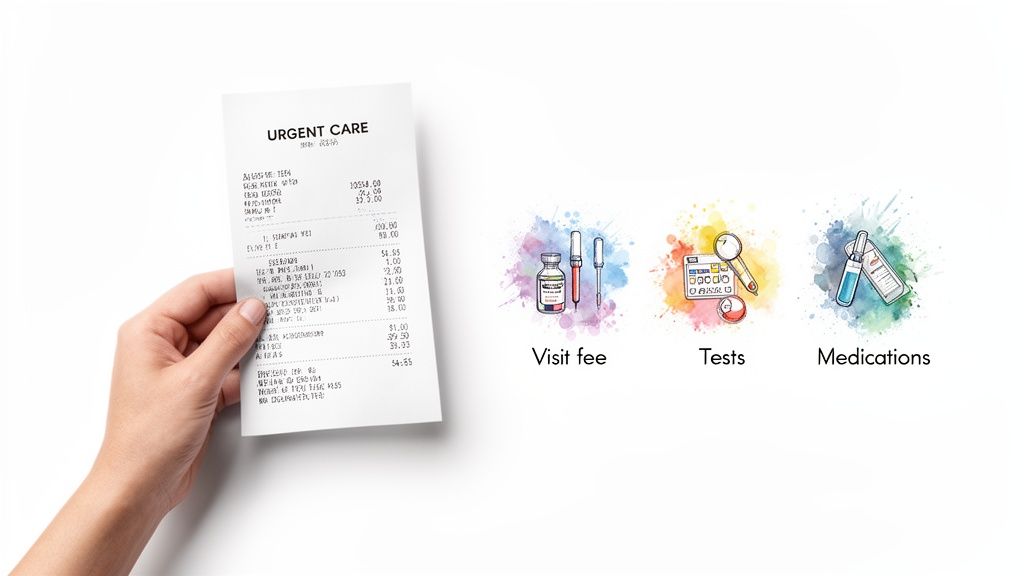
Trying to figure out your urgent care bill is a bit like ordering from a restaurant menu. There's a base price just for showing up (the visit fee), but your total really depends on what you "order" while you're there.
A simple chat with a doctor about a sinus infection will cost a lot less than treating a sprained ankle that needs an X-ray and a brace. That simple concept is the key to managing your healthcare spending. The initial fee covers the provider’s time for a basic exam, but the final price tag is the sum of every service you receive.
Let’s pull back the curtain and break down the individual pieces that make up that total cost. Knowing what to expect helps you anticipate the final bill before you even walk through the door.
Quick Look at Urgent Care Cost Components
Here’s a summary table that breaks down the common charges that build up your final urgent care bill. It gives you a clear snapshot of what to expect, from the basic visit fee to common add-on services for tests and treatments.
| Service Type | Typical Cost Range (Without Insurance) | Brief Description |
|---|---|---|
| Basic Visit Fee | $100 – $200 | Covers the consultation with a healthcare provider for a straightforward issue. |
| Lab Tests | $30 – $150+ | Includes services like rapid strep tests, flu swabs, or urinalysis. |
| X-Rays | $150 – $400 | The cost for diagnostic imaging, often needed for sprains or fractures. |
| Procedures | $150 – $500+ | Covers treatments like stitches for a cut, wound care, or abscess drainage. |
Keep these ranges in mind as we dig into each factor in more detail. Of course, these numbers can still feel a bit unpredictable when you’re on the spot.
For situations where you just need a clear, upfront price, understanding how telehealth works can be a fantastic, cost-effective alternative.
What Really Drives the Cost of Your Visit
The fee you see advertised for an urgent care visit is just the starting point. Think of it like a base fare for a flight—several key factors are going to determine the final price of your ticket. Getting a handle on these variables is the best way to figure out how much an urgent care visit will cost you.
Your final bill is really a mix of four things: your insurance plan, where you live, how complex your issue is, and exactly what services you end up needing. Let’s break down how each one hits your wallet.
Your Insurance Coverage
Insurance is the single biggest player when it comes to your out-of-pocket costs. The way your plan is set up dictates what you pay at the front desk and what you might get billed for later.
- Copay: This is a fixed amount, like $50, that you pay for the visit itself. It's the most predictable part of your cost, but it usually only covers the basic consultation with the doctor or nurse practitioner.
- Deductible: This is the magic number you have to pay out-of-pocket for covered services before your insurance company starts chipping in. If you have a high-deductible plan and haven't met it for the year, you could be on the hook for the full cost of the visit and any procedures.
- In-Network vs. Out-of-Network: This is a big one. Visiting a clinic that’s in-network with your insurance means they've agreed on pre-negotiated rates, which saves you a ton of money. Going out-of-network can leave you responsible for a much, much larger chunk of the bill.
Location, Location, Location
Just like gas prices or a slice of pizza, healthcare costs can be wildly different depending on where you are. A visit for the exact same problem in a big city like Los Angeles could cost a lot more than in a smaller, rural town.
It’s not just a small difference, either. Research shows that an X-ray might average $230 to $600 in Los Angeles but only $100 to $250 in Miami. This regional price gap applies to everything from the base visit fee to specific lab tests, and it's all driven by local operating costs and what the market will bear.
The Complexity of Your Condition
Not all visits are created equal. The seriousness and nature of your medical issue play a direct role in the final price. Urgent care centers often use a tiered system, a lot like an ER's triage process, to classify how complex your visit is.
A Level 1 visit for a simple rash is going to be far less expensive than a Level 3 visit for a deep cut that needs to be cleaned, stitched up, and requires a tetanus shot. Each extra step adds another line item to the bill.
This is why a simple sore throat might run you $150, but a sprained ankle that needs an X-ray could easily top $400. The more resources, time, and expertise your condition demands, the higher the cost climbs.
Specific Services and Tests
Beyond the initial consultation, every single test and procedure is its own charge on your bill. This is where costs can really start to stack up if you're not paying attention.
- Lab Work: A rapid strep test might add $50, while a flu swab or urinalysis can have similar price tags.
- Imaging: X-rays are a common and pretty significant expense, often tacking on another $150 to $400 to your total.
- Procedures: Things like getting stitches, having a sprained wrist splinted, or getting an abscess drained all involve supplies and a provider's skilled time, pushing the cost up considerably.
It’s no surprise that people are relying on these convenient clinics more and more. National urgent care spending shot up a massive 51.1% between 2018 and 2022, a surge driven by more of us seeking quick care for common problems. You can explore more about this trend and its drivers to see why these clinics have become so incredibly popular.
Choosing the Right Care: Urgent Care vs ER vs Telehealth
When you’re sick or injured, the last thing you want is a financial headache piled on top of everything else. Figuring out where to go for immediate medical attention isn't just about what's closest; it's a critical choice that directly impacts how much your visit will cost. Understanding the differences between an urgent care center, an emergency room, and telehealth can literally save you hundreds, if not thousands, of dollars.
The emergency room is built for life-threatening situations. It's staffed and equipped for the worst-case scenario, making it by far the most expensive place to get care. Urgent care centers fill the gap perfectly, offering a more affordable walk-in option for problems that aren't life-threatening but still need immediate attention. And then there's telehealth, which has become an incredibly convenient and cost-effective alternative for a huge range of common conditions.
Let's put this into a real-world context with a head-to-head comparison. Imagine you're dealing with a severe sinus infection—the kind with facial pressure, a pounding headache, and a fever. It's miserable, but it's not a life-threatening emergency. Where you go for treatment will drastically change your bill and your overall experience.
Cost and Convenience Breakdown: Urgent Care vs. ER vs. Telemedicine
| Factor | Emergency Room (ER) | Urgent Care Center | Telemedicine (ChatWithDr) |
|---|---|---|---|
| Typical Cost | $1,000 – $3,000+ (before insurance) | $150 – $400 (before insurance) | $39.99 (flat fee) |
| Wait Time | 2-6+ hours | 15-60 minutes | < 2 hours for a response (often much faster) |
| Overall Experience | High-stress environment, long waits, exposure to severe illnesses. | Walk-in clinic, efficient for minor issues, but still requires travel and waiting. | Consult from home, no travel, no waiting room, direct path to a prescription. |
As you can see, the differences are stark. For something like a sinus infection, the ER is massive overkill in both time and money. Urgent care is a solid middle ground, but telehealth offers a level of affordability and convenience that the other two simply can't match.
A Real-World Cost Showdown
Let's get even more specific with another common health issue: a urinary tract infection (UTI). While a UTI is incredibly painful and disruptive, it's a perfect example of how choosing the right care setting can protect your wallet.
Heading to the ER for a UTI can be a massive financial mistake. For context, treating a common UTI costs just $218 at an urgent care, with patients paying only $83 out-of-pocket on average. Compare that to a staggering $2,511 and $545 out-of-pocket at the ER. This huge price difference is a key reason why so many people are now choosing more affordable options; you can read the full research on this urgent care trend to see the data for yourself.
This is because your final bill isn't just one number. It’s a combination of different factors all layered on top of each other.
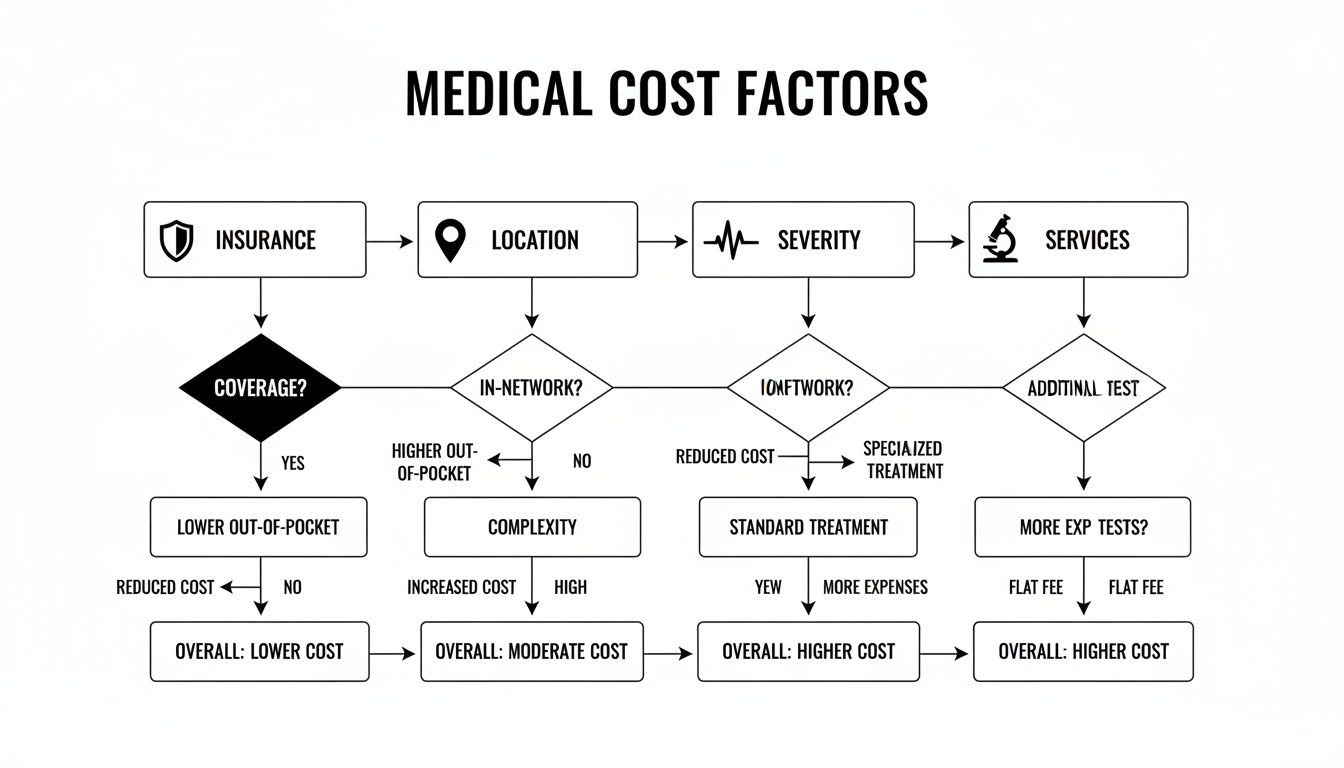
As this flowchart shows, everything from your insurance plan to the specific tests you need will add complexity—and cost—to your visit.
Telehealth: The Modern, Transparent Alternative
This is where modern telehealth platforms completely change the game. Instead of gambling on variable costs and wasting hours in a waiting room, services like ChatWithDr offer a clear, upfront price for a wide range of common conditions.
With ChatWithDr, a consultation for that same UTI costs a flat $39.99. No facility fees. No hidden charges. No surprise bills showing up in your mailbox weeks later. You get a diagnosis, a treatment plan, and a prescription sent straight to your pharmacy, all from your own home.
The benefits go way beyond just the price tag. You save time, you skip the travel, and you avoid sitting in a waiting room full of other sick people. For dozens of common issues, from sinus infections to pink eye, the telehealth model offers unbeatable value and convenience.
If you want to see what's covered, you can explore the full list of telehealth services and see how it fits your needs. At the end of the day, choosing the right setting for your care is the single most powerful way to take control of your healthcare spending.
Real-World Cost Scenarios
Abstract price ranges are one thing, but let's make this real. The best way to get a handle on how much urgent care costs is to walk through a few common situations. Think of this as your financial playbook for the next time an unexpected illness or injury pops up.
You'll see just how quickly a simple base fee can grow once tests and treatments get added to the mix. These stories will help you visualize how the final bill gets built, giving you a much clearer picture of what you might actually end up paying out-of-pocket.
Scenario 1: Strep Throat Symptoms
Imagine you wake up with a throat that feels like you swallowed sandpaper, and you're running a fever. You figure it might be strep, so you head to the nearest urgent care clinic.
Here’s a pretty standard cost breakdown if you're paying without insurance:
- Base Visit Fee: This covers the initial exam with the doctor or nurse practitioner. (~$150)
- Rapid Strep Test: To know for sure, they'll need to do a quick swab. (~$50)
- Total Estimated Cost: You're likely looking at a final bill of around $200.
This simple example shows how even a straightforward visit for a common bug involves more than just the consultation. That necessary diagnostic test is a separate line item that bumps up your total cost.
Scenario 2: A Minor Cut Needing Stitches
Okay, next up: a kitchen accident. You get a deep cut on your hand that just won’t stop bleeding. This kind of visit involves a procedure, which completely changes the cost structure.
A procedure-based visit like this involves more of the provider's time, specialized supplies, and a higher level of care. The final bill is going to reflect that increased complexity.
- Base Visit Fee: For the initial assessment of the wound. (~$175)
- Sutures (Stitches): This covers cleaning the area, numbing it, and the actual stitching. (~$250 – $400)
- Tetanus Shot (if needed): An important add-on for prevention. (~$75)
- Total Estimated Cost: For this, you could be looking at a bill somewhere between $500 and $650.
Scenario 3: A Sprained Ankle
Let's say you twist your ankle playing basketball. It's swollen, it hurts, and you need to make sure it isn't broken. This is a classic urgent care case that brings diagnostic imaging into the picture.
An X-ray is easily one of the most common—and significant—add-on costs you'll see at an urgent care center.
- Base Visit Fee: The physical exam of your ankle. (~$150)
- X-Ray (2 views): To check for any fractures. (~$200 – $300)
- Splint or Brace: To keep the ankle stable while it heals. (~$75)
- Total Estimated Cost: Your total bill would probably land between $425 and $525.
These scenarios really drive home the variable nature of medical billing and point to a larger trend. Looking ahead, healthcare costs are only expected to climb, with North America anticipating a 9.3% jump in benefit costs, largely driven by conditions like cancer and cardiovascular disease. If you're curious, you can explore the key drivers of future health care cost increases to see what’s on the horizon.
How to Save Money on Your Next Urgent Care Visit

Navigating healthcare costs can feel like you’re trying to solve a puzzle with half the pieces missing. But with a few smart moves, you can save a surprising amount of money. The real trick is to be an informed patient before you need care, especially when you’re trying to figure out how much urgent care costs.
Your first move? Pick up the phone. Before you even grab your car keys, call the clinic to confirm they take your insurance. While you have them on the line, ask about their self-pay or cash discounts if you’re uninsured or staring down a high deductible. Many clinics have these rates ready to go.
Be Proactive with Pricing
Don’t be shy about asking for a price list before you agree to anything. They might not be able to give you an exact, final number, but the staff can almost always provide a ballpark cost for common services like a basic visit, a flu test, or an X-ray.
This simple step is your best defense against surprise bills. Getting an estimate upfront puts you back in the driver's seat, allowing you to make a clear-headed decision about your care without feeling pressured in the moment.
Knowing the potential costs before you walk through the door lets you control your healthcare spending and plan accordingly.
Smart Strategies to Lower Your Bill
Beyond calling ahead, a few other tactics can help keep your urgent care bill from getting out of hand. Putting these into practice can make a real difference to your wallet.
- Choose Telehealth for Common Issues: For things like UTIs, sinus infections, or pink eye, telehealth is often the most affordable and convenient route. Platforms like ChatWithDr offer consultations for a flat fee (like their $39.99 rate) with no hidden charges, so you know exactly what you're paying.
- Use Your HSA or FSA: If you have a Health Savings Account (HSA) or Flexible Spending Account (FSA), use it. Paying for copays, deductibles, and other medical expenses with these pre-tax dollars is one of the easiest ways to save.
- Review Your Bill Carefully: Mistakes happen. Once you get your itemized bill, look it over for any errors or charges that don’t make sense. It’s always worth a quick double-check.
In a time when U.S. healthcare costs are projected to jump by 9.6% in 2026, finding ways to get affordable care is more critical than ever. Urgent care is already a cost-effective alternative to the ER, but these strategies make it an even smarter choice. You can read more about upcoming healthcare cost trends to stay ahead of the curve.
By using these tips, you can get the treatment you need without the financial anxiety. For many situations, you'll likely find that exploring your online urgent care options gives you the best mix of convenience, speed, and savings.
Wrapping It Up: Making the Smart Choice for Your Health and Wallet
Urgent care is an incredible resource, but as we’ve seen, the final bill can feel like a roll of the dice. Getting a handle on what drives your costs—from your zip code to the specific tests you need—is the first step toward making smarter healthcare decisions. When you're proactive, you protect both your physical and financial health.
For a lot of common, non-emergency issues, modern telehealth platforms really do offer the best of both worlds. They give you immediate access to professional care with total price transparency, which takes all the guesswork out of the equation.
With a service like ChatWithDr, a consultation for a common condition has a flat $39.99 fee. You know the exact cost before you even start, and that’s a powerful tool for managing your budget.
Hopefully, this guide has given you the confidence to navigate your options. For anyone facing a mountain of medical expenses, it's also worth understanding if you can get help by including medical debt in debt relief programs; it could be a crucial step toward getting back on solid financial ground.
At the end of the day, whether you choose a brick-and-mortar clinic or an online service, being an informed patient is your greatest asset. It’s what ensures you get the right care at the right price, every single time.
Frequently Asked Questions About Urgent Care Costs
It’s completely normal to have a few lingering questions when you’re trying to figure out medical costs. Even after you understand the basics, the little details can be tricky. Let’s clear up some of the most common questions people have about how much urgent care will cost.
Is Urgent Care Cheaper Than a Primary Care Doctor?
This is a great question, and the answer is: it depends on the situation.
For a one-off visit without insurance, an urgent care clinic might look a bit pricier on the surface than your regular doctor. But its real value is getting you seen right now for an acute problem when you can't get a timely appointment. If you have insurance, your copay for both is often pretty similar.
However, when it comes to managing chronic conditions and getting routine check-ups, your primary care doctor will always be the most cost-effective choice over the long haul.
Do I Have to Pay for Urgent Care Upfront?
Yes, in most cases, you'll need to pay something at the time of your visit. If you’re uninsured, clinics will almost always require the full estimated payment before you even see the provider.
If you have insurance, you’ll be asked to pay your copay or a part of your deductible right then and there. It’s always a smart move to call the clinic ahead of time to confirm their specific payment rules. That way, there are no surprises when you walk in the door.
Can I Use My HSA or FSA at an Urgent Care Center?
Absolutely. Your urgent care visit, plus any lab tests or prescriptions that come with it, are considered qualified medical expenses. This means you can swipe your Health Savings Account (HSA) or Flexible Spending Account (FSA) debit card to cover everything.
Using these tax-advantaged accounts is a savvy way to pay for healthcare. For your own records, tax purposes, or insurance claims, you might need to know how to get copies of receipts for your urgent care visits. This applies to both in-person clinics and modern telemedicine platforms, making them an even more affordable option.
Ready for clear, upfront pricing and immediate care from home? ChatWithDr offers 24/7 online consultations for just $39.99. Skip the waiting room and get a diagnosis and treatment plan from a board-certified doctor in as little as an hour. Get started now at https://chatwithdr.com.
Related posts:
 Decoding the Virtual Doctor Visit Cost for Smart Healthcare
  Explore do you need insurance for urgent care and what it means for your visit
  Testosterone Replacement Therapy Cost Guide And Saving Tips
  How to Get Medical Care Without Insurance Your Practical Guide
  The 7 Best Online Doctor Services of 2025: A Detailed Review