

If you're looking to increase your testosterone naturally, the game plan boils down to five key lifestyle pillars: strategic strength training, hormone-supportive nutrition, restorative sleep, managing your body fat, and cutting down on chronic stress.
This isn't about some miracle pill or a quick fix. It's an actionable blueprint for making consistent, intelligent adjustments that will actually improve your T levels, boost your energy, and restore your overall vitality.
The Blueprint for Naturally Boosting Testosterone
Forget the idea that there's one magic solution for low testosterone. The truth is, your hormonal health is a system, and it responds best to a combination of positive inputs across the board. When you consistently apply the right strategies in different areas of your life, the effects build on each other in a powerful way.
This isn't about going to extremes. It’s about making smart, sustainable changes that give your body what it needs to produce hormones at its optimal level.
The journey starts by accepting that there are no shortcuts. Lasting results come from building a solid foundation of healthy habits. Each pillar we’re about to cover works in tandem with the others, creating an environment where your body can finally thrive.
The Five Foundational Pillars
Optimizing your testosterone is a multi-faceted process. The most effective approach always addresses the core lifestyle factors that directly influence your endocrine system.
- Strategic Strength Training: This is more than just mindlessly lifting weights. It’s about using specific protocols, like heavy compound movements, to trigger the biggest possible hormonal response from your body.
- Hormone-Supportive Nutrition: Your diet literally provides the raw building blocks for hormone synthesis. We'll zero in on healthy fats, quality proteins, and the essential micronutrients your body is crying out for.
- Restorative Sleep: The vast majority of your testosterone production happens while you're asleep. Making 7-9 hours of quality rest a non-negotiable priority is absolutely critical for hormonal balance.
- Smart Body Fat Management: That excess body fat, especially around your midsection, is a problem. It contains an enzyme that actively converts your testosterone into estrogen. Keeping your body composition in a healthy range is crucial.
- Active Stress Reduction: Chronic stress jacks up your cortisol levels, and cortisol is the enemy of testosterone—it directly suppresses its production. You have to learn how to manage stress.
For a deeper dive into this, you can find more excellent insights on these effective natural ways to boost testosterone.
The key takeaway is consistency. One great workout or a week of perfect eating isn't going to move the needle much. It’s the cumulative effect of your daily choices over weeks and months that creates real, measurable change in your hormonal profile and how you feel.
To help you visualize this, we've summarized the core lifestyle interventions in the table below.
Key Pillars of Natural Testosterone Enhancement
| Lifestyle Pillar | Primary Mechanism of Action | Expected Impact |
|---|---|---|
| Strength Training | Stimulates androgen receptors and triggers acute hormonal release. | Increased baseline T levels, improved muscle mass, and greater insulin sensitivity. |
| Nutrition | Provides essential fatty acids, cholesterol, and micronutrients for hormone synthesis. | Supports the raw material supply chain for testosterone production. |
| Sleep | The majority of daily testosterone is produced during deep sleep cycles (REM). | Restores and maximizes daily T production; lack of sleep crushes T levels. |
| Body Fat Management | Reduces aromatase enzyme activity, which converts testosterone to estrogen. | Lowers estrogen, freeing up more testosterone to circulate in the body. |
| Stress Reduction | Lowers cortisol, a catabolic hormone that directly inhibits testosterone production. | Removes the "hormonal handbrake" that chronic stress puts on your system. |
As you can see, each pillar plays a distinct but interconnected role. Neglecting one area can easily undermine your progress in the others.
This visual breaks down the three most critical pillars of any physical transformation—training, nutrition, and sleep—which are the absolute bedrock of hormonal health.
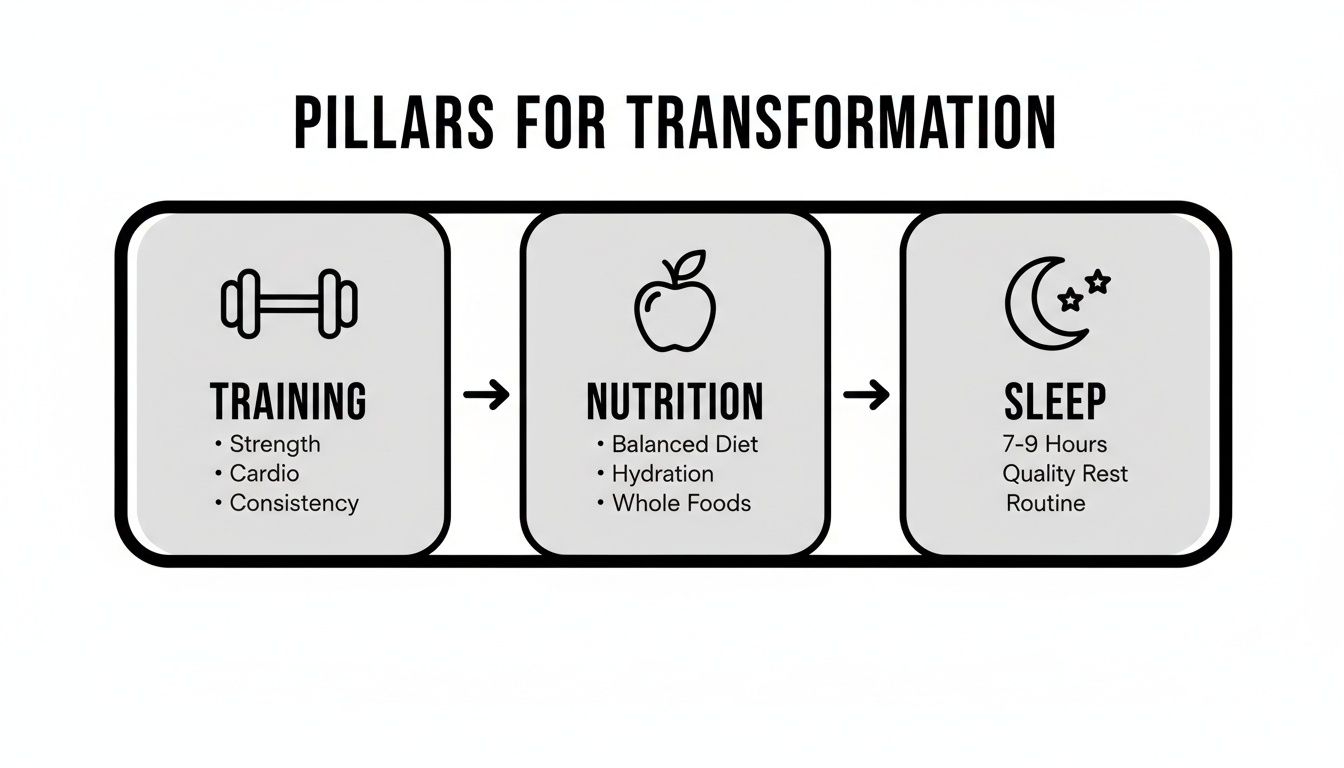
Think of it this way: these three components form the foundation upon which all your other hormonal health efforts are built. Each one supports the others, making a combined approach far more powerful than focusing on just one piece of the puzzle.
Building Muscle to Fuel Testosterone Production
If you’re serious about increasing testosterone naturally, resistance training isn't just an option—it’s a non-negotiable part of the plan. But just showing up and going through the motions won’t get you there. You need to train with intensity and purpose, using specific strategies that send a powerful hormonal signal to your body to grow stronger.
The most effective workouts for boosting testosterone are built around big, demanding, multi-joint movements. We're talking about heavy squats, deadlifts, bench presses, and overhead presses. These are the exercises that recruit massive amounts of muscle and put a significant metabolic stress on your system, triggering a much bigger anabolic hormone release than isolation exercises like bicep curls ever could.
Focus on Intensity and Compound Lifts
Your body’s hormonal response is directly tied to how hard you push it. Lifting heavy is the key that unlocks this process. This means training with weights that genuinely challenge you, typically in the range of 80-90% of your one-rep max (the absolute most you can lift for a single repetition).
Structure your workouts around these core principles:
- Heavy Compound Movements: Make exercises like squats, deadlifts, bench presses, and rows the absolute foundation of your routine.
- Strategic Rep Ranges: Aim for the 6-12 repetition range per set. This is the sweet spot that stimulates both muscle growth (hypertrophy) and a powerful hormonal response.
- Sufficient Volume: To create enough stimulus for adaptation, shoot for 3-5 working sets per major compound exercise.
This style of training is profoundly effective. Decades of research have confirmed that heavy resistance exercise is one of the most reliable ways to naturally boost testosterone. One landmark meta-analysis found that heavy lifts like squats and deadlifts increased testosterone by an average of 15-20% right after the workout. Another study showed that men who lifted weights three times a week saw their baseline testosterone jump by 17% in just eight weeks—a massive increase compared to the cardio-only group.
The Critical Role of Progressive Overload
To keep the gains coming—both in muscle and testosterone—your body needs a constant reason to adapt. That’s where progressive overload comes in. It’s the simple principle of continually increasing the demands you place on your body over time. Without it, your progress will inevitably stall, and so will your hormonal benefits.
You can apply progressive overload in a few straightforward ways:
- Increase the Weight: Add a small amount of weight to the bar every week or two.
- Increase the Reps: Push for one more rep than you did last time with the same weight.
- Increase the Sets: Add another working set to your main exercises.
The key is to make small, consistent improvements. Your body responds to these new challenges by building more muscle, which in turn helps create a healthier hormonal environment. To really dial in your training for T production, you need to learn about the most science-backed ways to build muscle faster.
Avoid the Overtraining Trap: More is not always better. Pushing yourself too hard, too often, without giving your body time to recover will skyrocket your cortisol levels. Chronically high cortisol is testosterone’s arch-nemesis; it directly suppresses T production and can undo all your hard work.
Finding the right balance is everything. For most guys, 3-4 intense resistance training sessions per week is the sweet spot. This schedule provides plenty of stimulus for growth while allowing your body the downtime it needs to recover and repair—which is when the real hormonal optimization actually happens. Listen to your body and prioritize recovery just as much as you do lifting heavy.
Your Hormone-Supporting Nutrition Plan

While your work in the gym sends the signal to build muscle and produce more testosterone, your diet delivers the actual raw materials to get the job done. Think of nutrition as the supply chain for your body's hormone factory. If that supply chain breaks down, production grinds to a halt, no matter how hard you train.
This is why understanding how to increase testosterone naturally really starts on your plate. A hormone-supporting diet isn't about extreme calorie cutting or weird restrictions. It's about strategically prioritizing the specific nutrients your endocrine system needs to fire on all cylinders.
Healthy Fats Are The Foundation
Let’s get one thing straight: dietary fat is not the enemy of your hormonal health—it’s the cornerstone. Steroid hormones like testosterone are literally built from cholesterol. This is a non-negotiable biological fact. That means a super low-fat diet can directly sabotage your body’s ability to produce T.
To fuel hormone production, you need to be intentional about incorporating a variety of healthy fats into your meals.
- Monounsaturated Fats: These are your daily drivers. Think olive oil, avocados, and almonds. They're fantastic for overall cardiovascular health, which is closely linked to hormonal balance.
- Saturated Fats: Found in sources like egg yolks, red meat, and coconut oil, these are directly involved in hormone synthesis. You don't need to go overboard, but you shouldn't fear them as part of a balanced diet.
- Polyunsaturated Fats: Here, the focus is on omega-3s from fatty fish like salmon and mackerel. These are inflammation-fighters, and chronic inflammation is a known hormone disruptor.
By making sure you get enough high-quality fats, you’re giving your body the essential building blocks it needs. A good target is to have around 20-30% of your daily calories come from these sources. This creates a strong foundation for everything else.
Get Your Protein And Carbs Right
Fats might be the foundation, but protein and carbs are the critical support crew. Protein is obviously essential for repairing the muscle you break down during training, which helps you maintain a lean, healthy body composition—a huge factor in hormonal balance. Stick with high-quality sources like lean meats, poultry, fish, and eggs.
Carbohydrates are your body's go-to energy source. They fuel those intense workouts and help keep the stress hormone cortisol from getting out of control. But the type of carb you eat matters. A lot.
Stick with complex carbohydrates like sweet potatoes, oats, quinoa, and plenty of vegetables. These provide slow-burning, sustained energy without the blood sugar rollercoaster caused by sugar and refined carbs, which can absolutely crush testosterone levels.
Constant insulin spikes from a high-sugar diet throw a wrench into the delicate hormonal cascade that leads to testosterone production. Keeping your blood sugar stable is a simple but incredibly powerful way to support healthy T levels all day long.
Zero In On Key Micronutrients
Certain vitamins and minerals are like the spark plugs for your hormonal engine. You can have all the fuel (macros) you want, but without these key micronutrients, nothing fires. A deficiency here can create a major roadblock, even if your diet seems perfect otherwise.
These are the big three you can't ignore:
- Zinc: This mineral is a direct player in the creation of testosterone. Study after study has shown a clear link between zinc deficiency and low T levels. Oysters are the undisputed king here, but red meat and pumpkin seeds are great sources, too.
- Vitamin D: Often called the "sunshine vitamin," Vitamin D really functions more like a hormone in the body. Research consistently shows that men with healthy Vitamin D levels have significantly higher testosterone than those who are deficient. Get it from sensible sun exposure, fatty fish, and fortified foods.
- Magnesium: This mineral helps "un-stick" testosterone that's bound to proteins in your blood, which increases the amount of "free" testosterone your body can actually use. You can find it in dark leafy greens like spinach, plus almonds and avocados.
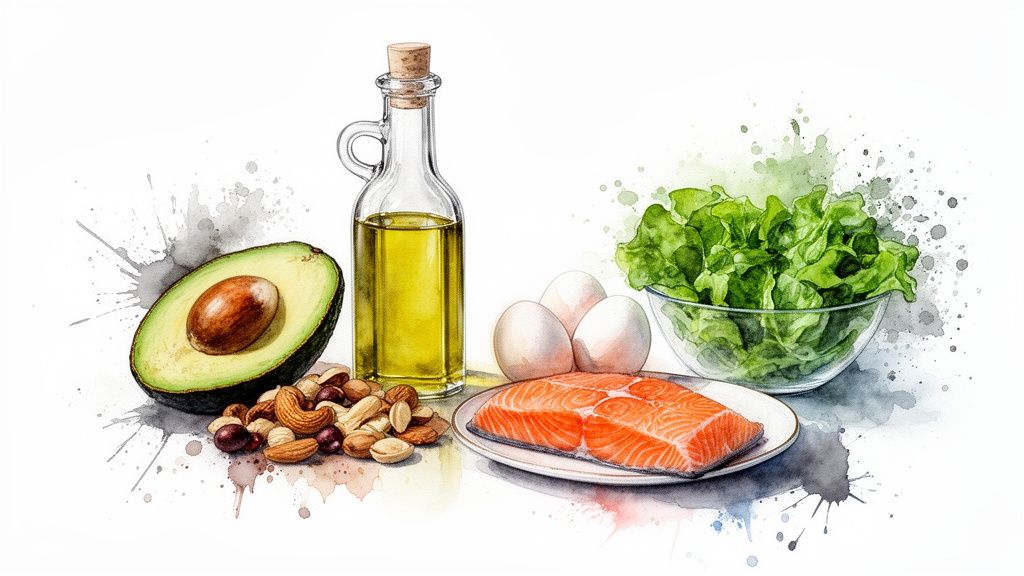
To make this even more practical, here’s a quick guide to some of the best foods you can add to your grocery list.
Top Foods for Natural Testosterone Support
| Food Group | Example Foods | Key Nutrient & Benefit |
|---|---|---|
| Fatty Fish | Salmon, Mackerel, Sardines | Omega-3s & Vitamin D: Reduces inflammation and provides a key hormone-like vitamin essential for T production. |
| Lean Meats & Eggs | Grass-Fed Beef, Chicken Breast, Whole Eggs | Zinc & Saturated Fat: Delivers zinc for T synthesis and healthy fats (from yolks) for hormonal building blocks. |
| Leafy Greens | Spinach, Kale, Swiss Chard | Magnesium & Micronutrients: Increases free testosterone by binding to SHBG and provides essential vitamins. |
| Cruciferous Veggies | Broccoli, Cauliflower, Brussels Sprouts | Indole-3-Carbinol: Helps the body metabolize and clear excess estrogen, promoting a better T-to-estrogen ratio. |
| Nuts & Seeds | Almonds, Brazil Nuts, Pumpkin Seeds | Zinc, Magnesium & Selenium: A powerhouse trio for direct hormone production and antioxidant support. |
| Healthy Oils & Fats | Olive Oil, Avocados, Coconut Oil | Monounsaturated & Saturated Fats: Provides the raw cholesterol needed to synthesize steroid hormones like testosterone. |
Incorporating these foods isn't a magic bullet, but it's a fundamental part of an effective nutrition plan for hormonal health. Think of it as stacking the deck in your favor. A rich, varied diet is the best way to cover all your bases and keep your body's natural hormone factory running at peak capacity.
Why Quality Sleep Is Your Strongest T-Booster
If you're lifting heavy and eating clean but ignoring your sleep, you're trying to fill a bucket with a massive hole in it. Rest isn't a luxury; it's the primary window of opportunity your body uses for hormonal regulation and repair. When it comes to learning how to increase testosterone naturally, prioritizing sleep is your most powerful lever.
Your body does its most important hormonal work while you're in deep sleep. This is when the brain signals the testes to produce the majority of the day's testosterone. Cutting this process short by even an hour or two, night after night, creates a hormonal deficit that no amount of training or perfect nutrition can overcome.
The impact of sleep deprivation on testosterone is not subtle—it's immediate and severe. Skimping on sleep is one of the fastest ways to crush your T levels and undo all the hard work you're putting in at the gym and in the kitchen.
The Science of Sleep and Testosterone
The connection between sleep and testosterone is incredibly direct. Research has shown that just one week of sleep restriction can dramatically lower T levels in healthy young men.
A landmark University of Chicago study found that limiting sleep to five hours per night for a single week slashed daytime testosterone by a staggering 10-15%. To put that in perspective, this drop is equivalent to aging 10 to 15 years—a massive hit from just a few nights of poor rest. You can read more about these critical sleep study findings.
This isn't an isolated finding. Larger analyses confirm that men who consistently sleep less than six hours a night have significantly lower testosterone levels, often 20-30% lower than their well-rested peers. The message from the science is crystal clear: insufficient sleep directly sabotages your efforts.
Your body produces testosterone on a daily rhythmic cycle, peaking in the early morning hours just as you wake up. This peak is entirely dependent on the quality and duration of the sleep you got the night before. Consistently shortchanging sleep flattens this crucial morning peak, leaving you with lower T levels all day long.
This means making 7-9 hours of quality, uninterrupted sleep a non-negotiable priority. It's the foundation upon which your diet and training efforts are built.
Creating Your Sleep Sanctuary
Mastering your sleep hygiene isn't complicated, but it does require consistency. It’s all about creating an environment and a routine that signals to your body that it's time to power down, repair, and produce hormones.
Your bedroom should be optimized for one thing: sleep. This means transforming it into a cool, dark, and quiet sanctuary.
- Keep It Cool: Your body temperature needs to drop to initiate deep sleep. Aim for a room temperature between 60-67°F (15-19°C).
- Make It Dark: Even small amounts of light can disrupt your circadian rhythm and melatonin production. Use blackout curtains, cover electronics, and consider a sleep mask.
- Keep It Quiet: Unwanted noise is a major sleep disruptor. Use earplugs or a white noise machine to drown out sounds that might wake you.
Pre-Bed Routines That Work
What you do in the hours leading up to bedtime has a massive impact on your sleep quality. This is where you can build powerful habits that set you up for success.
Start by creating a consistent sleep schedule. Going to bed and waking up at the same time every day—yes, even on weekends—helps regulate your body's internal clock, making it easier to fall asleep and wake up naturally.
You also need to manage your light exposure. The blue light emitted from phones, tablets, and computers is particularly disruptive to melatonin production, the hormone that tells your body it's time to sleep.
- Enforce a Digital Curfew: Stop using all screens at least 60-90 minutes before you plan to go to sleep.
- Dim the Lights: Lower the lights in your home during the evening to signal to your brain that it's time to wind down.
- Watch Your Caffeine: Caffeine has a long half-life. Avoid it completely for at least 8-10 hours before bed to ensure it doesn't interfere with your ability to fall into a deep, restorative sleep.
Managing Body Fat and Stress to Protect Your Hormones

Beyond the gym and the kitchen, two silent hormone disruptors often sabotage even the best efforts: excess body fat and chronic stress. Think of them as hormonal thieves, working behind the scenes to drag your testosterone down. Tackling them is a non-negotiable step in any serious plan to boost your T levels naturally.
Excess body fat, especially the visceral fat hanging around your organs, isn't just a passive problem—it's an active endocrine organ. This fat tissue is packed with an enzyme called aromatase, and its primary job is to convert your hard-earned testosterone directly into estrogen.
The more body fat you carry, the more active this aromatase process becomes, kicking off a vicious cycle. Lower testosterone makes it harder to build muscle and easier to gain fat, which in turn leads to even more aromatase activity. It's a hormonal trap you have to break out of.
Sustainable Fat Loss for Hormonal Health
The answer isn't a crash diet. In fact, that can often make things worse by jacking up stress hormones and causing you to lose precious muscle. The real goal is sustainable fat loss through a modest and consistent calorie deficit, driven by the smart nutrition and exercise habits we've already covered.
Losing this excess weight is one of the most powerful natural strategies out there. The data is crystal clear: for overweight or obese men, shedding fat can dramatically improve testosterone. One study followed men on a calorie-restricted diet and found that an average weight loss of 15% over a year boosted their testosterone by an incredible 58%. That was enough to reverse low T in most of the guys. If you want to dive deeper, you can find more insights on the link between body weight and testosterone.
If you're finding it tough to manage your weight on your own, exploring options like online weight loss medication under a doctor's guidance can be a genuinely helpful tool in your journey.
Don’t get caught in the trap of extreme dieting. Just focus on creating a small, sustainable energy deficit of about 300-500 calories per day. Pair this with consistent strength training to ensure you're torching fat, not muscle.
This slow-and-steady approach protects your metabolism and keeps your hormones balanced, ensuring your weight loss journey actively supports—rather than tanks—your testosterone goals.
Conquering Stress and Lowering Cortisol
The second hormonal thief is chronic stress. When you're constantly wound up, your body floods itself with the hormone cortisol. In short bursts, cortisol is a lifesaver. But when it’s chronically elevated from work deadlines, money worries, or relationship drama, it becomes a direct enemy of testosterone.
Think of cortisol and testosterone as being on opposite ends of a seesaw; when one is high, the other tends to be low. Your body has to choose where to put its resources. If it thinks you're in a constant state of emergency (i.e., stress), it will prioritize making cortisol at the expense of testosterone production.
Managing your stress isn't just a "nice-to-have" for mental wellness; it's a critical part of optimizing your hormones.
Here are a few proven techniques to get your cortisol in check:
- Mindfulness and Meditation: Even just 10-15 minutes of daily meditation can seriously lower cortisol levels. Apps like Headspace or Calm are a great place to start if you're new to it.
- Get Outside: Spending time in nature, whether it's a walk in the park or a weekend hike, has been shown to slash cortisol. The mix of light physical activity and a natural setting is a potent de-stressor.
- Schedule Your Downtime: Actively block out time for things you enjoy that have nothing to do with being productive. This could be reading a book, listening to music, or getting lost in a hobby.
- Ease Up on Stimulants: Too much caffeine can send your body's stress response into overdrive. Try cutting back, especially in the afternoon, so you don't mess with your cortisol rhythm or your sleep.
By actively managing both your body fat and your daily stress, you're removing two of the biggest roadblocks standing between you and optimal hormonal health. This two-pronged attack protects the testosterone your body is already making and creates an environment where it can thrive.
When Lifestyle Changes Aren't Enough
Putting in the work with diet, exercise, and sleep is a massive step toward supporting your body’s natural hormone production. For a lot of men, sticking to these strategies is enough to feel a real difference in energy, mood, and drive.
But sometimes, even with all that effort, the needle just doesn't move as much as you’d hope.
This isn’t necessarily a sign of failure. It can happen for all sorts of reasons—genetics, the natural decline that comes with age, or an underlying medical issue that’s messing with your endocrine system. If you've been grinding it out for a few months and still feel like you’re running on fumes, it’s a strong hint that something more is going on under the hood.
It's time to figure out the difference between feeling a little off and dealing with the persistent symptoms of clinically low testosterone, also known as hypogonadism.
Recognizing The Signs of Low T
Symptoms that go way beyond just feeling tired are red flags that you shouldn’t ignore. Paying attention to what your body is telling you is the first step toward getting the right kind of help.
Here are the key symptoms to watch for:
- Persistent Low Libido: A noticeable and consistent drop in your desire for sex.
- Erectile Dysfunction: Trouble getting or maintaining an erection.
- Chronic Fatigue: A deep, bone-weary exhaustion that sleep and rest just don't seem to touch.
- Loss of Muscle Mass: Finding it harder to build or even keep muscle, no matter how hard you train.
- Mood Changes: Feeling more irritable, down, or just completely unmotivated.
If that list sounds uncomfortably familiar, it’s time to stop guessing and start measuring. The only way to know for sure what your testosterone levels are is with a simple blood test.
Taking charge of your health means knowing when to call in an expert. Natural methods are the perfect place to start, but professional medical insight is crucial when you hit a wall. It ensures you’re on the safest, most effective path forward.
Getting a Professional Medical Opinion
Trying to navigate the healthcare system can feel like a chore, but modern services have made getting professional advice incredibly simple. This is where a text-based platform like ChatWithDr can be a total game-changer for men who want clear answers.
Instead of waiting weeks for an in-person appointment, you can get a professional opinion discreetly and affordably. You'll connect with a board-certified physician who can evaluate your symptoms, order the right lab tests to check your hormone levels, and then build a personalized treatment plan based on those results. It’s an approach that completely removes the old barriers of time and inconvenience.
If you’re ready to get clear, definitive answers about your hormonal health, you can easily book a consultation with a certified physician to get the process started.
Common Questions About Boosting Testosterone
When you start digging into how to increase your testosterone naturally, you're bound to run into a lot of questions. It's a topic flooded with information—and a whole lot of misinformation. Let's clear up some of the most common points of confusion I see all the time.
One of the first things guys want to know is how long it'll take to actually feel a difference. While you might notice a bump in energy from better sleep in just a few days, measurable changes in your T levels require a bit more patience. If you're consistent with your diet, exercise, and sleep, you can expect to see real results on a blood test within 8-12 weeks. The trick is to stick with it long-term.
Are There Any Supplements That Really Work?
Walk down any supplement aisle, and you'll be bombarded with "T-booster" products, but frankly, most have very little science backing them up. Your first and most important job is to fix any nutritional deficiencies.
- Vitamin D: If your levels are low, supplementing can make a noticeable difference. It acts more like a hormone in your body than a simple vitamin.
- Zinc and Magnesium: These two minerals are absolute workhorses for testosterone production. A shortfall here can really hold you back.
Don't just guess, though. Get your levels tested. A doctor can pinpoint what you're actually deficient in, so you're supplementing smartly instead of just throwing money away on stuff that won't work.
Let's be clear: it's virtually impossible to push your testosterone to a dangerously high level with natural methods alone. Lifestyle changes are about optimizing your body's own production system to get you into a healthy, normal range—not forcing it past its natural limits.
Another big question is about cardio. Is it good or bad for T? The answer is nuanced. Moderate cardio is fantastic for your overall health, helps with weight management, and improves circulation—all things that indirectly support healthy T levels.
But there's a catch. Excessive, chronic endurance training, like marathon running without enough recovery time, can jack up your cortisol and actually suppress testosterone. The sweet spot for hormonal health is a balanced routine that makes strength training the priority.
It's also crucial to understand how hormonal balance affects other parts of your life, including sexual health. For more on that connection, you can check out our detailed guide on managing erectile dysfunction.
If you've put in the work with these lifestyle changes but still feel like something's off, it’s time to stop guessing and get a professional opinion.
ChatWithDr offers a discreet, text-based consultation with a U.S.-licensed physician who can order lab tests and build a personalized plan for you, all from the privacy of home. Get started with a consultation for just $39.99 today.
Related posts:
 GLP-1 Weight Loss Success: 7 Mistakes You’re Making (And How to Fix Them for Long-Term Results)
  Birth Control Options and Side Effects: Your Complete, Click-Worthy Guide
  Period delay pill: Your Complete Guide to Timing, Types, and Safety
  Erectile Dysfunction Causes and Treatments Explained
  Testosterone Replacement Therapy Cost Guide And Saving Tips