
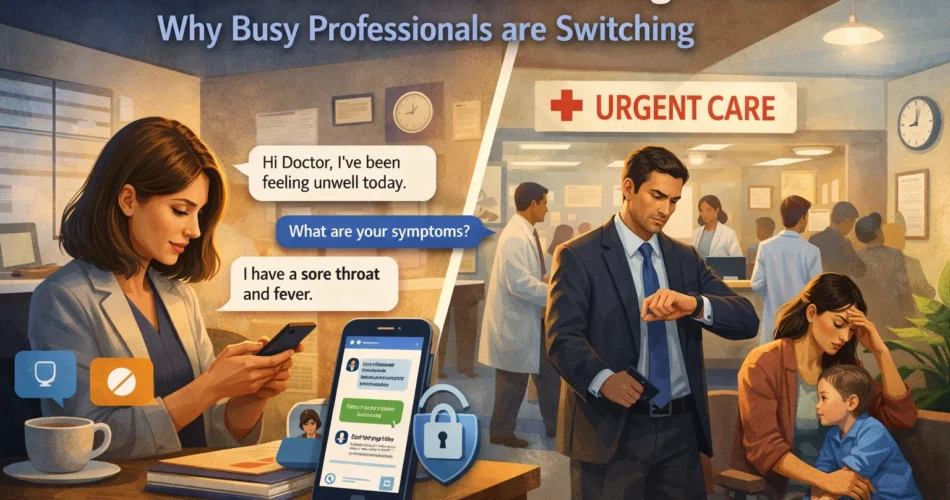
Picture this: It's Tuesday afternoon, you're in back-to-back meetings, and you notice that familiar burning sensation. You know you need antibiotics for what's likely a UTI, but the thought of driving to urgent care, sitting in a waiting room with a dozen other sick people, and losing two hours of your day feels overwhelming. What if there was a better way?
Thousands of busy professionals, parents, and travelers are discovering that live medical chat offers a practical alternative to traditional urgent care visits: without sacrificing quality care or safety. Here's what you need to know about this growing shift in healthcare delivery.
The Time Factor: 9 Minutes vs. 70 Minutes
Time is the single biggest driver pushing professionals toward online medical chat services. Recent healthcare data reveals a striking difference: virtual consultations average 9.38 minutes from start to finish, while traditional urgent care visits consume approximately 70.89 minutes of your day.
But the time savings go beyond just the visit itself. Consider the full timeline of an urgent care trip:
- 15-20 minutes: Drive to the clinic (depending on traffic and location)
- 20-45 minutes: Waiting room time, even with online check-in
- 10-15 minutes: Actual medical consultation
- 10-15 minutes: Checkout and prescription processing
- 15-20 minutes: Drive back home or to work
That's easily 70-115 minutes taken out of your day. And if you need to bring a sick child? Add another 20-30 minutes managing logistics.
With a 24/7 live medical chat platform like ChatWithDr, you're texting with a licensed physician while sitting at your desk, waiting for your flight, or from your couch at 11 PM. Most patients receive their first response in under 2 hours, often much faster.

Cost Comparison: Transparent Pricing vs. Surprise Bills
Healthcare costs continue to rise, making price transparency more important than ever. Traditional urgent care visits average $142.66 before insurance kicks in, according to industry data. But that number doesn't tell the whole story.
Urgent care bills often include:
- Facility fees ($50-$150)
- Provider consultation fees ($100-$200)
- Diagnostic test fees (urinalysis, strep test, etc.)
- Potential copays if using insurance
- Hidden fees that appear weeks later
With online urgent care via text, pricing is straightforward. ChatWithDr charges a flat $39.99 fee: no hidden costs, no surprise bills, no facility fees. You know exactly what you're paying before you start the consultation. The prescription is sent directly to your preferred pharmacy, where you can use your regular insurance coverage to fill it.
For professionals managing healthcare budgets or using HSA/FSA accounts, this transparency matters. ChatWithDr accepts HSA and FSA cards, making it even easier to budget for unexpected medical needs.
Convenience for Different Lifestyles
Busy Professionals
If your calendar looks like Tetris and you're juggling deadlines, client meetings, and project launches, taking two hours for an urgent care visit isn't just inconvenient: it's nearly impossible. Chat with a doctor 24/7 services eliminate the need to block out time, reschedule meetings, or explain to your boss why you need to leave early.
Text-based consultations allow you to message during a meeting break, between calls, or even during your commute (if you're not driving). You maintain productivity while addressing your health concern.

Parents with Young Children
For parents, urgent care visits with sick children are especially draining. You're managing a miserable toddler in a waiting room full of germs, trying to keep them entertained with worn-out toys, and worrying about exposing them to additional illnesses.
Live medical chat lets you handle your child's care from home. If they have pink eye, a potential UTI, or need a strep test follow-up prescription, you can chat with a doctor while your child rests comfortably on the couch. Many parents also use these services for themselves: when you're already caring for a sick child, getting treatment for your own sinus infection without leaving the house is invaluable.
Travelers and Remote Workers
Business travelers and digital nomads face unique healthcare challenges. Getting sick in an unfamiliar city means searching for urgent care clinics, navigating unfamiliar insurance networks, and potentially missing important commitments.
Online medical chat services like ChatWithDr are licensed in all 50 states, meaning you can receive consistent care whether you're in New York, Texas, or Oregon. The service operates 24/7, including holidays, so you're covered during weekend trips or late-night emergencies when you're three time zones away from your usual doctor.
When to Use Each Option: Making the Right Choice
Not every medical situation is appropriate for virtual care. Understanding when to use live medical chat versus urgent care versus emergency services is crucial for your safety.
Best Situations for Live Medical Chat
Online medical chat works well for:
- Urinary tract infections (UTIs)
- Sinus infections
- Strep throat follow-ups
- Pink eye (conjunctivitis)
- Skin rashes and mild dermatological issues
- Yeast infections and bacterial vaginosis
- Seasonal allergies
- Cold, flu, and COVID-19 symptom management
- Birth control refills and emergency contraception
- Minor conditions that don't require physical examination
You can get your prescriptions online for these conditions, with medications sent directly to your local pharmacy, often within hours.

When Urgent Care is Better
Visit urgent care if you need:
- X-rays for potential broken bones or fractures
- Wound closures requiring stitches or glue
- Severe cuts or lacerations
- Physical examinations for abdominal pain
- Diagnostic imaging for specific injuries
- In-person diagnostic testing that can't be arranged remotely
Emergency Situations: Go to the ER Immediately
Seek emergency care immediately if you experience:
- Chest pain or pressure, especially radiating to arm or jaw
- Difficulty breathing or shortness of breath
- Severe bleeding that won't stop
- Sudden severe headache (potential stroke symptoms)
- Loss of consciousness or confusion
- Severe abdominal pain
- Symptoms of stroke (facial drooping, arm weakness, speech difficulty)
- Severe allergic reactions (anaphylaxis)
- Major trauma or injuries from accidents
- Suicidal thoughts or mental health crisis
Virtual care providers will redirect you to emergency services if your symptoms indicate a serious condition requiring immediate in-person evaluation.
How ChatWithDr Works: 3 Simple Steps
Getting care through live medical chat is straightforward. Here's the ChatWithDr process:
Step 1: Start Your Consultation
Visit chatwithdr.com and describe your symptoms through secure text messaging. No account creation required, no app to download. Simply text your concern to a medical professional. The platform is HIPAA-compliant, ensuring your health information remains private and secure.
Step 2: Chat with a Licensed Physician
A licensed doctor reviews your information and responds, typically within 2 hours (often faster). They'll ask relevant follow-up questions through the secure chat interface to understand your condition fully. This is real-time medical consultation, just through text instead of in-person.
Step 3: Receive Your Treatment Plan
If appropriate, the doctor sends a prescription directly to your preferred pharmacy: you can use your regular insurance to fill it. You'll also receive care instructions and guidance on symptom management. The entire interaction is documented in your secure chat history for future reference.
The $39.99 flat fee covers the consultation, diagnosis, and prescription (if medically appropriate). There are no membership fees, no monthly subscriptions, and no hidden costs.

Why the Professional Shift is Accelerating
The migration from traditional urgent care to urgent care online platforms isn't just about convenience: it reflects changing expectations about healthcare delivery. Today's professionals expect the same on-demand access to medical care that they have for banking, shopping, and communication.
Several factors are driving this acceleration:
Post-Pandemic Comfort with Virtual Care: COVID-19 normalized remote healthcare interactions. Patients and providers both discovered that many conditions don't require physical examination for accurate diagnosis and treatment.
Rising Healthcare Costs: With deductibles climbing and healthcare consuming larger portions of household budgets, the transparent $39.99 pricing model appeals to cost-conscious consumers.
Workplace Culture Changes: Remote and hybrid work arrangements mean people aren't necessarily near their usual healthcare providers during business hours. Having access to licensed physicians regardless of location removes geographical barriers.
Time Scarcity: Professional demands continue intensifying. Saving 60+ minutes per medical visit adds up significantly over time, especially for people managing chronic conditions or families with multiple members needing care.
Real-World Scenarios: When Minutes Matter
Consider a few common scenarios where live medical chat proves invaluable:
The Business Traveler: You're presenting at a conference in Seattle when UTI symptoms hit. Instead of scrambling to find urgent care in an unfamiliar city, you discreetly text with a doctor during lunch break, get your prescription sent to a nearby pharmacy, and pick it up before your evening event.
The Working Parent: Your child's school calls: pink eye outbreak. You need a prescription but you're in the middle of a critical deadline. You consult with a doctor via text during your commute home, and the prescription is waiting at your neighborhood pharmacy by the time you arrive.
The Remote Worker: You're battling what feels like a sinus infection but you're in a rural area, hours from the nearest urgent care. Through 24/7 telehealth, you connect with a licensed physician, receive appropriate treatment, and avoid an unnecessary 3-hour round trip.
These aren't hypothetical situations: they represent the daily reality for millions of Americans who need medical care but can't afford the time disruption of traditional healthcare delivery.
Making an Informed Choice
Live medical chat and traditional urgent care both have their place in modern healthcare. The key is understanding which option serves your needs best for each specific situation.
For routine infections, prescription refills, minor conditions, and situations where your schedule is tight, platforms like ChatWithDr offer significant advantages in time savings, cost transparency, and convenience. The ability to access licensed physicians in all 50 states, around the clock, from any location makes these services particularly valuable for professionals with demanding schedules.
For injuries requiring imaging, conditions needing physical examination, or situations where you're uncertain about severity, traditional urgent care provides necessary in-person evaluation and diagnostic capabilities.
And for life-threatening emergencies, never hesitate: call 911 or go directly to the nearest emergency room.
The professionals making the switch to live medical chat aren't abandoning traditional healthcare: they're adding a practical tool that fits their lifestyle, saves time and money, and delivers quality care when and where they need it. As healthcare continues evolving, having options that respect your time while maintaining high standards of medical care isn't just convenient( it's essential.)
Related posts:
 Live Medical Chat: The Fastest Way to Get Your Prescriptions Online (No Waiting Rooms)
  Live Medical Chat: The Faster, Affordable Alternative to Traditional Urgent Care
  Chat with a Doctor 24/7: Why "Live Medical Chat" is Replacing the Urgent Care Waiting Room
  Live Medical Chat vs. Traditional Urgent Care: Why Text-Based Care is Winning
  Chat With a Doctor 24/7: Is Live Medical Chat Really Better Than Urgent Care?