
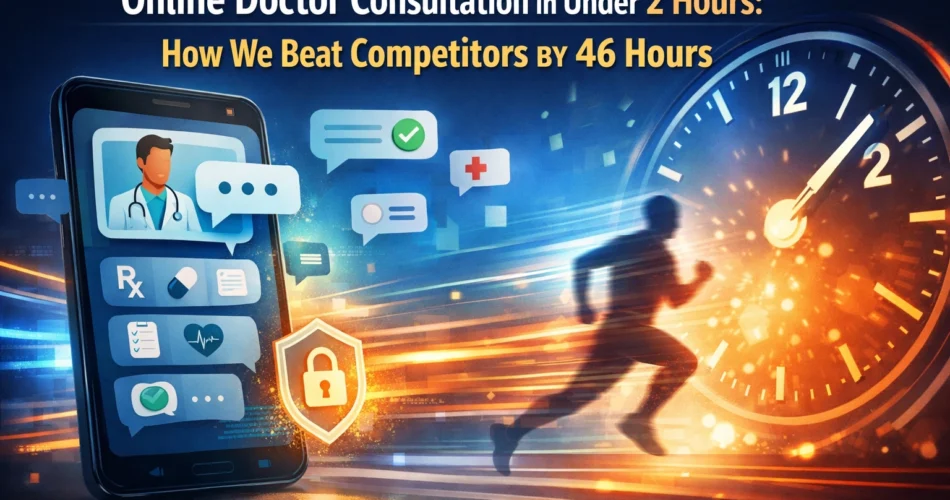
Your throat is killing you. You're pretty sure it's strep. But here's the problem: Your primary care doctor can't see you until Thursday, and it's Monday. The urgent care clinic down the street? There's a two-hour wait, and you still need to drag yourself there feeling miserable.
So you wait. And wait. By the time you actually see a provider, get diagnosed, and fill your prescription, it's been 48 hours or more since symptoms started.
That's the broken system most Americans still deal with in 2026. But there's a better way.
The 48-Hour Healthcare Problem Nobody Talks About
According to research from the Commonwealth Fund, the average wait time to see a primary care physician in the United States is 24 days for routine care. Even for urgent needs, most patients wait 1-2 days for an appointment slot.
Walk-in urgent care clinics seem like the obvious solution, but they come with their own headaches:
- Average wait times of 30-90 minutes once you arrive
- Travel time to and from the clinic
- Exposure to other sick patients in waiting rooms
- Operating hours that conflict with work schedules
- Surprise bills that can reach $150-$300 per visit
Add it all up, and you're looking at 24-48 hours (or longer) from "I need to see a doctor" to "I'm starting treatment."
For conditions like urinary tract infections, strep throat, or pink eye, that delay isn't just inconvenient, it's extending your suffering unnecessarily.

How Text-Based Telehealth Delivers in Under 2 Hours
Here's where the online doctor consultation model changes everything. At ChatWithDr, licensed physicians review patient messages and medical histories within 2 hours, often much faster.
Why? Because text-based care eliminates the bottlenecks that slow down traditional healthcare:
No appointment scheduling. You don't wait for an available time slot. Submit your consultation request 24/7, and a doctor reviews it during their next available moment.
No commute time. Whether you're at home, work, or traveling, you can access medical care from your phone. The U.S. Department of Health and Human Services reports that telehealth eliminates an average of 142 minutes per visit when accounting for travel and wait times.
Asynchronous communication. Doctors can review multiple patient cases efficiently through secure medical messaging, rather than the rigid time blocks required for in-person or video appointments.
No waiting room bottlenecks. Traditional clinics can only see one patient per room at a time. Text-based telehealth urgent care allows providers to manage patient care without physical space constraints.
The result? Most ChatWithDr patients receive a response, diagnosis, and treatment plan, including same day prescription online when appropriate, within 2 hours of submitting their consultation.
Why Text Beats Video for Most Medical Issues
Let's address the elephant in the room: Isn't video chat with a doctor better than text?
Not necessarily. For the majority of common urgent care conditions, text-based consultations are just as clinically effective as video or in-person visits.
Consider what doctors actually need to diagnose and treat conditions like:
- Urinary tract infections: Your symptoms (burning, frequency, urgency) and medical history
- Sinus infections: Duration and type of symptoms, facial pain, nasal discharge color
- Sore throat: Symptom description, fever, exposure history
- Bacterial vaginosis: Discharge characteristics, odor, itching
- Nausea and vomiting: Timing, severity, associated symptoms
For these conditions, detailed written information is often more useful than a brief video conversation where patients might forget to mention important details.
Plus, text-based care offers advantages that video simply can't match:
- No need to "look presentable" when you're feeling terrible
- Write out symptoms clearly without rushing through a timed appointment
- Reference your message thread later if questions arise
- Faster doctor response times since physicians can review cases more efficiently

The Transparent Pricing Advantage: $39.99 Flat Fee
Here's another way traditional urgent care fails patients: surprise medical bills.
You walk into an urgent care clinic with a sore throat. The front desk says it'll be $150. But then you get a separate bill for the strep test. Another bill for the doctor's review. Maybe even a facility fee. Your $150 visit suddenly costs $300 or more.
ChatWithDr's approach is radically different: $39.99 per consultation. Period.
That flat fee includes:
- Medical consultation with a licensed physician
- Review of your symptoms and medical history
- Diagnosis and treatment plan
- Prescription sent to your pharmacy (when medically appropriate)
- Follow-up messaging if needed
No hidden fees. No surprise bills. No insurance headaches to deal with.
According to the National Institutes of Health, the average urgent care visit costs patients $176 out-of-pocket. That means you're saving $136 per visit while getting faster care.
Same-Day Prescriptions: How It Actually Works
One of the biggest questions patients ask about telehealth urgent care: "Can I actually get a prescription online?"
The answer is yes: for appropriate conditions. Here's how same day prescription online services work through ChatWithDr:
Step 1: You submit a consultation request describing your symptoms and medical history through our secure platform.
Step 2: A licensed physician reviews your case, typically within 2 hours. They may ask follow-up questions to ensure an accurate diagnosis.
Step 3: If your condition requires medication and is appropriate for telehealth treatment, the doctor sends a prescription electronically to your preferred pharmacy.
Step 4: You pick up your medication the same day, often within hours of your initial consultation.
Conditions commonly treated with same-day prescriptions include:
- UTIs and bladder infections
- Bacterial sinus infections
- Strep throat and bacterial pharyngitis
- Pink eye (bacterial conjunctivitis)
- Emergency contraception
- Skin infections and rashes
- Allergic reactions
It's important to note that controlled substances and certain medications aren't available through telehealth due to federal regulations. But for the vast majority of urgent care prescriptions: antibiotics, antihistamines, topical medications: text-based consultation with a licensed doctor gets you treated fast.

When Under-2-Hour Response Times Actually Matter
The speed advantage of online doctor consultation isn't just about convenience: it directly impacts health outcomes for time-sensitive conditions.
UTIs: Untreated urinary tract infections can spread to kidneys within 24-48 hours, causing serious complications. Fast treatment prevents progression to pyelonephritis, which may require hospitalization.
Strep throat: Each day of untreated strep increases your risk of spreading infection to others. Quick diagnosis and antibiotics reduce contagious period and prevent complications like rheumatic fever.
Pink eye: Bacterial conjunctivitis spreads rapidly in schools and workplaces. Same-day treatment reduces transmission and gets patients back to normal activities faster.
Skin infections: Cellulitis and other bacterial skin infections can worsen quickly. Early antibiotic treatment prevents deeper tissue involvement and potential sepsis.
For conditions like these, the 46-hour difference between traditional healthcare access and ChatWithDr's under-2-hour response isn't just about comfort: it's about preventing complications and stopping the spread of contagious illness.
The Future Is Text-Based (Whether Healthcare Likes It or Not)
The healthcare industry spent years convinced that video telehealth was the future. Then COVID-19 forced a massive natural experiment, and we learned something surprising: patients often prefer text.
Why? Because modern consumers are already trained to communicate asynchronously. We text our friends. We Slack our coworkers. We message support teams when we have questions. It's how we naturally communicate in 2026.
Research published in the Journal of Medical Internet Research found that 76% of patients preferred text-based communication with healthcare providers over video or phone calls for non-emergency issues. The reasons? Convenience, clarity, and the ability to review information later.
ChatWithDr's 24/7 telehealth doctor service meets patients where they already are: messaging on their phones. No app downloads required. No complicated video setup. Just secure, straightforward medical messaging that gets you answers fast.

Not Everything Belongs in a Text Message
To be clear: text-based online urgent care isn't appropriate for every medical situation.
You should still go to an emergency room or call 911 for:
- Chest pain or suspected heart attack
- Difficulty breathing or severe shortness of breath
- Signs of stroke (facial drooping, arm weakness, speech difficulty)
- Severe injuries or trauma
- Loss of consciousness
- Uncontrolled bleeding
Similarly, some conditions require in-person examination or diagnostic testing that can't be done remotely. Your ChatWithDr physician will let you know if your situation requires an in-person visit.
But for the dozens of common conditions that send Americans to urgent care clinics every day: conditions that account for an estimated 44% of all emergency department visits according to the CDC: text-based telehealth provides faster, more affordable, and equally effective care.
Getting Started Is Actually This Simple
If you're used to the hassle of traditional healthcare, you might be skeptical that online doctor consultation can really be this straightforward. Here's the actual process:
- Visit ChatWithDr.com and describe your symptoms
- Provide basic medical history and pharmacy preference
- Receive a response from a licensed physician, typically within 2 hours
- Get your treatment plan and prescription (if appropriate)
- Pick up your medication same-day
Total cost: $39.99. Total time from submission to treatment plan: Under 2 hours in most cases.
No insurance forms. No sitting in waiting rooms feeling miserable. No wondering if you'll get a surprise bill next month.
Just fast, affordable, professional medical care when you need it: which is exactly what healthcare should have been all along.
Disclaimer: This information is not a substitute for professional medical advice, diagnosis, or treatment. Always seek the advice of your physician or qualified health provider with questions regarding medical conditions or treatments.
Related posts:
 The 7 Best Online Doctor Services of 2025: A Detailed Review
  Best Telemedicine Platforms: best telemedicine platforms for 2025
  Online Doctor Consultation in Under 2 Hours: Why ChatWithDr Is 24x Faster Than Competitors
  Same Day Prescription Online in Under 2 Hours: The Simple Trick Competitors Don’t Want You to Know
  Online Doctor Consultation: Why 2-Hour Response Times Beat 48-Hour Wait (And What It Means for You)