

Remember the last time you needed medical advice? You probably faced the familiar dilemma: wait days for a doctor's appointment, spend hours in an urgent care waiting room, or hope your symptoms just go away on their own. For millions of Americans, this frustrating cycle is the reality of traditional healthcare access.
But what if you could text a licensed doctor and get a response in under two hours: anytime, from anywhere?
The landscape of online doctor consultation is evolving rapidly, and response time has emerged as the critical differentiator between telehealth services that truly serve patients and those that simply replicate the inefficiencies of traditional care in a digital format.

The Response Time Revolution: Why Under 2 Hours Changes Everything
Traditional healthcare operates on a schedule that rarely aligns with when you actually need care. Research shows that the average wait time for a primary care appointment in the United States is 26 days, with some specialties requiring waits of over 50 days.
Even when you finally get that appointment, you're often spending 2-3 hours of your day between travel time, waiting room delays, and the actual consultation: all for what might be a 15-minute conversation.
Telehealth urgent care with sub-2-hour response times fundamentally disrupts this model. Here's why this specific timeframe matters:
Medical urgency alignment: Most non-emergency health concerns require attention within hours, not days. A urinary tract infection causing significant discomfort, a migraine preventing you from working, or a suspected case of strep throat: these conditions benefit dramatically from rapid intervention. A 2-hour window allows you to receive medical guidance while symptoms are acute, leading to faster relief and better outcomes.
Same-day prescription availability: When response times stay under 2 hours, patients can receive same day prescription online recommendations and have medications filled at their local pharmacy before the end of the business day. This eliminates the frustrating cycle of scheduling appointments days in advance only to discover you need a simple prescription that could have been issued immediately.
Reduced symptom anxiety: The psychological impact of rapid response shouldn't be underestimated. When you're experiencing worrying symptoms, every hour of uncertainty compounds stress. Quick access to medical expertise provides reassurance or identifies when more immediate care is necessary.

The Real Cost of Slow Healthcare: Comparing Response Times
Let's examine what different response time models actually mean for patients:
Traditional In-Person Care (48-72 hours or more)
- Schedule appointment (often days or weeks out)
- Take time off work or rearrange commitments
- Travel to clinic and wait in waiting room
- 15-minute consultation
- Travel to pharmacy for prescription
- Total time investment: 3-7 days, 3-4 hours of active time
Standard Telehealth (24-48 hour response)
- Submit inquiry online
- Wait for callback or message response
- Receive consultation
- Get prescription electronically sent
- Total time investment: 1-2 days
Rapid-Response Telehealth (Under 2 hours)
- Text with licensed doctors whenever symptoms arise
- Receive medical evaluation within 2 hours
- Get prescription sent to pharmacy immediately
- Total time investment: 2-3 hours from initial contact to treatment
The difference isn't just convenience: it's clinically meaningful. Studies show that early intervention and faster access to treatment significantly improve patient outcomes across a wide range of conditions.
Why Text-Based Care Is the Future of Healthcare Access
While video consultations dominated early telehealth adoption, text-based medical messaging is emerging as the superior model for most healthcare needs. Here's why secure medical messaging outperforms traditional virtual visits:
Asynchronous flexibility: Unlike scheduled video calls, text-based consultations don't require both parties to be available simultaneously. You can describe your symptoms in detail whenever convenient, and doctors can review your case and respond thoughtfully when they have dedicated time: resulting in more comprehensive evaluations.
Better documentation: Every interaction is automatically documented in writing, creating a complete medical record that both you and your doctor can reference. This is particularly valuable for chronic conditions requiring ongoing monitoring or when symptoms evolve over days.
Enhanced privacy: Many patients feel more comfortable discussing sensitive health issues through private messaging than face-to-face, whether in person or via video. Research indicates that text-based consultations improve patient disclosure, particularly for mental health, sexual health, and other personal concerns.
Efficient for acute care: Most common health concerns: from sinus infections to pink eye: don't require a physical examination. A detailed symptom description via secure messaging provides sufficient information for accurate diagnosis and treatment in the majority of cases.

The $39.99 Value Proposition: Transparent, Accessible Healthcare
One of the most significant barriers to healthcare access isn't just time: it's cost uncertainty. Traditional medical billing is notoriously opaque, with surprise charges appearing weeks or months after care.
A flat-fee model for online doctor consultation eliminates this anxiety entirely. At $39.99 per consultation, patients know exactly what they're paying before they seek care. No hidden fees, no insurance surprises, no billing codes to decipher.
Compare this to typical alternatives:
- Urgent care visit: $150-$300 without insurance, plus additional fees for prescriptions and any diagnostic tests
- Emergency room visit: $500-$3,000+ (even for non-emergencies)
- Primary care visit: $100-$300 depending on insurance coverage and copays
- Traditional telehealth: Often $75-$150 per consultation
The transparent pricing model makes healthcare accessible to more people, including those without insurance, with high-deductible plans, or who need care for conditions not covered by their insurance. It also encourages earlier intervention: when treatments are often simpler and more effective: because patients don't hesitate due to cost concerns.
Real-World Scenarios: When 2-Hour Response Time Makes the Difference
Understanding how rapid-response telehealth works in practice helps illustrate its transformative potential:
Scenario 1: Late-Night UTI Symptoms
Sarah develops painful urinary symptoms at 10 PM on a Tuesday. Rather than suffering through the night and trying to get an appointment the next day, she texts with a doctor through her phone. Within 90 minutes, she has a diagnosis and prescription sent to her 24-hour pharmacy. She picks up her medication before bed and starts treatment immediately.
Scenario 2: Sick Child During Business Hours
Marcus notices his daughter has symptoms of strep throat on a workday morning. Instead of taking half a day off to visit urgent care, he sends photos and describes symptoms via secure messaging during his commute. The doctor responds with a treatment plan before lunch, and his wife picks up the prescription on her way home.
Scenario 3: Vacation Health Crisis
Elena develops nausea and vomiting while traveling out of state. Rather than searching for an unfamiliar urgent care clinic, she accesses online urgent care through her phone. A licensed doctor evaluates her symptoms remotely, determines she needs anti-nausea medication, and sends a prescription to a nearby pharmacy: all within two hours.

How ChatWithDr Delivers Sub-2-Hour Healthcare Access
The promise of rapid-response telehealth requires robust infrastructure and a commitment to accessibility. ChatWithDr has built its platform specifically around the principle that healthcare should be fast, affordable, and available when you need it.
The process is straightforward:
- Access 24/7: Visit the platform anytime through your smartphone, tablet, or computer: no appointment scheduling required
- Describe symptoms: Use secure medical messaging to detail your health concerns, upload photos if relevant, and share your medical history
- Receive evaluation: A licensed doctor reviews your case and responds within 2 hours (often faster)
- Get treatment: Receive a diagnosis, treatment recommendations, and prescriptions sent directly to your preferred pharmacy
The platform specializes in common acute conditions that benefit most from rapid intervention: UTI treatment, cold and flu care, migraine headaches, and dozens of other treatable conditions that traditionally require inconvenient medical visits.
For ongoing care needs, the platform also provides access to online prescriptions for chronic condition management and connects patients with online dermatologist services and other specialty consultations when needed.
The Bigger Picture: Reimagining Healthcare Accessibility
The shift toward sub-2-hour response telehealth represents more than just technological innovation: it's a fundamental reimagining of how healthcare delivery can serve patients rather than institutional convenience.
Research published in medical journals demonstrates that patients using rapid-response telehealth services have 38% fewer hospital admissions and are 63% more likely to spend fewer days in the hospital when admission is necessary. This suggests that faster access to initial care prevents minor issues from escalating into serious medical emergencies.
The implications extend beyond individual convenience:
- Reduced emergency room burden: When people can access medical guidance quickly and affordably, they're less likely to use emergency departments for non-emergency care
- Earlier intervention: Fast response times encourage people to seek medical advice when symptoms first appear, rather than waiting until conditions worsen
- Healthcare equity: Flat-fee pricing and 24/7 availability make quality healthcare accessible to populations traditionally underserved by the medical system

Making the Switch: What to Consider
If you're considering adding rapid-response telehealth to your healthcare toolkit, keep these factors in mind:
Best for: Acute, non-emergency conditions that require prompt attention but not immediate physical intervention. This includes most infections, minor injuries, common illnesses, and prescription refills.
Not a replacement for: Emergency care (chest pain, severe injuries, breathing difficulties), complex diagnostics requiring imaging or labs, or conditions requiring physical examination or procedures.
Ideal users: Anyone who values time efficiency, needs healthcare outside traditional office hours, lacks easy access to primary care, or wants transparent pricing for routine medical needs.
The key is understanding that different healthcare needs require different delivery models. Rapid-response telehealth excels at what it's designed for: getting you quick access to medical expertise for the conditions that affect you most frequently.
The Future Starts Now
Healthcare delivery that prioritizes patient convenience and rapid response isn't a distant future possibility: it's available today. The question isn't whether this model will become standard, but how quickly traditional healthcare systems will adapt to meet the expectations set by services delivering sub-2-hour responses.
For patients tired of waiting days for appointments, spending hours in waiting rooms, and facing unpredictable medical bills, the solution already exists. Text-based care with guaranteed rapid response times transforms healthcare from something you fit into your schedule into something that fits into your life.
The 2-hour standard isn't arbitrary: it's the threshold where medical care becomes genuinely accessible, where treatment happens fast enough to matter, and where healthcare finally works the way patients need it to.
Your health concerns don't wait for business hours. Your healthcare shouldn't either.
Disclaimer: This information is not a substitute for professional medical advice, diagnosis, or treatment. Always seek the advice of your physician or qualified health provider with questions regarding medical conditions or treatments.
Related posts:
 Online Doctor Consultation: Why 2-Hour Response Times Beat 48-Hour Wait (And What It Means for You)
  Best Telemedicine Platforms: best telemedicine platforms for 2025
  The 7 Best Online Doctor Services of 2025: A Detailed Review
 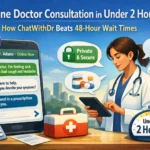 Online Doctor Consultation in Under 2 Hours: How ChatWithDr Beats 48-Hour Wait Times
  Online Doctor Consultation in Under 2 Hours: Why Speed Matters for Telehealth Urgent Care