
Getting a prescription refilled online has moved from a niche convenience to an essential part of modern healthcare. So, how does it all work? In short, you connect with a licensed doctor through a secure platform, discuss your ongoing medication needs, and they send an electronic prescription directly to your pharmacy. It’s the new, common-sense way to manage chronic conditions safely and efficiently.
The New Standard for Managing Your Prescriptions

The idea of an online doctor prescription refill isn't some futuristic concept anymore—it's a practical reality for millions. This guide will walk you through the entire process, step by step, so you can handle it with total confidence.
Forget rearranging your whole day for a quick clinic visit or sitting on hold forever just to speak with a nurse. Telehealth puts control right back in your hands. This is especially helpful if you're managing an ongoing health concern, as it ensures you never miss a dose of vital medication. It just wipes out common hassles like transportation issues, taking time off work, or the simple inconvenience of an in-person appointment for a routine need.
Why Digital Refills Are Gaining Momentum
The move toward digital healthcare is more than just a trend; it's a fundamental change in how we manage our health. Recent data shows this perfectly. A landmark 2025 survey found that 38% of U.S. adults have bought prescription medicines online. Among that group, a massive 55% now get most or all of their prescriptions digitally.
The reasons are crystal clear: 31% love the time savings, 29% point to better affordability, and 27% value the improved access to care. You can dive into the full findings from the ASOP Global Foundation for a deeper look at this shift.
Think of this guide as your roadmap to understanding:
- Who is actually eligible for online refills
- How to get ready for your virtual visit
- What to expect during the actual consultation
- How to pick a safe, legitimate, and trustworthy service
By using telehealth for your prescription management, you’re not just saving a little time. You’re adopting a proactive, modern approach to your own health, giving you consistency and peace of mind with every single refill. This is about making healthcare finally work for your life, not the other way around.
Are You Eligible for an Online Prescription Refill?
Before you jump into a virtual consultation, the first question to ask is a simple one: is your situation a good fit for telehealth? An online doctor prescription refill is a game-changer for managing stable, chronic conditions that rely on non-controlled medications.
Think of it this way: if you're consistently taking a statin for high cholesterol or need your routine inhaler refill for well-managed asthma, a virtual visit is perfect. These scenarios are exactly why telehealth shines—it lets you safely continue a treatment plan you're already on, without the hassle of a trip to the doctor's office.
What Kinds of Medications Are a Good Fit?
The biggest factor in your eligibility is the type of medication you need. Most online platforms are set up to handle refills for a huge range of common, non-controlled drugs.
This typically includes medications for:
- Heart Health: Things like blood pressure medications and statins for cholesterol.
- Breathing Issues: Routine asthma inhalers and allergy medications.
- Hormonal & Metabolic Conditions: Thyroid medication and metformin for diabetes.
- Mental Wellness: Many common antidepressants (SSRIs) and anxiety medications.
- Other Everyday Needs: Birth control, acid reflux medications, and various skin creams.
This isn't a niche service anymore; it's becoming mainstream. The global market for online prescription refills was valued at around USD 25.3 billion in 2023 and is expected to rocket to nearly USD 54.7 billion by 2032. This incredible growth is driven by people managing chronic conditions who need reliable, easy access to their medications.
The Hard Line: Controlled Substances
Now for the important exception. This convenient route isn't available for every type of prescription. Federal laws, most notably the Ryan Haight Act, put strict guardrails on prescribing controlled substances through telehealth. These are medications with a higher potential for abuse, so they require a much closer, often in-person, evaluation.
This is all about patient safety. A doctor needs to establish a clear medical need and monitor these specific medications very carefully, which is why an initial in-person visit is almost always required for controlled drugs.
This means you generally can't get an online-only prescription for medications like:
- Opioid Pain Relievers: Such as Vicodin or OxyContin.
- Stimulants: Including Adderall or Ritalin, commonly used for ADHD.
- Certain Anxiety Medications: Benzodiazepines like Xanax or Valium.
If your medication is on this list, you'll need to see a doctor in person to get things started. Knowing these rules from the get-go helps you set the right expectations and choose the right path for your care. For a better idea of what can be refilled online, you can explore the different types of online prescriptions available.
A successful online doctor prescription refill really comes down to a few minutes of smart prep. It's less like a traditional doctor's visit and more like a focused, efficient check-in. Getting your ducks in a row beforehand means the physician has everything they need to make a safe and informed decision, which gets you on your way much faster.
This isn’t just about having a decent internet connection; it's about coming to the virtual table with the right information. When you have your details organized, you’re not just a passive patient—you’re an active partner in your own healthcare.
Get Your Key Info Ready
Before you even think about logging on, take a moment to pull a few things together. Having these items on hand will prevent any back-and-forth and show the doctor you mean business. It’s a simple step that makes a world of difference.
You’ll want to have these handy:
- A Government-Issued Photo ID: This is standard practice. It’s a critical safety step to verify your identity before any prescriptions are written.
- Your Current Prescription Bottle: If you can, have the actual bottle with you. Even better? Snap a clear photo of the label. This gives the doctor the exact medication name, dosage, prescribing physician, and pharmacy info all in one go.
- Your Go-To Pharmacy Details: Know the exact name, address, and phone number of the pharmacy where you want your prescription sent. Don't just say "the CVS on Main Street"—there are probably three of them. Be specific to avoid any mix-ups.
Having this stuff ready transforms the consultation from a frantic scramble for information into a smooth, professional conversation.
Be Clear About What You Need
Clarity is your best friend in a virtual appointment. A vague request like "I need more pills" is a surefire way to slow things down. The more precise you are, the faster the doctor can grasp your situation and help.
For instance, try saying: "I need a 90-day refill for my Losartan 50mg, which I take daily for hypertension." That single sentence covers the medication, dose, duration, and condition. It’s incredibly efficient.
I’ve learned that preparing a quick list of all your current medications—including over-the-counter vitamins or supplements—is one of the most helpful things you can do. This complete picture helps the doctor screen for potential drug interactions and ensures your refill is both appropriate and safe.
Finally, find a quiet, private spot for the consultation. Whether it's a text-based chat or a video call, your medical information is sensitive. Making sure you're in a confidential space allows you to communicate openly without distractions, which is the foundation of good medical care. It's a simple act of respect for your own privacy and helps the doctor focus completely on you.
What to Expect During the E-Prescription Process
So you've gathered your info and started a consultation. What happens next? Getting your online doctor prescription refill is actually a lot more straightforward than you might think. Knowing how the process flows—from the doctor's review all the way to your phone buzzing with a "ready for pickup" text—helps take any guesswork out of the experience.
Most telehealth platforms, especially for something routine like a refill, rely on a chat-based or asynchronous model. This just means you're not on a live video call. Instead, you communicate through secure messages and forms, which is incredibly efficient for everyone involved. A licensed physician can review your intake form, medical history, and specific refill request on their own time, giving it a thoughtful and thorough evaluation without the rush of a real-time appointment. You can learn more about how this convenient process works to see if it’s the right fit for you.
From Digital Consultation to Pharmacy Pickup
Once you hit "submit" on your information, a doctor will review it promptly. Don't be surprised if they send a follow-up question through the secure chat. They might need a little more clarity on something, like asking if your symptoms have changed or just confirming your pharmacy's address. This back-and-forth is all secure and part of the official record.
If everything looks medically appropriate, the doctor approves the request and generates an e-prescription. This is a secure, digital order sent directly to your pharmacy's computer system. It's way faster and less prone to the errors that can happen with old-school paper or faxed prescriptions.
This little graphic breaks down the essential prep steps for a super smooth virtual visit.
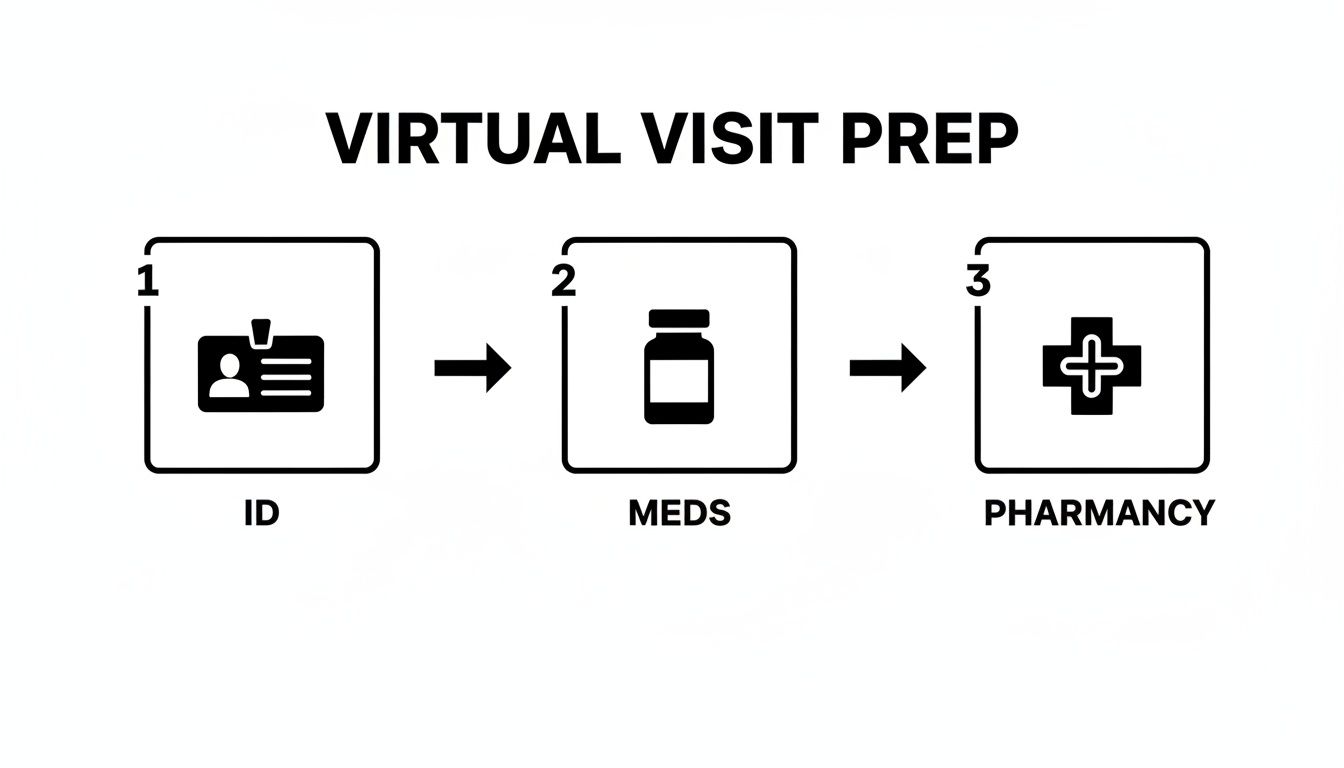
Honestly, just having your ID, medication details, and pharmacy info ready to go makes the entire process faster for both you and the physician.
Timelines and Costs
While the virtual consultation itself can be wrapped up very quickly—often in just a couple of hours—remember that your pharmacy still needs time to do its thing. After the doctor sends the e-prescription, give your pharmacy a little time to fill it before you head over. Most will send you a text or email notification the moment it's ready for pickup.
As for the cost, many telehealth platforms operate on a simple flat-fee basis for the consultation. This transparency is a huge plus, since you know the exact cost before you even start. Insurance coverage for these visits can vary, so it's always smart to check with your provider. The prescription itself, however, is typically covered by your insurance at the pharmacy just like any other.
Different telehealth models serve different needs. This table can help you figure out which format is best for your situation.
Comparing Online Consultation Methods
| Method | Best For | Typical Cost | Speed |
|---|---|---|---|
| Asynchronous Chat/Forms | Routine refills, common issues (UTIs, colds), follow-ups | $30 – $75 | Very fast (often under 2 hours) |
| Live Video Call | New conditions, mental health, issues needing visual assessment | $75 – $200+ | Immediate, but requires scheduling |
| Phone Call | Simple questions, tech-limited users | $50 – $150 | Slower than chat, requires scheduling |
Ultimately, for a straightforward refill, the asynchronous chat model is usually the fastest and most cost-effective way to get what you need.
The move to digital healthcare is making a massive difference. Studies show telemedicine can slash prescription processing times by 40%, push patient satisfaction over 85%, and even improve medication adherence by 28%. This efficiency is exactly why getting an online doctor prescription refill has become a go-to solution for millions of people who need reliable, convenient healthcare.
Choosing a Safe and Reputable Refill Service
In the world of digital health, safety isn't just a feature—it's the foundation of everything. With so many options popping up for an online doctor prescription refill, knowing how to spot a legitimate service is essential for your well-being. The truth is, not all platforms are created equal, and your goal should be to find one that puts your health and privacy above all else.
The single most critical factor to look for is HIPAA compliance. The Health Insurance Portability and Accountability Act is the federal law that sets the gold standard for protecting your sensitive health information. Any reputable U.S.-based telehealth service will be completely transparent about its HIPAA-compliant practices, using encryption and secure servers to keep your data locked down.
Key Indicators of a Trustworthy Platform
Beyond data security, a trustworthy service operates with complete transparency and medical integrity. It's not enough to get a prescription; you need to know you're getting it from a qualified professional who has your best interests at heart.
Look for services that exclusively use:
- U.S.-licensed, board-certified physicians. This is non-negotiable. It ensures your consultation is handled by a doctor who meets the highest standards of medical practice right here in the United States.
- Transparent and upfront pricing. You should know exactly what the consultation costs before you pull out your wallet. Hidden fees are a massive red flag.
- Clear communication channels. A legit service will have a straightforward way to contact support and will provide clear, easy-to-understand information about its processes.
It’s also vital to consider how they handle information on potential drug interactions. Being aware of these details is part of responsible healthcare, and a good platform makes this accessible for understanding potential drug interactions and risks.
Red Flags to Watch Out For
Just as important as knowing what to look for is knowing what to avoid. Some websites operate in a gray area of legality and safety, and they often give themselves away with a few common warning signs.
A legitimate platform will always prioritize a real patient-doctor relationship, even a virtual one, to ensure your health and safety. If a service feels more like an impersonal vending machine than a medical consultation, it’s best to look elsewhere.
Be extremely wary of any website that:
- Offers to prescribe controlled substances online. With very few exceptions, federal law requires an in-person visit for drugs like opioids, stimulants, or benzodiazepines. Any site promising these is a huge risk.
- Provides prescriptions without any consultation. If a doctor doesn't ask you questions about your health history and current condition, they are not practicing responsible medicine. Period.
- Uses doctors who are not licensed in the U.S. Verifying a physician’s credentials is a cornerstone of safe telehealth. If you can't find this information easily, walk away.
- Makes unrealistic promises. Guarantees of a prescription before a consultation even begins are a clear sign of a fraudulent operation.
By keeping these points in mind, you can confidently choose an online refill service that is safe, effective, and professional.
Common Questions About Online Prescription Refills
Even with how easy it is to get a prescription refilled online, it’s completely normal to have a few questions before you jump in. The process is pretty straightforward, but getting a handle on the specifics will give you the confidence you need to manage your health without any headaches. Let's clear up a few of the most common uncertainties.
Can I Get a New Prescription from an Online Doctor?
Yes, in many cases, you absolutely can. Telehealth doctors are more than equipped to diagnose and prescribe initial treatments for a whole host of common, non-emergency conditions. Think of things like sinus infections, urinary tract infections (UTIs), or annoying skin rashes.
That said, this service is really designed for those straightforward health concerns. If you're looking to start treatment for a new chronic disease, are dealing with complex symptoms, or need a hands-on physical exam, an in-person visit with your primary care provider is still the way to go. It's always a good idea to check a platform's scope of services to see what they cover before you begin.
What Happens if My Online Refill Request Is Denied?
A denial isn't a failure—it’s actually a sign of responsible medical practice. A U.S.-licensed doctor might deny a refill if they believe it isn't medically safe without seeing you in person, if your symptoms have changed since your last prescription, or if you need lab work to monitor your condition.
A denial is just a professional judgment call made to ensure you get the safest, most appropriate care. Think of it as a protective measure, not a roadblock.
For example, certain blood pressure medications require occasional kidney function tests to make sure they're working safely. If your request gets denied, the doctor will always explain why and lay out clear next steps, which usually means seeing your primary care physician for a closer look.
How Does Insurance Work with These Services?
This is a big one, and the answer can vary. Many insurance plans now cover telehealth consultations, often with a standard copay just like you'd pay for an in-person visit. Still, you absolutely have to check with your insurance provider directly to understand what your specific plan covers.
The prescription itself is covered at the pharmacy by your insurance, just as it normally would be. Another model that's getting really popular involves telehealth platforms that operate on a direct-to-consumer basis. These services charge a flat, transparent fee for the consultation. This can be a fantastic, cost-effective option, especially if you're uninsured or have a high-deductible plan, because you know the exact cost right from the start.
Is My Personal Health Information Kept Private?
Absolutely, as long as you choose a reputable platform. All U.S. telehealth services are required by law to be HIPAA-compliant. The Health Insurance Portability and Accountability Act (HIPAA) enforces incredibly strict rules to protect your sensitive health data.
This isn't optional; it includes mandatory practices like:
- End-to-end encryption for all communications between you and the doctor.
- Secure server infrastructure for storing your medical records.
- Strict access controls so only authorized people can ever view your data.
Before signing up for any service, look for its "Notice of Privacy Practices" or a clear statement about its HIPAA-compliant technology. This confirms the platform takes your privacy seriously. For more detailed answers, you can almost always find a comprehensive list of frequently asked questions on the service's website. You can find ours right here: https://chatwithdr.com/faq.
Related posts:
 Medication Refill Online Doctor: medication refill online doctor for fast access
  Your Guide to a Cheap Online Prescription Refill
  How to Use an Online Doctor for Refills The Simple Way
  A Complete Guide to Online Doctor Prescription Refills
  The 7 Best Online Doctor Services of 2025: A Detailed Review