
Think of an online primary care consultation as your neighborhood doctor's visit, but without the commute, the waiting room, or the hassle. It’s a way to connect with a board-certified physician for diagnoses, treatment plans, and prescriptions, all from your phone or computer.
You get the professional medical advice you need, right from the comfort of your home.
Your Doctor Visit, Reimagined for Modern Life
An online primary care consultation is basically the new front door to your healthcare. Instead of having to schedule an appointment weeks out, drive across town, and flip through old magazines in a waiting room, you get medical care right on your device. This modern approach swaps the physical clinic for a secure, virtual one, making healthcare something that fits into your life, not the other way around.
This isn't just a niche trend; it’s a fundamental change in how people are taking control of their health. The global market for online doctor consultations is exploding—it's projected to jump from USD 11.93 billion in 2025 to a massive USD 38.26 billion by 2030. That kind of growth tells you everything you need to know about how much people trust and rely on virtual care for their everyday medical needs.
Key Differences Between Online and In-Person Care
While both paths lead you to a qualified doctor, the experience is completely different. An in-person visit is absolutely necessary for things that require a hands-on physical exam or specific procedures. But for a huge number of common health issues, an online consultation is just faster and more efficient.
An online primary care consultation bridges the gap between needing medical advice and the real-world hurdles of a traditional office visit. It puts the focus squarely on patient convenience and getting you answers—fast.
Different types of consultations work in slightly different ways. For example, you can explore guides on specific services like online mental health assessments to see how they are structured.
To help you see the core differences at a glance, we’ve put together a quick comparison.
Online vs In-Person Primary Care at a Glance
This table breaks down the main distinctions between getting care online versus heading into a clinic. It’s a simple way to see which option might be the best fit for your needs right now.
| Feature | Online Consultation | In-Person Consultation |
|---|---|---|
| Convenience | Access care from absolutely anywhere, 24/7. Often, no appointment is even needed. | Requires travel to a clinic and sticking to their strict business hours. |
| Wait Times | Minimal to none. You can often get a diagnosis and treatment plan within a few hours. | Can involve long waits in the lobby and scheduling appointments days or weeks out. |
| Cost | Usually a transparent, flat fee. ChatWithDr, for example, is just $39.99 per visit. | Varies widely based on your insurance copay, deductibles, and hidden clinic fees. |
| Scope of Care | Perfect for common, non-emergency issues like UTIs, skin rashes, and prescription refills. | Necessary for physical exams, lab work, vaccinations, and complex or urgent health problems. |
Ultimately, having both options available means you can choose the right type of care for the right situation, giving you more control over your health than ever before.
How Your Virtual Doctor Visit Actually Works
If you've never had an online primary care consultation, the whole idea might feel a bit mysterious. But the process is actually much simpler—and a lot faster—than your typical clinic visit. It boils down to a few straightforward steps that get you from feeling sick to having a solid treatment plan, often in just a few hours.
Think of it like ordering a custom-tailored suit online. Instead of a tailor taking your measurements in person, you provide them yourself through a detailed form. The more accurate your information, the better the final fit. In healthcare, this means a more precise diagnosis.
Step 1: Start Your Consultation
It all begins when you pick a platform and tell it what's wrong. With a service like ChatWithDr, you just select your condition from a list of common issues, like a sinus infection or a UTI. This first step gets your case pointed in the right direction, telling the medical team exactly what kind of information they'll need from you.
Step 2: Complete a Secure Medical Intake
Next, you'll fill out a secure, HIPAA-compliant medical questionnaire. This is the most important part of your virtual visit. You’ll describe your symptoms, share your medical history, list any medications or allergies, and upload photos if they’re helpful (like for a skin rash). Being thorough here is everything; your detailed answers give the physician the clear picture they need to make a confident diagnosis without a physical exam.
This chart shows just how different the online process is from a traditional in-person visit.
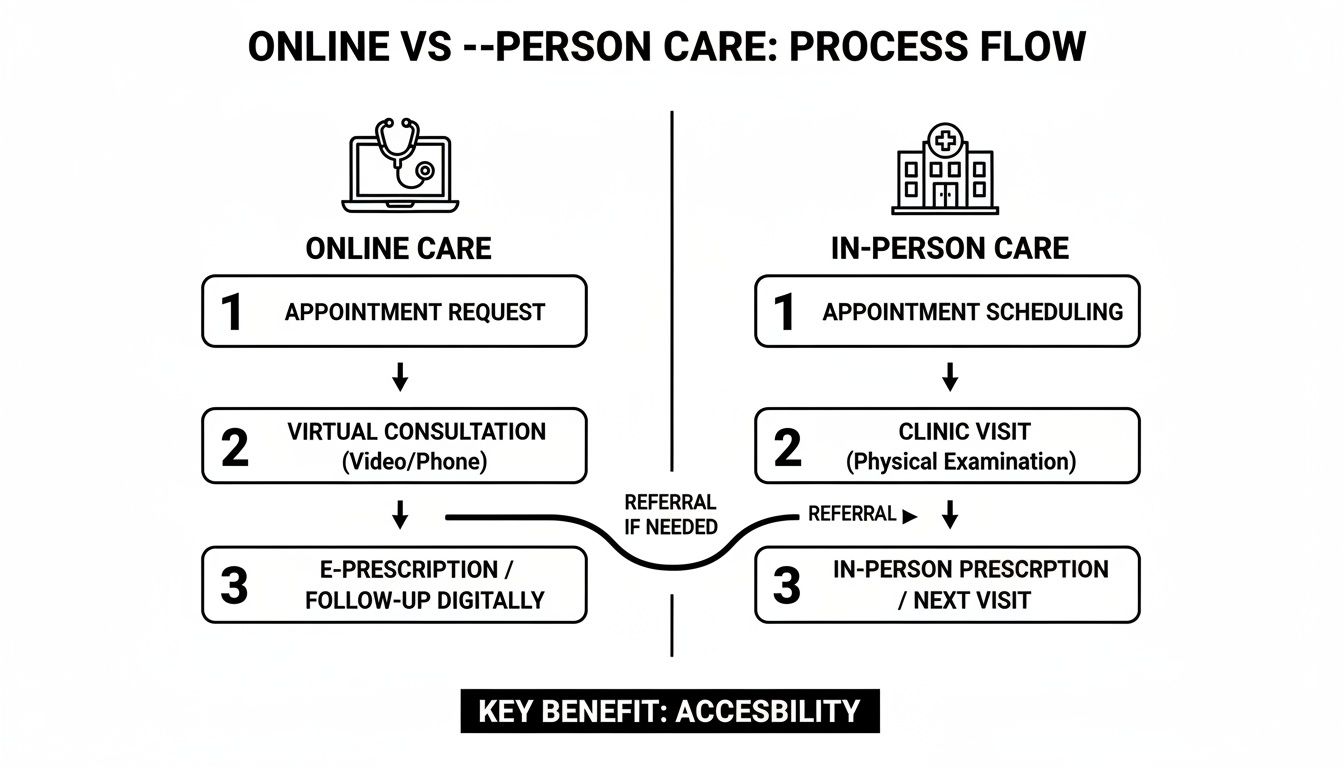
As you can see, the online route cuts out the biggest hassles, like travel time and sitting in a waiting room.
And it’s a model that’s rapidly gaining trust. In 2024 alone, over 116 million people worldwide used an online primary care consultation for minor illnesses and health screenings. This reflects a huge shift in how people get care. In fact, data from 22 OECD countries showed that 13% of all doctor consultations were done remotely back in 2023.
Step 3: Doctor Review and Diagnosis
Once you hit "submit," your information goes to a board-certified, state-licensed physician for review. They’ll carefully go over everything you’ve provided to make a professional medical diagnosis. On text-based platforms, this happens "asynchronously," which is a fancy way of saying you don't have to be on a live call. The doctor works on your case behind the scenes, fitting it into their day.
Step 4: Receive Your Personalized Treatment Plan
Finally, you’ll get your diagnosis and a personalized treatment plan delivered right to you. This usually includes medical advice, lifestyle recommendations, and, if needed, an e-prescription sent straight to your pharmacy. You'll get a notification the moment it's ready, wrapping up a process built for speed and convenience.
To get a feel for how this patient-first approach works from start to finish, you can explore how the ChatWithDr service works.
What Can You Actually Treat with Online Primary Care?
It’s the first question on everyone’s mind: “Can a doctor really figure out what’s wrong with me through a screen?” For a surprisingly wide range of common health issues, the answer is a definite yes. Telehealth has grown up, and it’s now incredibly effective for most of the everyday, non-emergency problems that throw a wrench in your day.
Think of it like calling a trusted mechanic. You wouldn’t ask them to rebuild your engine over the phone, but for a strange rattling noise or a check engine light, a quick chat is often all they need to diagnose the problem and tell you exactly what to do next. Online primary care operates on the same principle, focusing on conditions where a doctor’s experienced ear and your detailed symptoms are more important than a hands-on physical exam.

Everyday Urgent and Acute Care
This is where virtual care is an absolute game-changer. So many common illnesses follow a predictable script that an experienced physician can spot from a mile away, just by listening to your symptoms. These are the exact same issues that would send you to a packed urgent care clinic, but now you can get treated without ever leaving your couch.
Some of the most common urgent care issues treated online include:
- Respiratory Infections: Think sinus infections, bronchitis, and that miserable sore throat. A doctor can assess your symptoms to figure out if it’s a bacterial infection that needs antibiotics or a virus that just needs rest and supportive care. To see how this works for specific illnesses, check out how to treat cold, flu, and COVID symptoms online.
- Urinary Tract Infections (UTIs): The tell-tale symptoms of a UTI are so distinct that it’s one of the easiest and most common conditions to treat remotely.
- Eye and Ear Infections: Problems like pink eye or swimmer's ear are frequently diagnosed and treated virtually, often with just a description of the symptoms and maybe a quick photo.
Chronic Condition Management and Prescription Refills
If you’re managing an ongoing health condition, telehealth offers a brilliantly simple way to get routine prescription refills without the hassle of a quarterly office visit. As long as your condition is stable and you don’t need new physical tests, a virtual consultation is perfect for keeping your treatment plan on track. This is ideal for refills for medications managing things like blood pressure, cholesterol, and thyroid conditions.
An online primary care consultation isn’t a substitute for emergency care, but it’s an incredibly powerful tool for handling the vast majority of everyday health concerns that disrupt your life.
Specific Health Categories
Beyond general urgent care, online platforms are perfectly set up to handle specific health areas where convenience, speed, and privacy are essential.
- Dermatology: A picture is worth a thousand words. Many skin conditions—like acne, mysterious rashes, and eczema—can be diagnosed with a few clear photos. A physician can see what’s going on and prescribe the right cream or medication.
- Women's Health: This is a huge one. Get convenient and quick access to birth control prescriptions or treatment for common issues like yeast infections without the wait.
- Men's Health: Virtual care provides a discreet and straightforward way to get help for conditions such as erectile dysfunction (ED), premature ejaculation (PE), and hair loss.
By handling these kinds of conditions remotely, services like ChatWithDr give you a faster, more direct path to feeling better.
Comparing the Benefits and Limitations of Virtual Care
Deciding between an online primary care consultation and a traditional office visit can feel like choosing between two very different tools for the same job. Both are designed to get you the medical care you need, but each one really shines in different situations. Let's take a clear, honest look at the pros and cons of each so you can confidently pick the right one for what you're dealing with right now.
The biggest draw of virtual care, without a doubt, is the incredible convenience. It strips away almost all the usual hassles of a doctor’s visit—no commute, no germ-filled waiting rooms, and no need to block off half your day. For people with packed schedules, mobility issues, or those living far from a clinic, this isn't just a nice perk; it's an absolute game-changer for staying on top of their health.
The Major Advantages of Going Virtual
Affordability is another huge win. When you look at services like ChatWithDr, you get a completely transparent, flat fee of just $39.99 per consultation. This kind of predictable pricing is a huge relief, especially when you compare it to the surprise bills and confusing insurance claims that often come with in-person visits. You know exactly what you’re paying before you even start.
Beyond the savings and simplicity, online care offers:
- Speed: You can get a diagnosis, a treatment plan, and even a prescription sent to your pharmacy, often in just a few hours.
- Privacy: Text-based chats offer a discreet way to handle sensitive health issues from the comfort and security of your own home.
- Accessibility: It breaks down geographic barriers, giving anyone with an internet connection access to a board-certified physician, no matter where they live.
Virtual care is built for the pace of modern life. It prioritizes getting you fast, affordable answers for common health issues so you can get back to your day without disruption.
Understanding the Inherent Limitations
That said, it’s crucial to be realistic about what an online consultation can't do. The biggest limitation is the lack of a physical exam. A doctor can’t listen to your lungs, check your blood pressure, or physically press on a painful spot through a screen. This makes virtual care the wrong choice for complex symptoms or anything that really needs a hands-on assessment.
Likewise, online care is not for medical emergencies. Things like severe chest pain, trouble breathing, or a serious injury demand an immediate, in-person evaluation at an emergency room. Virtual doctors are trained to spot these red flags and will tell you to seek emergency care, but they can't manage a true crisis.
Comparing Online vs. In-Person Care
To help make the choice crystal clear, it’s useful to see the options side-by-side. Think of this table as a quick guide to help you decide which path makes the most sense for your current health needs.
| Aspect | Online Primary Care | In-Person Primary Care |
|---|---|---|
| Best For | Common, non-emergency issues like UTIs, sinus infections, rashes, and prescription refills. | Complex symptoms, emergencies, physical exams, vaccinations, and chronic disease monitoring. |
| Key Benefit | Unmatched speed, convenience, and transparent, affordable pricing. | Ability to perform hands-on physical exams and complex diagnostic tests. |
| Main Drawback | Cannot conduct physical exams or manage medical emergencies. | Requires travel, scheduling, and often involves long wait times and unpredictable costs. |
In the end, it’s not about one being definitively "better" than the other; it’s about choosing the right care for the right situation. By understanding both the powerful benefits and the clear limitations of an online primary care consultation, you can make a smart, informed decision that always puts your health first.
Figuring Out the Cost: Insurance and Payment Options
Let's talk money. Navigating the financial side of an online primary care consultation can feel like a headache, but it’s usually more straightforward than you think. In fact, for many people, the clear, upfront pricing is one of the biggest reasons they choose virtual care in the first place. It gets rid of the guesswork and lets you sidestep confusing copays and surprise clinic fees.
This transparency is a massive shift from traditional healthcare billing. The whole point is to give you a predictable, all-in cost so you can focus on getting better, not on worrying about a mysterious bill showing up weeks down the line.
How Different Payment Models Work
Online care platforms generally fall into two buckets: monthly subscriptions or a simple pay-per-visit model. While a subscription can be a good deal if you need to talk to a doctor frequently, the pay-per-visit approach offers the most flexibility for those one-off, urgent health concerns.
For example, a service like ChatWithDr keeps it refreshingly simple with a flat fee of $39.99 for every consultation. That price covers everything—the doctor's review of your case, your diagnosis, and a personalized treatment plan. You only pay when you actually need care, making it an incredibly affordable option for immediate health issues without getting locked into a long-term commitment.
The best online care models are built on transparent, flat-fee pricing. It ensures you know the full cost before your consultation even begins, which completely removes the financial uncertainty so common in traditional healthcare.
Navigating Insurance and Prescriptions
A common question is, "Where does my insurance fit in?" For most of these direct-to-consumer platforms, you pay for the consultation itself out of pocket. But that doesn't mean your insurance is useless.
If your doctor prescribes medication, that prescription gets sent to your local pharmacy. That's where you'll use your insurance to cover the cost of the medicine, just like you always have. Think of it this way: the consultation fee is for the doctor's time and expertise, while your insurance kicks in for the pharmacy side of things.
To make access even easier, most platforms accept a variety of payment methods:
- Credit and Debit Cards: The most common and straightforward option.
- HSA/FSA Accounts: You can use your pre-tax Health Savings Account or Flexible Spending Account funds to pay for your consultation. This is a smart way to use money you've already set aside for medical expenses.
How to Prepare for a Successful Online Consultation
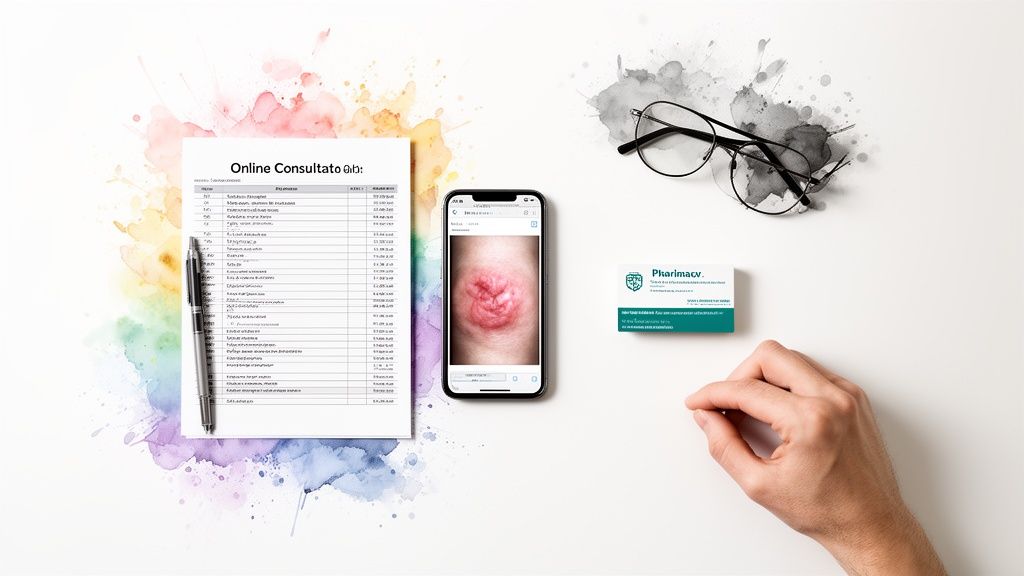
Getting the most out of your online primary care consultation really comes down to teamwork. A little bit of prep work on your end helps your physician get the clear, high-quality information they need to give you a fast and accurate diagnosis.
Think of it like packing for a trip—having everything you need ready to go makes the journey much smoother. Before you even start, take a few moments to gather some key details.
Your Pre-Consultation Checklist
Before you book a consultation, just five minutes of organizing can make all the difference. Here’s what to have on hand:
- Medical History & Medications: Jot down a quick list of any ongoing health conditions, past surgeries, and all the medications you're currently taking. Don't forget to include dosages and any vitamins or supplements.
- Symptom Summary: Note what your symptoms are, exactly when they started, and anything that seems to make them better or worse. A clear timeline is incredibly helpful for your doctor.
- Clear Photos: For anything visible, like a skin rash or pink eye, snap a few photos in good, natural light. Good lighting makes a massive difference for a remote diagnosis.
- Pharmacy Details: Keep the name, address, and phone number of your preferred pharmacy ready. This ensures any prescriptions can be sent over without a single delay.
When you have this information ready beforehand, your consultation becomes a genuinely efficient, collaborative process. It gives your doctor everything they need to provide the best possible care right away.
To make sure the whole experience goes smoothly, it's always a good idea to follow a clear process, much like this helpful step-by-step guide for online sessions.
Your Questions About Online Primary Care Answered
It's totally normal to have a few questions when you're trying a new way to see a doctor. When something feels off, you want to be sure you’re in good hands. To help you feel confident, we've answered some of the most common concerns people have about online primary care. Let’s clear up any doubts you might have.
Are Online Doctors Real Licensed Physicians?
Yes, absolutely. Every single physician you connect with on a reputable telehealth platform is a real, board-certified, and state-licensed medical professional. For instance, a service like ChatWithDr works exclusively with U.S.-based doctors who’ve all gone through a rigorous verification process.
You're being treated by the same caliber of professional you'd see in a traditional clinic. The only thing that’s different is the setting.
Is My Personal Health Information Safe and Private?
Patient privacy isn't just a promise; it's the law. Leading online care platforms are required to be HIPAA-compliant, which is the exact same federal standard for data protection that every hospital and clinic in the U.S. must follow.
Your consultation is confidential and secure. These platforms use enterprise-grade security and encryption to shield all your personal and medical information, making sure your data is kept safe from anyone who shouldn't see it.
This means you can share your health concerns with the same level of confidence you would in your family doctor’s office.
What Happens If I Need a Physical Exam or Lab Work?
Online primary care is expertly designed for conditions that can be safely diagnosed and treated based on your symptoms, medical history, and sometimes photos. It’s perfect for many common issues, but it isn’t a replacement for hands-on care when it’s truly needed.
If the physician reviewing your case determines that your condition requires a physical exam, lab tests, or imaging, they'll tell you right away. They will guide you on the right next steps and advise you to seek in-person care. They can't manage medical emergencies, so for any life-threatening symptoms, you should always go straight to the nearest emergency room.
Ready for fast, professional medical care without leaving your home? Get a diagnosis and treatment plan from a U.S.-licensed physician in just hours. Start your ChatWithDr consultation today for just $39.99 at https://chatwithdr.com.