

When that scratchy, tickling sensation in your throat kicks off a coughing spell, your first thought is probably, "How do I make this stop right now?" The good news is, you likely already have everything you need for immediate, soothing relief right in your kitchen.
You don't need a complicated action plan. The most effective first steps are often the simplest ones that get right to the source of the irritation.
Think of these remedies as first aid for your airways. They work by hydrating dry tissues, calming inflammation, or coating the irritated lining of your throat to stop that tickle in its tracks. It's all about calming the immediate distress before it turns into a coughing fit that ruins your day or keeps you up all night.
Your First Steps for Immediate Relief

Comparing At-Home Remedies for Quick Relief
To help you choose the best approach for what you're feeling, here’s a quick rundown of the most effective at-home remedies. Each one offers a unique benefit, so you can pick what makes the most sense for you in the moment.
| Remedy | How It Helps | Best For | Typical Relief Time |
|---|---|---|---|
| Warm Salt Water Gargle | Reduces swelling by drawing out excess fluid from inflamed tissues. | A raw, swollen, or scratchy throat. | Immediate, temporary relief. |
| Honey | Acts as a demulcent, coating and soothing the throat. Natural cough suppressant. | A dry, tickly cough and general throat soreness. | A few minutes. |
| Warm Fluids (Tea, Broth) | Hydrates tissues and the warmth soothes irritated throat muscles. | General dryness and soreness. | Immediate comfort. |
| Humidifier / Steam | Adds moisture to the air, preventing throat and nasal passages from drying out. | A dry cough, especially at night, and congestion. | 15-20 minutes. |
These simple, time-tested remedies are your first line of defense. They are safe, effective, and can make a huge difference in how you feel, often within minutes.
Hydration and Moist Air
The absolute foundation for soothing an itchy throat and cough is moisture. A dry throat is an irritated throat, and that irritation is exactly what triggers the cough reflex.
- Drink Warm Fluids: Herbal tea, warm water with lemon, or even a simple cup of clear broth can feel incredibly comforting. The warmth helps relax your throat muscles while the liquid gets to work hydrating those parched tissues.
- Use a Humidifier: Running a cool-mist humidifier, especially in your bedroom at night, is a game-changer. It adds moisture back into the air, preventing your airways from drying out while you sleep—a classic reason for waking up with a hacking cough.
- Try a Steamy Shower: The steam from a hot shower offers immediate, though temporary, relief. It moistens your throat and nasal passages, helping to soothe that raw, scratchy feeling.
Keeping things moist creates an environment where irritation simply can't thrive. It’s a basic but powerful strategy for calming things down.
Soothing Natural Remedies
Beyond just adding moisture, some natural remedies have proven properties that take relief a step further.
Honey is a real standout here. It’s a natural demulcent, which is a fancy way of saying it forms a soothing film over the mucous membranes in your throat. This provides an instant coating that quiets that raw, itchy sensation. Its anti-inflammatory properties don't hurt, either.
A spoonful of honey, especially before bed, has been shown to be as effective as some over-the-counter cough suppressants in calming nighttime coughs, particularly in children over one year old.
Another time-tested method is the classic salt water gargle. Just dissolve half a teaspoon of salt into a glass of warm water and gargle for about 30 seconds. The salt helps draw excess fluid out of inflamed throat tissues, which reduces swelling and discomfort.
While these remedies are fantastic for short-term relief, sometimes symptoms stick around or get worse. If that's the case, getting professional medical advice is the right next step. For situations like that, you can get an online prescription after a quick, convenient evaluation right from home.
Identifying the Cause: Allergies or Infection?
To get a handle on that itchy throat and cough, you have to play detective first. Is your body duking it out with a virus, or is it overreacting to an allergen like pollen or dust? Pinpointing the source is the single most important step you can take.
Why? Because the treatment for an infection is a world away from the approach you’d take for allergies. Using allergy medicine for a cold is like bringing a rake to a snowball fight—it’s just the wrong tool for the job. You have to learn to spot the unique clues your body is giving you.
Key Differences in Symptoms
Infections, like the common cold or flu, usually bring a crew of other symptoms with them. These are tell-tale signs that your entire body is engaged in a battle. Allergies, on the other hand, are much more localized. They’re your immune system’s dramatic response to something harmless, and the symptoms are typically stuck to the areas that made contact—your nose, eyes, and throat.
Here’s what to look for:
- Fever and Body Aches: This is the classic signature of a viral infection. Your body cranks up its internal thermostat to fight off the invader, leaving you with chills and muscle soreness you just don't get with allergies.
- Mucus Color and Consistency: While it's not a perfect science, the mucus from allergies is almost always clear and watery. Infections often trigger thicker, yellowish, or even greenish mucus as your body’s white blood cells get to work.
- Symptom Onset: Did your symptoms seem to appear out of nowhere overnight? That sudden hit often points to a virus. Allergies tend to linger or show up predictably right after you’ve been around a trigger.
This distinction is crucial. During peak season, for instance, flu positivity rates can soar above 30% in tested cases. Knowing that a virus is making the rounds can give you some much-needed context for your own symptoms.
Consider Your Environment and Timing
Context is everything when you're trying to figure out what’s causing your itchy throat. Think about when and where your symptoms flare up.
Does your throat get scratchy every time you're outside on a windy spring day? That’s a massive hint that pollen is your problem. But if your symptoms kicked in right after your coworker was coughing all over the office last week, a virus is the much more likely culprit. The timing and your surroundings offer up the best clues.
A helpful rule of thumb is to look for itchiness. If your eyes, nose, and throat all feel incredibly itchy, lean toward allergies. Viruses cause soreness and irritation, but that intense, widespread itching is a hallmark of an allergic reaction.
Don't forget about your indoor environment, either. A persistent cough and itchy throat could be coming from irritants right inside your home, like dust mites or pet dander. Hidden environmental factors like mold can also be a major source of respiratory irritation. It's always a good idea to learn how to recognize signs of mold in your house just to rule out a sneaky, hidden cause.
By paying attention to these patterns, you can make a much more educated guess about the root cause and finally choose a path to relief that will actually work.
Navigating Over-The-Counter Medications
When home remedies just aren't cutting it, the pharmacy aisle offers a whole arsenal of options to calm that itchy throat and cough. But let's be honest, staring at that wall of boxes can be completely overwhelming. The real key is to match the active ingredient to your specific symptoms so you get relief without taking stuff you don't need.
The first step is learning to read the labels. A lot of "cold and flu" products are combination remedies, meaning they’re packed with multiple ingredients for different symptoms. While that might sound great, it’s usually much more effective to zero in on the one or two things that are really bothering you.
Choosing The Right Tool For The Job
Your cough is the biggest clue. Is it a dry, hacking cough that’s driving you crazy and keeping you up at night? Or is it a wet, gunky cough that feels like you have a swamp in your chest? Each one needs a totally different game plan.
A simple way to start is by figuring out if your body is fighting something off or just reacting to an irritant. This decision tree can help you narrow it down.
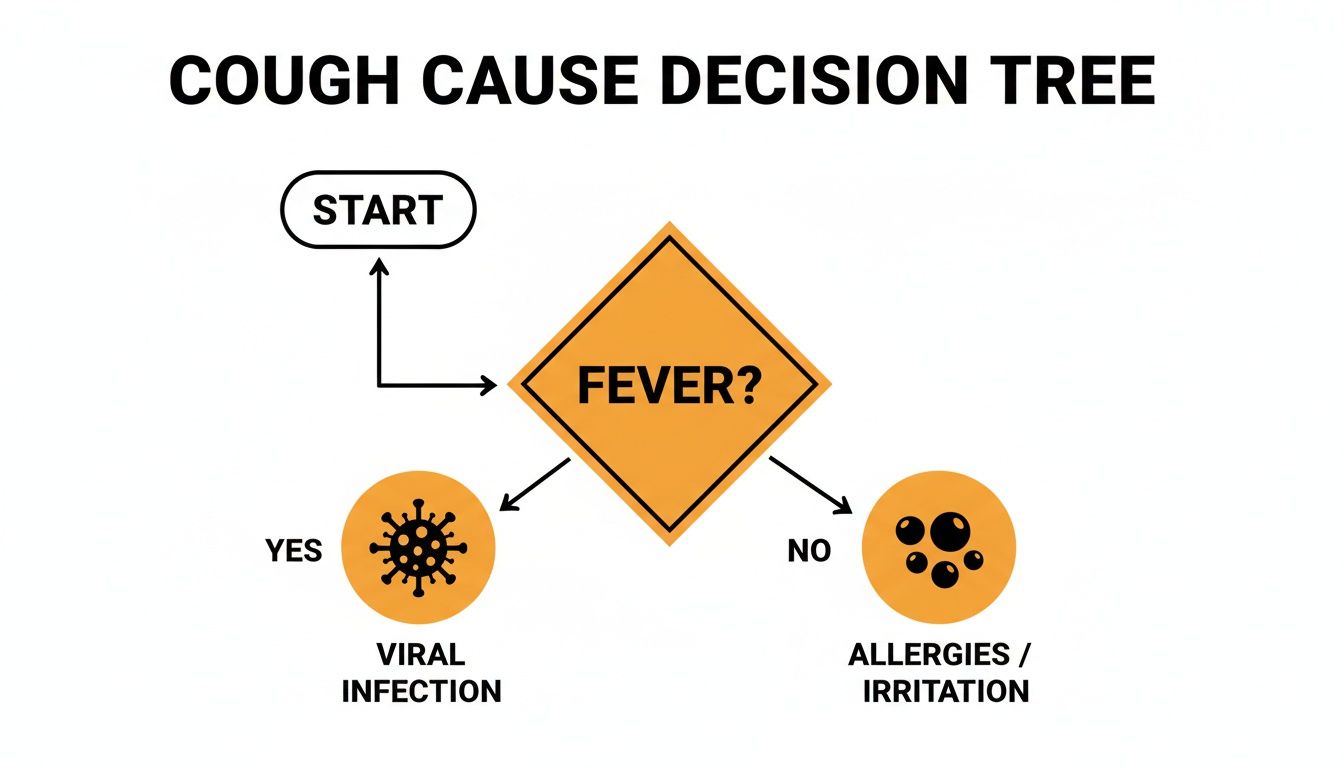
The takeaway here is pretty straightforward: a fever usually means your body is battling a virus. No fever? An allergen or irritant is a much more likely culprit.
Allergy Symptoms Vs. Congestion Symptoms
If you’ve pinpointed allergies as the source of that tickly throat, your strategy needs to shift. That dry, annoying cough is often caused by post-nasal drip—mucus dripping down the back of your throat.
In this case, an antihistamine can be a lifesaver. Medications with loratadine (Claritin®) or fexofenadine (Allegra®) work by blocking the histamine reaction that triggers all that itching and dripping in the first place. Stop the drip, and you often stop the cough.
But if a stuffy nose and sinus pressure are your main problems, a decongestant like pseudoephedrine or phenylephrine is what you’re looking for. These ingredients work by shrinking the swollen blood vessels in your nasal passages, which opens things up and helps you breathe again.
Your Guide to OTC Medications for Cough and Throat Irritation
To make it even simpler, think of the pharmacy aisle like a toolbox. You just need to know which tool to grab for which job. Here’s a quick breakdown of the most common options and what they’re actually for.
| Medication Type | Key Ingredient | Best Used For | Common Brand Names |
|---|---|---|---|
| Expectorant | Guaifenesin | Thinning mucus for a wet, productive chest cough. | Mucinex®, Robitussin Chest Congestion® |
| Cough Suppressant | Dextromethorphan (DM) | Quieting a dry, hacking, non-productive cough. | Delsym®, Robitussin DM® |
| Antihistamine | Loratadine, Cetirizine, Fexofenadine | Itchy throat, runny nose, and cough from allergies. | Claritin®, Zyrtec®, Allegra® |
| Decongestant | Pseudoephedrine, Phenylephrine | Nasal and sinus congestion accompanying a cough. | Sudafed®, Sudafed PE® |
Always remember to check the "Active Ingredients" section on the box. This helps you avoid accidentally taking too much of one ingredient, especially since many multi-symptom formulas already contain a pain reliever like acetaminophen or ibuprofen. Choosing a single-ingredient product that targets your main complaint is often the safest and most effective way to go.
A quick word of caution: It's so important to read labels carefully, especially if you have other health conditions. Decongestants like pseudoephedrine can raise blood pressure and heart rate, so they should be used very cautiously if you have hypertension.
When Your Cough Signals Something More
Most of the time, an itchy throat and a nagging cough are just your body's way of dealing with a minor bug or irritant. They’re annoying, but they’re temporary. But every so often, these symptoms are the first whispers of a much bigger health problem.
It’s easy to fall into a routine of self-treating with honey, tea, and whatever you can find at the pharmacy. But knowing the difference between a simple annoyance and a serious warning sign is crucial. Paying close attention to how your symptoms feel—and how they change over time—is what tells you when to stop guessing and get professional medical advice.
Red Flags You Should Not Ignore
Some symptoms are your body's alarm bells, telling you that a home remedy just isn't going to cut it. If you experience any of the following, it’s time to talk to a healthcare provider right away.
Key warning signs include:
- A high fever (above 101.5°F or 38.6°C) that won't come down with medication.
- Difficulty breathing, shortness of breath, or a feeling of tightness in your chest.
- A cough that brings up blood-tinged or rust-colored mucus.
- Symptoms that get a little better, only to come roaring back much worse.
- A cough that just won’t quit, lingering for more than three weeks without improving.
For instance, that cough that hangs around long after a cold seems to have cleared up could be a sign of a secondary infection like bronchitis or even pneumonia, both of which often need prescription medication to knock out.
Understanding Deeper Respiratory Threats
While most colds are mild, some viruses can pose a much greater risk, especially for older adults or people with other health issues. What feels like a simple cold with an itchy throat and cough can sometimes be caused by a more aggressive virus like Respiratory Syncytial Virus (RSV).
Adults fighting RSV-related respiratory infections face a shocking 2.7-fold higher risk of death within a year compared to their healthy peers. This really highlights how something that starts as a simple cough can signal a much deeper threat, particularly for those with pre-existing conditions. You can find more details in this in-depth Danish nationwide study.
If your itchy, scratchy cough persists or shows up with other alarming symptoms, it might point to more serious underlying conditions. It's always smart to be informed, and you can learn more about common lung cancer symptoms to stay aware of potential risks.
When your symptoms feel too serious to ignore, waiting days for a traditional doctor's appointment isn’t always practical. Getting a quick evaluation is key. For situations like these, services that provide online urgent care can give you a diagnosis and a treatment plan without the long wait, ensuring you get the right care exactly when you need it. Never hesitate to get professional help when your body is sending you clear warning signs.
Getting a Fast Diagnosis from Home

You've tried all the home remedies, but that itchy throat and cough are still winning. The last thing you want to deal with is the hassle of scheduling a doctor's appointment and waiting days for a visit, especially when you're feeling miserable right now.
Fortunately, modern healthcare offers a much faster path to professional care. Telemedicine has gone from a niche service to a mainstream solution for getting a diagnosis without ever leaving your house—or stepping into a germ-filled waiting room.
How Text-Based Care Works
Imagine getting a doctor's opinion without the awkward video calls or having to rearrange your entire day. Services like ChatWithDr have simplified the process of getting medical advice for common issues, especially a nagging cough and itchy throat that just won’t quit.
The process is refreshingly straightforward:
- Fill Out a Secure Form: You start by completing a secure, HIPAA-compliant online form. This is where you'll explain your symptoms, your medical history, and what you’ve tried so far.
- A Doctor Reviews Your Case: A board-certified, U.S.-licensed physician in your state looks over your information, often within just a couple of hours.
- Get Your Treatment Plan: The doctor sends you a diagnosis and a personalized treatment plan right through the secure platform. If you need medication, they send an e-prescription to your preferred pharmacy.
This text-based approach means no video calls, no travel, and no waiting. It’s available 24/7 across all 50 states for a single flat fee, making it a genuinely accessible option for just about everyone.
Getting a Prescription When You Need One
One of the biggest advantages of a telehealth consultation is the ability to get a prescription quickly if your symptoms call for it. Many persistent coughs are caused by infections that need targeted treatment to knock them out.
For example, Respiratory Syncytial Virus (RSV) is a common culprit behind itchy throats and nagging coughs. While supportive care has dramatically improved outcomes over the years, a prompt diagnosis is still key to managing it effectively.
This is where the efficiency of online care truly shines. Instead of waiting for an appointment to find out if you need an antibiotic for bronchitis or an antiviral for something else, you can get a diagnosis and have a prescription ready for pickup in hours.
This streamlined process puts you back in control of your health, on your own terms. For anyone needing fast, reliable medical advice, exploring options for an online doctor can be the quickest way to get back on your feet.
Common Questions About That Nagging Itchy Throat and Cough
When you're dealing with a cough that won't quit and an itchy throat that just won't let up, you're bound to have questions. Getting straight answers helps you figure out what to do next and when to worry. Here are the things people ask us most often.
How Long is This Cough Supposed to Last After a Cold?
It’s completely normal for a cough to be the last guest to leave the party after you’ve had a cold. That post-viral cough can hang around for three to four weeks while your airways are still inflamed and healing.
This is usually a dry, irritating kind of cough, all thanks to your airways being extra sensitive. But keep an eye on the calendar. If that cough is still with you after eight weeks, it's officially considered chronic and it's time to see a doctor to rule out other things like asthma or a secondary infection.
Can I Just Take Allergy Medicine for a Cough from a Cold?
Sometimes, but you have to know why you're taking it. If your cough is coming from post-nasal drip—that miserable trickle of mucus down the back of your throat—then yes, an older antihistamine that has a drying effect can definitely bring some relief. It goes right to the source of the irritation.
This isn't a one-size-fits-all fix, though. If you have a productive, chesty cough where the goal is to get mucus out, an expectorant like guaifenesin is a much better bet. Taking an antihistamine in that situation could actually make the mucus thicker and harder to cough up. Always match the medicine to the symptom.
Key Takeaway: If your cough comes with an itchy throat, sneezing, and watery eyes, those are all big clues an antihistamine could help. But if chest congestion is your main problem, grab an expectorant to clear things out.
Is My Itchy Throat Actually Strep?
Probably not, especially if a cough is one of your main symptoms. Strep throat is a bacterial infection that hits you with a sudden, severe sore throat, fever, and swollen tonsils that often have visible white spots. A cough is almost never part of the picture with strep.
When you have an itchy throat combined with a cough, runny nose, and sneezing, it almost always points to a virus (like the common cold) or seasonal allergies. Since strep needs antibiotics, guessing isn't a good strategy. If you really think it might be strep, a quick test from a doctor will give you a clear answer and get you on the right treatment fast.
When you need clear answers and a fast treatment plan without leaving home, ChatWithDr provides same-day consultations with board-certified physicians. Get a diagnosis and prescription sent to your pharmacy, all through a secure, text-based chat. Start your consultation now.