

When you’re stuck with the pounding head, facial pressure, and endless congestion of a sinus infection, the last thing you want to do is drag yourself to a doctor’s office. Getting sinus infection treatment online is a game-changer. It’s a fast, simple way to get a diagnosis and the right prescription from home, often in just a few hours, so you can start feeling better without ever leaving your couch.
Why Get Sinus Infection Treatment Online
Let’s be real—when you feel that miserable, traveling to an urgent care clinic is the absolute worst. Telehealth platforms are designed for exactly these moments, especially for common problems like sinusitis. The whole process is refreshingly straightforward: you explain what’s going on, a doctor reviews your symptoms, and they create a treatment plan just for you.
This approach pays off immediately:
- Speed and Convenience: You can get a diagnosis and have a prescription sent to your pharmacy, often in a couple of hours, all from the comfort of your sofa.
- Avoid Germs: Why sit in a crowded waiting room and expose yourself to other bugs when you’re already feeling down?
- Accessibility: Care is available 24/7, including nights and weekends. Perfect for busy schedules or when your symptoms decide to flare up at the worst possible time.

A Common Ailment Perfect for Virtual Care
Sinusitis is one of the top reasons people see a doctor, which makes it a perfect fit for telehealth. In fact, acute sinusitis is behind roughly 21.6 outpatient visits per 1,000 adults every year and is the number one reason for outpatient antibiotic prescriptions in the U.S. A 2020 review even found it’s the most common diagnosis handled on e-visit platforms. You can dig into the data on sinusitis in outpatient and telemedicine settings from Wiley Online Library.
Telehealth isn't just about convenience; it's about efficient, focused care. For conditions with clear-cut symptoms like sinusitis, virtual consultations allow physicians to quickly identify the issue and prescribe effective treatment, minimizing delays so you can start your recovery sooner.
Services like ChatWithDr are built to handle these exact situations. By using text-based consultations, they skip the need for awkward video calls, letting you provide detailed info on your own time. This structured approach helps ensure an accurate diagnosis while respecting your time and privacy. Explore the different conditions treated through our telehealth services to see just how simple getting care can be.
Is a Virtual Visit Right for Your Symptoms?
When you’re miserable with sinus pain and pressure, trying to figure out if you should book an online visit or drag yourself to a clinic is the last thing you want to do. It can be confusing, I get it. The key is knowing what symptoms an online doctor can safely and effectively treat from a distance.
For most straightforward cases of acute sinusitis, a virtual visit is an excellent choice. The real trick is telling the difference between a common cold that just needs to run its course and a bacterial sinus infection that might need antibiotics. A cold usually gets better after a few days. A sinus infection, on the other hand, just sticks around—and sometimes even gets worse after the first week.
Signs Your Symptoms Are a Good Fit for Telehealth
If you’re an adult and your symptoms sound like this, an online consultation is likely a perfect fit. These are the classic clues that tell an online doctor they can help:
- You've been sick a while: Your cold symptoms have been hanging on for more than 10 days and you’re not seeing any improvement.
- You got worse, not better: You thought you were on the mend, but then everything came roaring back. Doctors sometimes call this "double sickening."
- The pain is specific: You’ve got a nagging, persistent pain or pressure right in your forehead, between your eyes, or in your cheeks.
- There’s thick nasal discharge: You're dealing with gross yellow or green mucus that just won't clear up.
This combination of symptoms paints a very clear picture for a doctor. It allows them to make a confident diagnosis based on established medical guidelines, all without needing a hands-on physical exam.
A Quick Note: Don't get too hung up on the color of your mucus. By itself, it isn't the smoking gun for a bacterial infection. The most important things for an online diagnosis are the duration and pattern of your symptoms—how long this has been going on and whether you’re getting better or worse.
When You Need In-Person or Emergency Care
As convenient as getting sinus infection treatment online is, it’s not the right call for every situation. Certain "red flag" symptoms are signals that you need immediate, in-person medical attention because they could point to something more serious.
You should head to an urgent care clinic or an emergency room if you have any of these:
- A high fever (over 102°F or 38.9°C) that won’t break.
- A severe, relentless headache that over-the-counter pain meds can’t touch.
- Any vision changes, like seeing double or having trouble focusing.
- Obvious swelling or redness around your eyes.
- Confusion, feeling disoriented, or developing a stiff neck.
These warning signs are rare, but you have to take them seriously. Online health platforms are designed to screen for these symptoms and will always guide you to the right level of care to keep you safe.
For most typical sinus complaints, though, a virtual visit is the fastest and most effective way to get relief.
Online Visit vs In-Person Care for Sinus Symptoms
Use this table to quickly decide the best course of action based on how you're feeling.
| Symptom | Ideal for Online Visit (e.g., ChatWithDr) | Requires In-Person or Emergency Care |
|---|---|---|
| Facial Pressure & Congestion | Yes, especially if it has lasted over 10 days. | No, unless it's paired with a severe headache or vision problems. |
| Thick, Discolored Mucus | Yes, when it’s part of a longer-lasting illness. | No, on its own this is not an emergency. |
| Fever | Yes, for low-grade fevers (under 102°F). | Yes, for a persistent high fever (over 102°F). |
| Headache | Yes, for the typical sinus pressure kind of headache. | Yes, for a sudden, severe headache or one with a stiff neck. |
| Vision | No, not a primary symptom for online treatment. | Yes, for any changes like blurred vision or swelling around the eyes. |
Trust your gut. If your symptoms feel severe or are on the "in-person" side of this chart, don't hesitate. Otherwise, an online consultation can get you on the path to recovery quickly.
How to Prepare for Your Online Doctor Visit
A little bit of prep work goes a long way with a telehealth visit. When you're trying to get a sinus infection treated online, taking just a few minutes to get your thoughts in order can make the difference between a frustrating back-and-forth and a quick, accurate diagnosis.
Think of it as pulling together a simple "case file" for your illness. Don't overthink it—a few quick notes on your phone or a scrap of paper is all you need.
Create a Quick Symptom Timeline
The single most important thing you can give an online doctor is the story of your symptoms. A clear timeline is what helps them separate a run-of-the-mill cold from a stubborn bacterial sinus infection that might actually need antibiotics.
Your notes should cover a few key points:
- When did this all start? Try to pinpoint the exact day you first felt sick.
- How has it changed? This is a big one. Did you start to feel better for a day or two, only to have the symptoms come roaring back even worse? That "double sickening" is a classic sign doctors look for.
- What have you tried so far? List out any over-the-counter meds you've taken—decongestants, pain relievers, you name it—and mention if they helped at all.
This short history gives the physician the context they need to make the right call.
Providing a clear, written timeline is especially powerful on text-based platforms. It lets the doctor review your case thoughtfully without the pressure of a live video call, leading to a more precise diagnosis.
This decision tree gives you a good visual for how the length of your symptoms often steers the next steps.
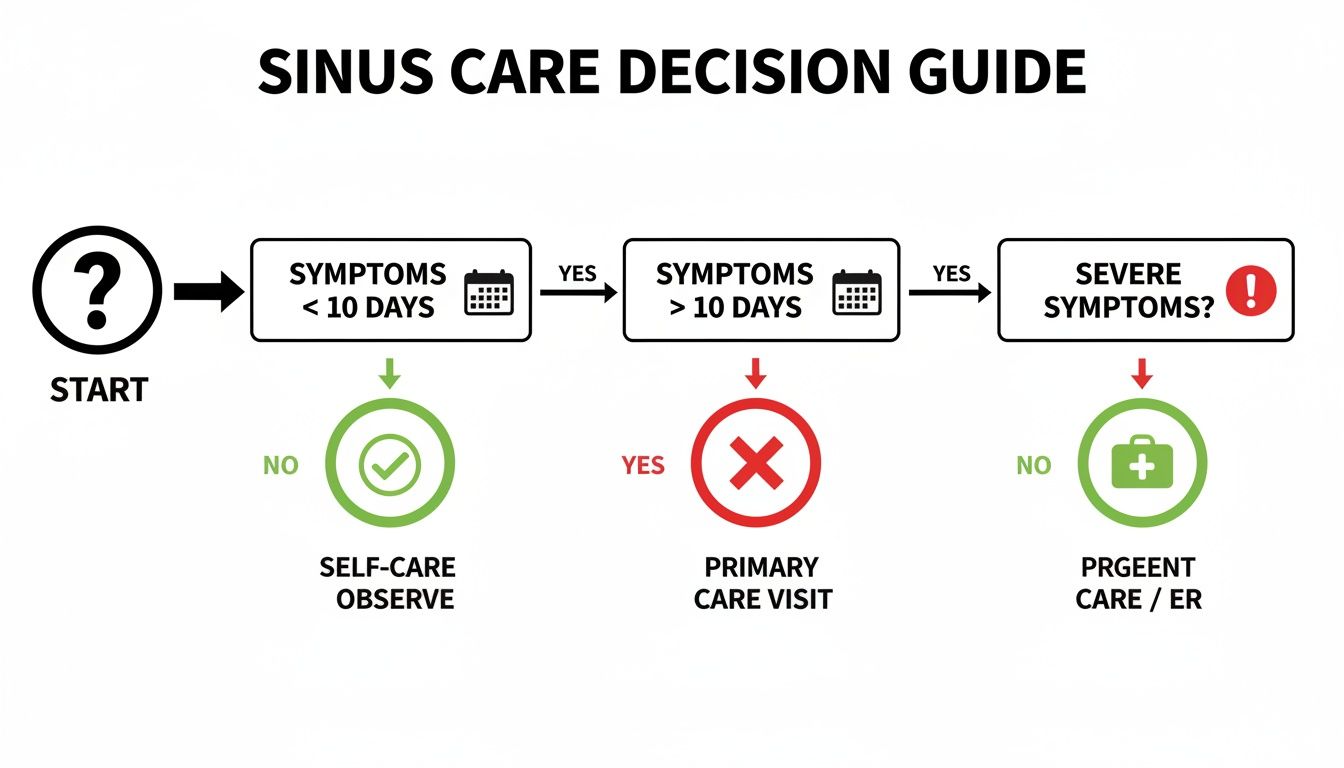
As you can see, once symptoms drag on for more than 10 days, it’s a strong signal that you might be dealing with a bacterial infection that needs a doctor's input.
Gather Your Essential Information
Besides your symptom notes, having a few other details ready will make the whole process incredibly smooth. It's the same stuff you'd need for any doctor's visit, just from the comfort of home.
Try to have these items handy:
- A list of all your current medications, vitamins, and supplements. This is non-negotiable for avoiding potential drug interactions.
- A list of any known allergies, especially to common medications like penicillin.
- Your government-issued photo ID for identity verification.
- Your preferred pharmacy's name and address so they know where to send an e-prescription.
- Your payment method, which is usually a credit card, HSA, or FSA card.
Platforms like ChatWithDr use this information to build out your secure patient profile. You can learn more about https://chatwithdr.com/how-it-works, which makes submitting these details incredibly easy.
Beyond just getting a diagnosis, it's smart to understand how to handle other health needs online safely. For instance, there's a great guide to buying health-related products online that has some excellent tips. With these simple preparations, your online visit will be efficient, effective, and completely stress-free.
What to Expect from Your Treatment Plan
Once your online doctor confirms you’re dealing with a sinus infection, they’ll map out a treatment plan designed to get you feeling better, fast. This isn’t some cookie-cutter solution; it’s tailored to your specific symptoms, how long you’ve been sick, and your medical history. The goal is always to relieve your discomfort and knock out the infection efficiently.
A solid plan usually combines supportive, at-home care recommendations with medication, but only when it’s truly necessary. You’ll get clear, simple instructions on what to do at home to ease your symptoms, which honestly forms the foundation of a good recovery.
The First Line of Defense: Supportive Care
Before even thinking about prescriptions, your doctor will almost always recommend effective over-the-counter (OTC) and at-home remedies. For most viral sinus issues—and even as a helping hand for bacterial ones—these simple steps can make a world of difference in how you feel.
Your initial plan will likely include practical advice like this:
- Saline Nasal Sprays: A simple saltwater spray is your best friend. It helps rinse your nasal passages, thinning out that stubborn mucus and calming down inflammation. It’s a gentle but surprisingly powerful tool for clearing up congestion.
- Decongestants: Meds like pseudoephedrine can give you some much-needed short-term relief from stuffiness by shrinking swollen nasal tissues. Just be sure to follow your doctor's advice on how long to use them, since overdoing it can sometimes cause a frustrating rebound effect.
- Pain Relievers: You can't go wrong with standard OTC pain relievers. Ibuprofen or acetaminophen work wonders for managing those pounding sinus headaches and facial pain.
- Warm Compresses: Applying a warm, damp cloth to your face is incredibly soothing. It can ease that feeling of pressure and pain building up around your nose and eyes.
Often, these initial steps are all you need to help your body fight off the infection and kickstart the healing process without stronger medications.
When Antibiotics Are Necessary
So, when does a prescription enter the picture? If your symptoms are screaming "bacterial infection"—for example, they've dragged on for more than 10 days without any improvement, or you had that classic "double sickening" where you started feeling better then got worse again—your doctor may prescribe an antibiotic.
This is where the responsible approach of online sinus infection treatment really shines.
Online doctors are trained to be excellent stewards of antibiotics. They follow strict, evidence-based guidelines to avoid contributing to antibiotic resistance, a massive public health concern. They won’t just hand them out "just in case."
A huge advantage of well-structured telehealth platforms is their strict adherence to clinical best practices. This often leads to more appropriate antibiotic use compared to some in-person urgent care visits, ensuring you get the right care at the right time.
This structured approach has been shown to be incredibly effective. A study of 350 adults found that virtual-visit patients were not only more likely to receive a diagnosis that aligned with medical guidelines (69.1% vs 45.7%) but were also prescribed antibiotics far less often (68.6% vs 94.3%) than patients seen in person. Another study showed antibiotic use for sinusitis was significantly lower in video visits compared to urgent care (67% vs 92%), highlighting how online care promotes responsible prescribing. You can learn more about these findings on guideline-concordant care in telemedicine.
If an antibiotic is the right call, it will likely be something like amoxicillin or amoxicillin-clavulanate, which are workhorses for the most common sinus pathogens. It is absolutely critical to take the full course of antibiotics just as they’re prescribed, even if you start feeling better after a couple of days. Stopping early is just asking for the infection to come roaring back.
Once your treatment plan is set, getting your medication is a breeze. If a prescription is part of your plan, the doctor sends it electronically straight to your preferred local pharmacy. Our guide on receiving an online prescription walks you through this seamless process, from consultation to pickup.
Tips for Faster Recovery and Preventing Future Infections
Your prescription is a huge part of the solution, but what you do at home can make a massive difference in how quickly you bounce back—and help keep the next sinus infection at bay. Think of these tips as your support crew. They're simple, practical things you can do to soothe your symptoms and beef up your defenses.

The environment where you recover really matters. Dry air is the enemy of inflamed nasal passages, so keeping things moist should be a top priority. A humidifier, especially running in your bedroom overnight, adds moisture back into the air, making it easier to breathe and helping to thin out that stubborn, thick mucus.
No humidifier? No problem. You can get a similar effect by taking a steamy shower or carefully breathing in the steam from a bowl of hot water. Just don't get too close and burn yourself.
Simple Steps for Immediate Relief
While your medication gets to work on the infection itself, these at-home strategies can bring some much-needed immediate comfort and help the healing process along. They are the perfect companions to any professional sinus infection treatment online.
- Stay Hydrated: This is non-negotiable. Pushing fluids—water, broth, or herbal tea—helps thin out mucus, allowing it to drain from your sinuses. Dehydration just makes it thicker, which is the last thing you want.
- Apply Warm Compresses: A warm, damp washcloth draped over your forehead, eyes, and cheeks can be incredibly soothing. It does wonders for easing that deep, throbbing facial pain and pressure.
- Sleep Elevated: Prop your head up with an extra pillow or two at night. This simple adjustment uses gravity to help your sinuses drain more effectively, preventing congestion from pooling while you sleep.
Your recovery is a team effort between you and your doctor. They provide the medical expertise, but these small, consistent actions you take at home create the perfect environment for your body to heal.
Long-Term Prevention Strategies
Once you’re finally feeling better, the goal is to stay that way. If you find yourself getting sinus infections over and over, there’s often an underlying issue like allergies or certain lifestyle habits at play. Making a few proactive changes can make a world of difference.
Managing allergies is a big one. If you know that pollen, dust, or pet dander sets you off, work on minimizing your exposure. Using a saline nasal rinse regularly is another powerhouse move. It helps keep your nasal passages clear of irritants and prevents mucus from building up over the long term. To really support your body’s defenses, try incorporating foods that can boost your immune system.
And finally, never underestimate the power of good old-fashioned hand washing. It’s one of the single most effective ways to stop the spread of the viruses that so often kick off a sinus infection in the first place.
Common Questions About Online Sinus Care
Even with telehealth becoming more common, it’s natural to have a few questions before you try getting medical care online. The thought of getting diagnosed without a doctor physically in the room can feel a little strange, but for straightforward issues like sinusitis, it's a proven and incredibly effective way to get help.
Let's clear up some of the most common concerns people have about getting sinus infection treatment online.
How Can a Doctor Diagnose Me Without an In-Person Exam?
This is probably the biggest question people have, and the answer comes down to the distinct patterns of the illness. Board-certified physicians can confidently diagnose most sinus infections just by hearing about your symptoms and reviewing your medical history.
The classic signs create a clear clinical picture. Things like persistent facial pressure, thick, colored nasal discharge, and symptoms that just won't quit after 10 days are dead giveaways. The intake forms used by online services are specifically designed to gather all the crucial details a doctor needs to make a safe, evidence-based diagnosis for uncomplicated cases.
How Do I Get My Medication?
Getting your prescription is surprisingly simple. If your doctor decides you need medication, they'll send an e-prescription straight to your local pharmacy—the exact same way your in-person doctor does.
You’ll usually get a text or a call from the pharmacy when your prescription is ready, often within a few hours. When you go to pick it up, you can use your health insurance just like you always do. These services are designed to work with all the major pharmacy chains, so it couldn't be more convenient.
The whole process is built for speed. From the minute you finish your online consultation to the moment you have your medication, the goal is to get you on the road to recovery as fast as possible.
Is Online Sinus Treatment Safe and Secure?
Absolutely. For uncomplicated cases of acute sinusitis, telehealth is an extremely safe option. Reputable platforms are set up to handle common, low-risk conditions and have strict safety protocols to screen for any red-flag symptoms that would require in-person care.
If your symptoms suggest something more serious, you'll be directed to see a doctor in person. The physicians are all board-certified, state-licensed U.S. doctors who follow established medical guidelines. Plus, the entire process is secure and HIPAA-compliant, which means your health information is protected with the same high level of security you'd find at a traditional doctor's office.
Many services also offer transparent, flat-fee pricing that’s often much more affordable than a trip to urgent care, making it an accessible and budget-friendly choice.
Ready to get fast relief without the hassle of a waiting room? At ChatWithDr, you can get a diagnosis and treatment plan from a board-certified U.S. doctor for just $39.99, often within a few hours. Start your consultation now and feel better faster.
Related posts:
 Cold vs Sinus Infection Know the Difference
  8 Unmistakable Signs You Have a UTI: Your 2026 Guide
  Sinus Infection Relief: How to Get Antibiotics Online Same-Day
  Sinus Infection Treatment Online: Quick Relief for Sinus Pressure & Pain
  Online Sinus Infection Treatment: Get Prescriptions 24/7 Without Waiting Rooms