

Yes, you can absolutely see a virtual doctor with no insurance. In fact, it's often far more affordable than walking into a traditional clinic. Instead of wrestling with deductibles and copays, you pay a simple, flat fee for the consultation. This makes getting care predictable and much easier on your budget.
How to See a Virtual Doctor Without Insurance
Trying to get medical care without insurance can feel like navigating a maze, but virtual care carves a straight, affordable path to a doctor. The whole idea is beautifully simple: you pay a set price for a single consultation. That’s it. No confusing billing codes or surprise fees that show up in the mail weeks later.
This pay-as-you-go model makes it easy to get help for common, non-emergency issues without a massive financial hit. Whether you're dealing with a sudden cold, need a routine check-in, or want to talk with a mental health professional, there's a telehealth service built for your needs.
Choosing the Right Type of Care
The first step is figuring out what kind of help you actually need. Different telehealth services focus on different areas of medicine, so matching your symptoms to the right platform is the key to getting great care.
This flowchart can help you decide which path makes the most sense for your specific health concern.
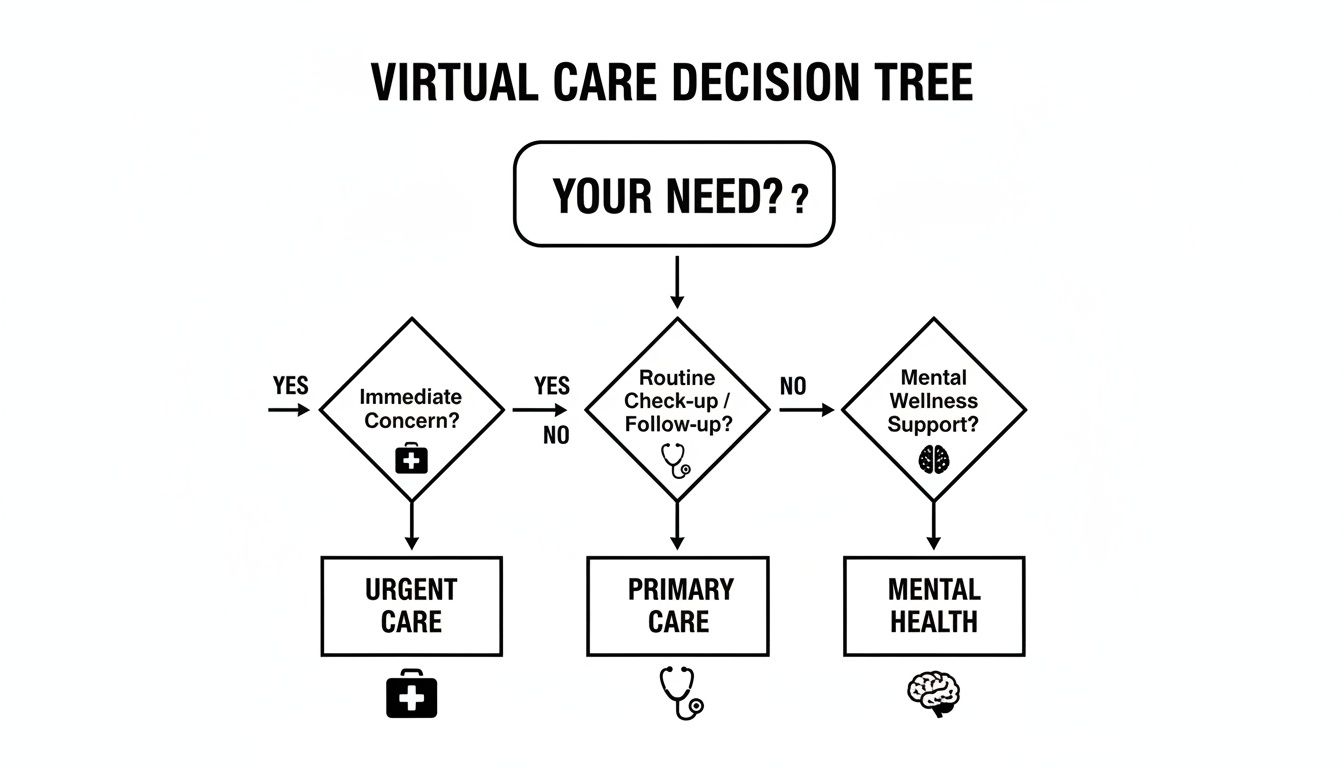
As you can see, your specific need—whether it's an urgent issue, a primary care question, or a mental health concern—points you toward the right type of virtual service. This clarity helps you find the right specialist fast. To see how a platform like ChatWithDr makes this process even simpler, you can learn more about how it works and see what conditions are treated.
To give you a clearer picture, here’s a quick breakdown of your options when paying out-of-pocket.
Your Virtual Doctor Options Without Insurance
| Service Type | Common Conditions Treated | Average Out-of-Pocket Cost |
|---|---|---|
| Urgent Care Telehealth | Colds, flu, sinus infections, UTIs, rashes, pink eye, minor injuries. | $39 – $99 per visit |
| Primary Care Telehealth | Routine check-ups, prescription refills, managing chronic conditions (like high blood pressure). | $49 – $129 per visit |
| Mental Health Teletherapy | Anxiety, depression, stress management, grief counseling, relationship issues. | $60 – $175+ per session |
This table shows just how accessible different types of care can be, even without an insurance plan. The key is to pick the service that lines up with your immediate health needs.
What to Expect From Your Visit
Once you’ve picked a service, the process is incredibly straightforward. You'll usually fill out a quick intake form describing your symptoms and medical history. A licensed doctor then reviews your case, provides a diagnosis, and outlines a treatment plan, which often includes a prescription if it's needed.
The biggest win for uninsured patients is the transparency. With flat-fee services, what you see is what you pay. A consultation for something like a sinus infection might cost around $39 to $79, which is just a fraction of what you'd pay at a typical urgent care clinic or ER.
Navigating the World of Telehealth and Virtual Care

If you’re on the hunt for a virtual doctor with no insurance, it helps to get a handle on what telehealth really is. At its core, it’s just using the tech you already have—like your smartphone or laptop—to connect with a licensed healthcare professional. Instead of driving to a clinic and flipping through old magazines in a waiting room, you get medical advice right from your couch.
Think of it as a secure, private video call or text conversation with a doctor, not just a friend. This isn't some futuristic idea; it's a legitimate and highly effective way to manage a huge range of health concerns. For anyone without an insurance plan, it’s a game-changer that knocks down many of the usual barriers to getting care.
How Does Virtual Care Actually Work?
The whole process is built for convenience and speed. Forget about scheduling an appointment weeks from now—you can often get the care you need the very same day. Virtual care isn't a one-size-fits-all solution; it comes in a few different flavors.
- Live Video Appointments: This is a real-time, face-to-face chat with a doctor, pretty much like a regular office visit but through a screen.
- Phone Calls: Sometimes video just isn't necessary or practical. For many common issues, a good old-fashioned phone call can be just as effective.
- Secure Messaging/Text-Based Consults: Got a non-urgent question or need a quick follow-up? You can chat with a doctor through a secure, HIPAA-compliant platform whenever you have a free moment.
This kind of flexibility means you get to pick the method that fits your life. It's a lifesaver if you're juggling a busy schedule, live miles from the nearest clinic, or don't have reliable transportation.
The Growing Importance of Telehealth
The rise of virtual care is more than just a passing trend; it's a fundamental shift in how we get medical help. It puts you back in the driver's seat of your own health, minus the logistical headaches and financial hurdles of in-person visits.
By cutting out travel time, waiting rooms, and the need to burn a sick day, telehealth makes seeing a doctor incredibly efficient. When you're paying out-of-pocket, that efficiency means real cost savings and a lot less stress.
As you explore this new world of virtual care, it’s interesting to see how it's transforming specific fields. For example, fresh approaches are changing how patients get treated for injuries and chronic pain, which you can see in this look at the future of telehealth in physical therapy. Ultimately, these advancements are making quality healthcare more accessible for everyone, insurance or not.
Understanding Your Out-of-Pocket Costs
When you're looking for a virtual doctor with no insurance, the most important question is usually the simplest: What is this actually going to cost me? The good news is that without the confusing maze of deductibles and copayments, telehealth pricing is refreshingly direct. You deserve to know the exact cost before you ever commit to a consultation.
Most telehealth platforms designed for uninsured patients operate on straightforward pricing models. This transparency is a huge relief, as it gets rid of the fear of receiving an unexpected, massive bill weeks down the road. You'll typically find a couple of common structures.
Common Pricing Models for Virtual Care
The most popular approach is the simple pay-per-visit model. Think of it like buying a single movie ticket; you pay one flat fee for one consultation to address a specific health issue. This is perfect for acute, one-off problems like a UTI, a sinus infection, or pink eye. The fee is clear right from the start, so you can budget perfectly.
Another option you'll see is a subscription model. This is more like a gym membership for your health, where you pay a monthly or annual fee for a certain number of visits or even unlimited access to doctors. This can be a smart move if you anticipate needing ongoing care for managing a chronic condition or expect to have frequent consultations.
Even when paying directly for virtual care, managing your budget is crucial. To get a better handle on this, you can delve deeper into understanding general healthcare out-of-pocket costs to get a broader perspective.
Realistic Price Ranges and Finding Value
So, what should you realistically expect to pay? Without insurance, virtual doctor visits often fall somewhere in the $50 to $150 range per session. But the real value shines when you compare it to the alternative. Telehealth has been shown to cause a 67% reduction in emergency department visits for manageable conditions, which could save an uninsured patient hundreds or even thousands in ER fees.
The key is to see the fee not just as a cost, but as an investment in avoiding a much larger expense. A $39.99 text-based consult for flu symptoms is far more affordable than a $500+ bill from an urgent care clinic.
To get the best deal, it always pays to compare platforms. Look for introductory offers for new patients and make sure you understand exactly what’s included in the fee—for example, does it cover any follow-up questions? Doing your homework upfront prevents any potential financial surprises later.
Comparing Costs of Popular Telehealth Platforms
To give you a clearer picture, here’s a quick look at how costs can stack up on different platforms for a single urgent care visit.
| Telehealth Provider | Single Visit Cost (Urgent Care) | Subscription Option Available? |
|---|---|---|
| ChatWithDr | $39.99 (Flat Fee) | No (Pay-per-visit focus) |
| Typical Platform A | $75 – $99 | Yes |
| Typical Platform B | $49 – $129 | Yes |
This side-by-side comparison shows how different services approach their pricing. Seeing it laid out like this empowers you to make the smartest financial choice for your specific health needs.
How to Get Prescriptions from an Online Doctor

One of the biggest questions people have about using a virtual doctor with no insurance is a simple one: can they actually write me a prescription? The answer is a resounding yes. Telehealth platforms provide a completely legitimate and seamless way to get the medication you need, often with way less hassle than a traditional office visit.
After your online chat or video call, if the doctor agrees a prescription is the right move, they’ll send it electronically to whatever local pharmacy you choose. You just tell them where you want to pick it up—whether it's a big chain like Walgreens or your small neighborhood spot—and the prescription will be waiting for you, sometimes in less than an hour.
What Can Be Prescribed Online
Virtual doctors are perfectly set up to handle a huge range of common, non-emergency health problems. This means they can prescribe medications for most of the same issues that would normally send you to an urgent care clinic.
Commonly prescribed medications include:
- Antibiotics for things like UTIs, sinus infections, or bronchitis.
- Allergy relief medications like antihistamines or nasal sprays.
- Birth control, including pills, patches, or rings.
- Antiviral medications for illnesses like the flu.
- Creams and ointments for skin problems like rashes or eczema.
It's really important to know the limits, though. By law, telehealth providers cannot prescribe controlled substances. This group includes specific pain medications, stimulants for ADHD, and some anti-anxiety drugs. For those types of medications, you absolutely have to see a doctor in person. For a more detailed guide, check out our overview on getting an online prescription.
Saving Money on Your Medications Without Insurance
Getting the prescription is only half the battle; paying for it is the other. The good news is that being uninsured doesn’t mean you’re stuck paying the full retail price. You have some powerful tools to bring that cost way down.
Always ask your doctor if there’s a generic version of the medication available. Generic drugs are chemically identical to their brand-name counterparts and are FDA-approved, but they can cost up to 85% less. This is the single biggest thing you can do to lower your pharmacy bill.
On top of that, start using pharmacy discount cards and apps. Services like GoodRx are free to use and give you access to coupons that can slash the price of your prescriptions. Just search for your medication, find the best price at a pharmacy near you, and show the coupon to the pharmacist.
Finally, don’t be afraid to just ask the pharmacy staff if they have any patient assistance programs or discount options. You’d be surprised how often you can find extra savings just by asking.
Weighing the Pros and Cons of a Virtual Doctor Visit
Deciding to use a virtual doctor with no insurance is a balancing act. You're trading the convenience and low cost of digital care against its built-in limitations. To make the right call for your situation, you have to look at both sides of the coin. This will help you see when telehealth is the perfect solution and when an in-person visit is the only real option.
The upsides are huge, especially when you're paying for everything yourself. The most obvious benefit is just how easy it is—getting medical advice from your couch without burning a sick day or figuring out a ride. This kind of immediate access is a total game-changer for those common but miserable illnesses that pop up out of nowhere.
Beyond convenience, the price tag is a massive plus. A flat-fee virtual visit is almost always a fraction of the bill you'd get from an urgent care clinic or an ER for the same problem. And the savings don't stop there. A huge study analyzing 35 million telehealth records found that for most specialties, patients didn't need an in-person follow-up within 90 days. That means you're avoiding even more costly appointments down the road. You can see the full breakdown of consumer adoption and telehealth effectiveness for yourself.
The Advantages of Going Virtual
When you’re paying directly for healthcare, every perk translates into saved time and money. Here’s a quick rundown of the biggest pros:
- Immediate Access: Get help for non-emergency issues in hours, not days or weeks.
- Cost Savings: Skip the massive overhead costs that come with in-person clinics and emergency rooms.
- Privacy and Comfort: Talk about sensitive health issues from the privacy of your own home.
- Reduced Exposure: Ditch the waiting room and avoid catching whatever else is going around.
Understanding the Limitations
But let's be real—virtual care isn't a silver bullet. Its main drawback is the complete lack of a physical, hands-on exam. A doctor can't listen to your lungs, press on your stomach to check for tenderness, or peek inside your ear through a screen. This makes it the wrong choice for complex symptoms or anything that truly needs a physical assessment.
Virtual care is built for straightforward, low-risk conditions. It is not a substitute for emergency services. If you're dealing with severe symptoms like chest pain, trouble breathing, or a serious injury, you need to go to the emergency room or call 911 immediately.
On top of that, technology itself can sometimes be a hurdle. A spotty internet connection can ruin a video call, and not everyone is comfortable trying to figure out a new app or website. It's crucial to have realistic expectations. Telehealth is brilliant for providing convenient help for specific problems, but it can't—and shouldn't—replace the full spectrum of in-person medical care.
Your Go-To Option: ChatWithDr’s Affordable Care
Trying to get medical care without insurance can be frustrating and wildly expensive, but that’s exactly the problem platforms like ChatWithDr were built to solve. It’s designed to be a direct, affordable answer for anyone needing a virtual doctor with no insurance. The whole idea is simple: quality medical advice shouldn't be locked behind a high price tag or an insurance plan.
What sets it apart is the focus on no-nonsense, transparent pricing. Instead of complicated subscriptions or hidden fees that pop up later, you pay one flat fee of $39.99 for a consultation. That’s it. This straightforward approach takes all the financial guesswork out of the equation, letting you get care for common issues like UTIs, sinus infections, or prescription refills without the fear of a surprise bill.
Getting Started Couldn't Be Simpler
The entire process is designed to be as easy as possible, especially if you’re trying telehealth for the first time. Forget about scheduling hassles or awkward video calls.
- Pick Your Condition: You just start by choosing what’s bothering you from a clear, easy-to-understand list of health concerns.
- Fill Out a Secure Form: Next, you’ll complete a HIPAA-compliant online intake form. It covers your symptoms and medical history, just like the paperwork you’d fill out at any doctor’s office.
- Connect with a Doctor: A U.S.-licensed, board-certified physician will review everything, give you a diagnosis and a treatment plan, and send any necessary prescriptions right to your local pharmacy.
This text-based approach means you can get the care you need discreetly and on your own time. Most people get a response and a full treatment plan in just a couple of hours.
The real power of ChatWithDr is how accessible it is. It gives you a direct line to a real doctor without the usual roadblocks of high costs, travel, or insurance red tape. It’s a practical and painless first step into virtual care.
If you have more specific questions about how it all works—from payment methods to the full list of conditions they treat—the detailed FAQ section has you covered. You can get all your questions answered by checking out the ChatWithDr frequently asked questions page. It’s the best way to get the full picture before you even start.
Answering Your Questions About Virtual Care
Even with all the benefits laid out, you probably still have a few questions rolling around in your head. Deciding to use a virtual doctor with no insurance is a big step, and it's smart to feel confident in your choice before you jump in.
Let's tackle some of the most common concerns people have when they're thinking about telehealth for the first time. Think of this as your final checklist to make sure you know exactly what to expect and can get rid of any lingering uncertainty.
Are Virtual Doctor Visits Safe and Private?
Absolutely. This is a non-negotiable for any legitimate telehealth service. Reputable platforms are required by law to be HIPAA-compliant, which is the same standard your local doctor’s office follows. It means they use secure, encrypted technology to protect every bit of your personal health information.
Your conversation with a virtual doctor is just as confidential as an in-person appointment. Before using any service, a quick glance at their privacy policy is always a good idea. Trustworthy platforms will be upfront and clear about the security measures they have in place to keep your data safe.
What Conditions Are Not Good for a Virtual Visit?
This is a critical distinction to understand. Virtual care is not for emergencies. If you are experiencing serious symptoms like chest pain, difficulty breathing, severe injuries, or signs of a stroke, you need immediate, in-person medical attention. Call 911 or go to the nearest emergency room right away.
Telehealth is fantastic for common, non-life-threatening conditions. It's simply not the right tool for issues that require a hands-on physical exam, like a suspicious skin mole, or procedures like getting stitches or having lab work done.
Can I Get a Doctor's Note for Work or School?
Yes, in most cases, this is totally possible. If your telehealth provider evaluates your condition and agrees it's medically necessary for you to miss work or school, they can issue a doctor’s note. This has become a common and accepted practice.
That said, if getting a note is the main reason for your visit, it’s always smart to confirm the platform’s specific policy on this before you start your consultation. A quick check ensures there are no surprises and that your needs will be met.
Ready to get the fast, affordable care you need without the hassle of insurance? ChatWithDr provides 24/7 access to board-certified U.S. doctors for just $39.99. Get your personalized treatment plan today.
Related posts:
 The 7 Best Online Doctor Services of 2025: A Detailed Review
  Your Guide to Virtual Urgent Care Online Doctor Visits
  Virtual Doctor Visit No Insurance: Affordable Telehealth Options
  Decoding the Virtual Doctor Visit Cost for Smart Healthcare
  Explore do you need insurance for urgent care and what it means for your visit