

So, how much does a virtual doctor visit actually cost? Let's get right to it. For most people paying out-of-pocket, a typical virtual doctor visit will run you somewhere between $40 and $90.
Think of it like this: you can grab a quick, affordable takeout meal or go for a pricier sit-down dinner. Telehealth is often that convenient, budget-friendly option for a whole host of common health issues.
Breaking Down the Typical Virtual Doctor Visit Cost

When you’re not feeling your best, the last thing you want is a surprise medical bill. The good news is that virtual doctor visits are often far more predictable than their in-person counterparts. It’s a straightforward path to getting care without the extra costs of gas, parking, or taking an entire day off work.
And this isn't just a hunch—the numbers back it up. A landmark 2017 study found that the average telehealth visit for a common respiratory infection cost just $79. That's a huge difference compared to the $146 average for the exact same treatment at a physical doctor’s office. You can dig into similar healthcare cost comparisons over on GoodRx.
This kind of price difference is exactly what makes immediate medical care more accessible for everyone.
A Quick Pricing Snapshot
So, what should you really expect to pay when you don't have insurance? The final price tag usually boils down to the kind of care you need. A general check-in will be on the lower end, while a specialized consultation will naturally cost more. This flexible pricing means you only pay for the level of expertise you actually need. Understanding how it works helps you pick the right service without overspending.
To give you a clearer picture, here’s a quick look at typical cash-pay prices for different types of virtual visits.
Typical Virtual Visit Costs Without Insurance
| Visit Type | Typical Price Range |
|---|---|
| General Medicine / Urgent Care | $40 – $90 |
| Mental Health Therapy | $90 – $250+ |
| Dermatology Consultation | $60 – $120 |
| Psychiatry (Initial Consult) | $200 – $300+ |
| Specialist Consultation | $100 – $350+ |
This table shows how costs can vary, but the fundamental benefit remains the same.
The real beauty of telehealth pricing is its transparency. Unlike in-person visits that can leave you with a confusing, itemized bill weeks later, most virtual platforms give you a clear, upfront cost before you even see a doctor.
That upfront clarity takes the financial anxiety out of the equation. It lets you focus on what really matters: getting better.
What Goes Into Your Final Bill?
Ever wondered why there's no single, flat price for every virtual doctor visit? It's a lot like ordering a pizza—the base price is for a plain cheese pizza, but the final cost changes once you start adding pepperoni, extra cheese, or mushrooms. The virtual doctor visit cost works the same way, with a few key factors adjusting what you actually pay out of pocket.
Your final bill isn't just one number; it's a puzzle with a few different pieces. When you know what those pieces are, you can see the full picture and sidestep any surprise charges. It’s about more than the advertised price—it’s how your specific situation fits into the bigger healthcare puzzle.
The biggest piece of that puzzle? Your health insurance. This one factor can swing your out-of-pocket costs from a small, manageable fee to a much larger bill.
How Your Insurance Plan Shapes the Price
Insurance is the main driver behind what you'll pay for telehealth. If your plan covers virtual visits—which most now do—you'll usually just be on the hook for a piece of the total cost. It can feel like you need a secret decoder ring to understand your insurance policy, but it really just comes down to a few key terms.
These are the terms that decide how much you pay versus how much your insurance company covers:
- Copay: This is a simple, fixed fee you pay for a service. For instance, your plan might have a $25 copay for a virtual urgent care visit, no matter what the doctor's total bill is.
- Deductible: This is the magic number you have to pay out-of-pocket for your healthcare before your insurance plan starts chipping in. If you have a $1,000 deductible, you’ll pay the full cost of your visits until you've spent $1,000 yourself.
- Coinsurance: After you’ve met your deductible, you’ll start sharing the cost with your insurer. This is your coinsurance. If your plan has 20% coinsurance, you’ll cover 20% of the bill, and your insurance will handle the other 80%.
Think of your deductible like a gate you have to unlock with your own money. Once you've paid enough to open it, your insurance starts helping out. But you might still need to pay a small "toll" (your coinsurance) each time you pass through.
How the Type of Care and Provider Affect the Cost
Beyond insurance, what you're being seen for makes a huge difference. A quick chat about a sinus infection is almost always going to be cheaper than an initial psychiatric evaluation, which needs a deep dive from a highly specialized doctor.
Who you see matters, too. A visit with a nurse practitioner is usually more budget-friendly than one with a board-certified physician or a specialist like a dermatologist. The platform you pick will offer different kinds of providers, and that choice has a direct line to your wallet.
Finally, don't forget that prescriptions are a separate cost. The fee for your virtual visit pays for the doctor's expertise and diagnosis. The actual medicine is paid for at your pharmacy, where you can use your insurance or hunt for discount cards to bring the price down. It's an important distinction to make when you're trying to figure out the total cost of getting better.
Comparing The True Cost Of Care Options
When you look at the price tag of a virtual doctor visit, it's easy to miss the bigger picture. The real value isn't just in the consultation fee—it’s in all the other expenses you don't have to pay.
Think about what it takes to see a doctor in person. You have to get in the car, pay for gas, maybe find and pay for parking, and—most importantly—take time off work. For a simple 15-minute chat with your doctor, you could easily lose a few hours of paid work. Those indirect costs add up fast, turning a "routine" visit into a surprisingly expensive trip.
The Hidden Expenses Of In-Person Care
Let's walk through a common scenario. You wake up feeling miserable with all the signs of a sinus infection. A trip to the local urgent care clinic might look something like this:
- Lost Wages: Taking a half-day off work could easily cost you $80-$100 or more.
- Transportation: Gas and parking can add another $10-$20 to the bill.
- Wait Time: You’ll likely spend an hour or more just sitting in the waiting room, surrounded by other sick people. That's valuable time you'll never get back.
Before you’ve even spoken to a doctor or picked up a prescription, you’re already out over $100. A virtual visit completely erases these extra costs, keeping that money right where it belongs—in your pocket.
This is where you can see the main variables that will ultimately shape what you pay for a virtual visit.
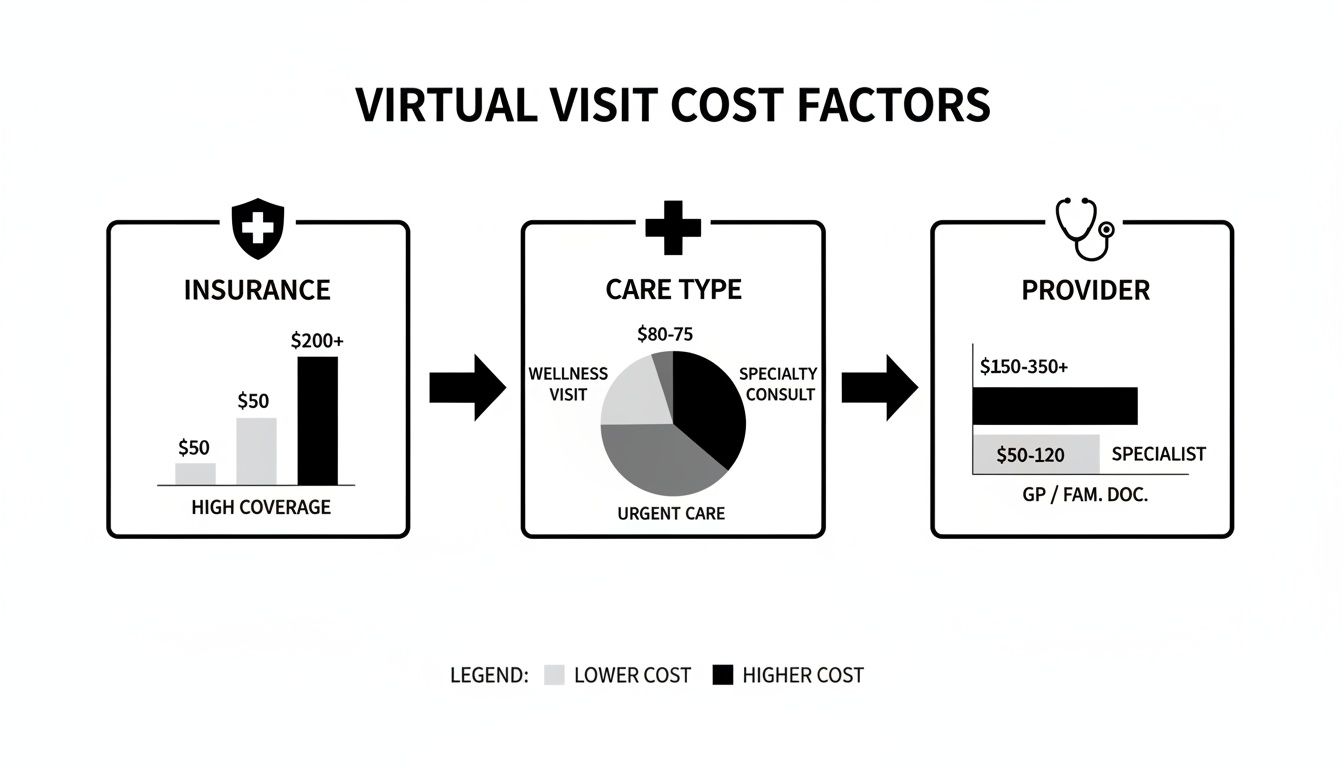
As the visual shows, your final bill really comes down to three things: your insurance plan, the kind of care you need, and the provider you choose.
Total Cost Of Care: A Side-By-Side Comparison
To really see the difference, let’s compare the total cost of treating a common ailment like a sinus infection across all three settings. This isn't just about the bill from the doctor; it's about everything else that goes into getting care.
| Cost Factor | Virtual Visit (e.g., ChatWithDr) | In-Person Visit | Urgent Care |
|---|---|---|---|
| Consultation Fee | $39.99 | $100 – $200 | $150 – $250+ |
| Lost Wages | $0 | $40 – $100+ | $40 – $100+ |
| Transportation Costs | $0 | $5 – $15 | $10 – $20 |
| Childcare | $0 | $20 – $50 | $20 – $50 |
| Wait Time | Minimal (async) | 15-45 mins | 30-90+ mins |
| Total Estimated Cost | $39.99 | $165 – $365+ | $220 – $420+ |
The numbers speak for themselves. While the consultation fee is the most obvious expense, it’s the combination of hidden costs that makes traditional care so much more expensive. Telehealth cuts out nearly all of them.
Telehealth's Impact On Healthcare Spending
The savings from telehealth don't just stop with your wallet; they have a ripple effect across the entire healthcare system. Virtual care is a powerful tool for heading off expensive and often unnecessary trips to urgent care or the emergency room for minor issues. When you need fast answers for a non-emergency problem, understanding how an online urgent care visit works can save you a ton of time and money.
This shift is making a huge dent in overall healthcare spending. During the height of the pandemic in 2020, one major health system found that almost 70% of its virtual care patients would have otherwise gone to an urgent care clinic or emergency room.
Those ER and urgent care visits can be up to 12 times more expensive than a standard doctor's appointment, fueling billions in wasteful spending every year. This shows that choosing telehealth isn't just about convenience—it's a financially savvy decision for you and the healthcare system as a whole. You can dig into the full report on telehealth's cost impact at NCQA.org.
Finally, Some Predictable Pricing in Telehealth
After wading through all the variables of telehealth pricing—from confusing insurance jargon to random provider markups—it’s fair to ask if there’s a simpler way. What if you could know the virtual doctor visit cost before your consultation even begins, taking all the financial stress off the table?

That's the real power of a transparent, flat-fee model. Instead of getting a bill that swings wildly depending on your insurance plan or how "complex" your issue was, you just pay one clear price. It's a refreshingly simple approach that puts you back in the driver's seat of your healthcare spending.
The Certainty of a Flat-Fee Model
Just imagine knowing the total cost up front. No copays, no deductibles to worry about, and definitely no surprise bills showing up in your mailbox weeks down the road. That’s exactly what platforms with this pricing structure deliver. It makes quality medical care both accessible and predictable, whether you have a premium insurance plan or no coverage at all.
ChatWithDr, for example, offers a nationwide flat fee of just $39.99 for every single consultation. This one price point cuts through the noise of the typical $40 to $90 industry range and completely sidesteps the sky-high costs of an urgent care visit.
A flat-fee service takes all the guesswork out of healthcare. You're not just paying for a doctor's time; you're paying for peace of mind, knowing there are absolutely no hidden charges waiting to ambush you.
This model is a game-changer for those common but urgent needs where you just need fast, affordable care without the administrative headache.
Why Predictability Matters Most
When you know the price from the get-go, it simplifies everything. You can make the decision to get care the moment you need it, rather than putting it off while you worry about the potential cost. The technology that makes this possible is also a factor; for those interested in the communications side of things, this guide on the best internet telephone service offers a look into related pricing structures.
Ultimately, this straightforward approach gives you some key advantages:
- No Financial Surprises: The price you see is the price you pay. Every single time.
- Insurance Independence: It works for everyone, insured or not, without any complicated paperwork.
- Immediate Access: You don't have to delay getting help because you're worried about the bill.
By choosing a service with a clear, upfront cost, you're picking a smarter, more modern way to manage both your health and your budget.
Why Virtual Care Is Here to Stay
Telehealth is so much more than a temporary fix—it's a fundamental shift in how we think about and access healthcare. What started as a niche convenience has quickly become a core part of the American medical system, and it’s not going anywhere. The momentum from patients, doctors, and even policymakers is just too strong to ignore.
This massive change didn't happen by accident. It’s the result of a few powerful forces all converging at once. Technology has taken huge leaps forward, making virtual platforms secure, dependable, and incredibly simple to use from just about anywhere. At the same time, patients like you are demanding more convenient, affordable ways to get medical care that actually fits into a busy life.
The Forces Driving Telehealth Forward
Government policies have also played a huge part in cementing telehealth’s role in modern medicine. New, supportive regulations have cleared the way for doctors to offer virtual services and for insurance plans to cover them, knocking down old barriers that once stood in the way. This widespread acceptance has sparked a more competitive market, which ultimately helps keep the virtual doctor visit cost in check for everyone.
The growth has been nothing short of explosive, completely reshaping the economics of healthcare. Projections now show that 25-30% of all U.S. medical care could be delivered virtually by the end of 2026. By early 2024, a staggering 79% of U.S. hospitals had integrated telehealth into their systems—a massive jump from just a few years ago, especially as Medicare continued its flexible coverage policies. You can dig into more stats on telehealth's incredible rise over at First Stop Health.
Choosing telehealth today isn't just about saving a few bucks on your next appointment. It's an investment in a more accessible, efficient, and patient-first healthcare future that's built to last.
A Lasting Change for Better Access
This unstoppable growth guarantees that virtual care will only get better, offering more sophisticated services and more predictable pricing. It’s a win for everyone, from busy professionals in the city who can’t spend hours in a waiting room to families in rural towns who might not have a specialist for miles.
The bottom line is crystal clear: virtual care is no longer some "future" concept. It’s here, now, and deeply woven into our healthcare system. It offers a reliable, affordable, and highly effective way to manage your health, making sure you get the care you need, right when you need it. That lasting presence should give you the confidence that telehealth is a smart choice for both your health and your wallet.
Your Questions About Telehealth Costs, Answered
Alright, let's wrap up by tackling some of the most common questions people have about the cost of a virtual doctor visit. Think of this as your quick-reference guide to navigating telehealth pricing with total confidence.
We'll clear up any confusion around insurance, prescriptions, and what happens when your issue needs a closer look.
Can I Use My Insurance For A Virtual Doctor Visit?
Absolutely. Most major insurance plans now cover telehealth services, often treating them just like a regular trip to the doctor's office. Your final out-of-pocket cost will really depend on your specific plan—things like your copay, deductible, and coinsurance will all play a part.
In fact, some insurers are actively encouraging telehealth by offering lower copays for virtual visits than for in-person ones. The smartest move? Always give your plan's benefits a quick check online or call your provider before booking an appointment. That way, there are no surprises. For anyone with a high-deductible plan or no insurance at all, flat-fee services are usually the most predictable and budget-friendly route.
Does The Visit Fee Include Prescription Medications?
This is a really important distinction to make: no, the visit fee is strictly for the medical consultation itself. You're paying for the doctor's time, their expertise in figuring out what's wrong, and their professional guidance on a treatment plan.
If your doctor decides a prescription is the right call, they’ll send it straight to your pharmacy of choice. You'll handle the cost of the actual medication separately at the pharmacy counter. What you pay there will depend on your insurance, but many telehealth platforms can also help you find digital coupons or point you toward discount programs to bring that cost down.
Is Virtual Mental Health Therapy More Affordable?
In many cases, the answer is a big "yes." Virtual therapy sessions can be significantly easier on your wallet than traditional in-person appointments. The main reason is simple: online providers have much lower overhead since they don’t have to maintain a physical office space.
While costs will always vary depending on a therapist’s credentials and where they're located, it’s common to find online sessions for less than you’d pay for a face-to-face visit. Most insurance plans cover teletherapy now, and many online platforms offer subscription packages that bring the per-session cost down even further, making crucial mental healthcare more accessible than ever.
The financial accessibility of teletherapy removes a major barrier for many people seeking mental health support. By reducing costs and eliminating travel time, it empowers more individuals to prioritize their mental well-being on their own terms.
What Happens If My Issue Needs In-Person Care?
Patient safety is always the top priority. If a virtual doctor believes your condition requires a hands-on physical exam, a specific lab test, or any kind of in-person treatment, they will tell you exactly that. Their recommendation will be to head to an in-person clinic, urgent care center, or hospital.
Reputable telehealth services have clear protocols for these situations. Many platforms won't charge you—or will offer a full or partial refund—if they can't fully diagnose and treat you online. It’s always a good idea to check the provider's specific policy on this before you book. To see how these situations are handled, you can explore the frequently asked questions on our website to get a better feel for the process.
This safety-first approach guarantees you always end up with the right level of care for your needs.
Ready for clear pricing and fast, expert care without leaving home? With ChatWithDr, you get a nationwide flat fee of just $39.99 for every consultation—no insurance needed and no hidden fees. Get a diagnosis, treatment plan, and prescriptions sent to your local pharmacy in hours. Skip the waiting room and connect with a board-certified doctor on your schedule at https://chatwithdr.com.
Related posts:
 The 7 Best Online Doctor Services of 2025: A Detailed Review
  How much does urgent care cost? A Practical Guide to Bills and Savings
  Explore do you need insurance for urgent care and what it means for your visit
  Virtual Doctor Visit No Insurance: Affordable Telehealth Options
  Your Guide to Virtual Urgent Care Online Doctor Visits