

Think of the last time you felt awful. A nagging cough, a burning UTI, or a mysterious rash that popped up out of nowhere. Your first thought probably wasn't, "I can't wait to spend half my day in a waiting room." This is exactly why virtual urgent care exists.
It’s on-demand medical care for common, non-emergency problems, delivered right through your phone or computer. No travel, no waiting rooms packed with sick people—just fast, convenient access to a board-certified doctor, whenever and wherever you need it.
What Is Virtual Urgent Care and How Does It Work?

The best way to think about virtual urgent care is as the perfect middle ground between your primary care physician (PCP) and the emergency room. It’s not for life-threatening situations, but it’s a lifesaver for those sudden health issues that need attention now—especially when your doctor's office is closed or you can't get an appointment for days.
The whole idea is to use technology to bring high-quality medical care directly to you. This approach is more important than ever, especially since 70% of urgent care centers reported staffing shortages in 2023, which often means you're stuck with painfully long wait times. Virtual care cuts through all that.
The Modern Clinic in Your Pocket
The process itself is refreshingly simple and secure. Platforms like ChatWithDr have boiled it down to a quick, three-step flow that puts you in the driver's seat. There are no appointments to book or awkward video calls to schedule. It's an asynchronous model, meaning you get care on your own time, whether that's at 6 a.m. or 11 p.m.
Here’s what that journey typically looks like:
- Select Your Condition: You start by picking your health issue from a straightforward list of common ailments.
- Complete a Secure Intake: Next, you'll fill out a HIPAA-compliant online form. This is where you describe your symptoms, medical history, and anything else the doctor needs to know. For things like rashes or pink eye, you can even upload a few photos.
- Receive Your Treatment Plan: A U.S. board-certified, state-licensed physician reviews everything, provides a diagnosis, and creates a personalized treatment plan. If a prescription is medically necessary, it's sent straight to your favorite local pharmacy.
From start to finish, the entire process often takes just a couple of hours. It removes all the usual friction of getting medical help, so you can get back to your day.
Why This Model Is Gaining Popularity
Virtual urgent care isn't just a temporary fix; it's quickly becoming a core part of how we manage our health. Hospitals and clinics are weaving virtual tools into their services to handle more patients, offer after-hours care, and get people treated faster. For patients, the advantages are impossible to ignore.
Virtual care isn’t used to replace in-person care but to enhance it: expanding reach, reducing friction, and unlocking capacity. It’s about keeping patients at the center of the healthcare experience.
This model gives you a direct line to a medical expert without the usual hurdles. You get to skip the germ-filled waiting room and handle sensitive health issues with total privacy. To get a better sense of what can be treated, you can explore the different telehealth services available and see how they fit your needs.
At the end of the day, it’s a powerful, efficient, and patient-first way to handle life's common medical curveballs.
Common Conditions Treated with Online Urgent Care
While virtual urgent care is a powerful tool, it’s not meant for every single medical issue. Its sweet spot is treating common, low-risk conditions where a doctor can make a confident diagnosis based on your symptoms and, in many cases, a simple photo.
Think of it as the perfect fix for those illnesses that throw your life off track but don't typically need a hands-on physical exam. Knowing what falls into this category helps you decide when to skip the waiting room and go virtual.
Common Infections and Illnesses
This is probably the #1 reason people turn to online care, and for good reason. Many routine infections have clear, tell-tale symptoms that experienced doctors can recognize immediately from a detailed description. This means you can get a diagnosis and a prescription sent to your pharmacy within hours, not days.
A few classic examples include:
- Urinary Tract Infections (UTIs): A doctor can easily diagnose a UTI from classic symptoms like a burning sensation and the constant need to go.
- Sinus Infections (Sinusitis): That awful combination of facial pressure, stuffy nose, and headache gives a doctor a very clear picture.
- Pink Eye (Conjunctivitis): This is often diagnosed with the help of a patient-submitted photo showing the obvious redness and discharge.
- Bronchitis or Strep Throat: A good description of your cough, sore throat, and other symptoms helps a doctor figure out the best way to treat it.
Because these conditions are so widespread, physicians are incredibly skilled at identifying them without a physical visit, making virtual care a seriously fast and effective option.
Skin Concerns and Conditions
Dermatology is another area where virtual care just makes sense, mostly because "a picture is worth a thousand words." The ability to securely upload a high-quality photo of a rash, bug bite, or acne flare-up gives a doctor a crystal-clear view of the problem, almost like you're in the room with them.
For many skin conditions, a clear, well-lit photo provides all the essential visual information a doctor needs to make an accurate diagnosis and prescribe the right treatment.
This visual evidence is the key to treating issues like:
- Rashes and Eczema: Identifying patterns, redness, and texture from a photo.
- Acne: Assessing the type and severity to recommend the right game plan.
- Minor Burns or Insect Bites: Evaluating the reaction and advising on home care.
The convenience of just snapping a photo and getting a treatment plan—instead of waiting weeks for a dermatologist appointment—is a massive advantage.
Everyday Ailments and Discomforts
Beyond infections and skin issues, virtual urgent care is an amazing resource for handling all sorts of everyday health problems that can pop up at the worst times. These are often things you might have dealt with before, where you just need a doctor’s confirmation and a prescription or some solid advice to get relief.
To make it even clearer, here’s a quick guide to help you decide on the spot.
Is Virtual Urgent Care Right for Your Condition?
| Condition Category | Excellent for Virtual Urgent Care (Examples) | Requires In-Person Care (Examples) |
|---|---|---|
| Head & Respiratory | Migraines, Allergies, Cold & Flu Symptoms | Severe Shortness of Breath, Head Injury |
| Digestive Issues | Nausea, Heartburn, Constipation, Diarrhea | Severe Abdominal Pain, Vomiting Blood |
| Pain & Injury | Minor Sprains (for initial advice), Gout Flares | Broken Bones, Deep Cuts, Severe Burns |
This approach allows you to get professional medical guidance for disruptive but non-emergency problems fast, so you can get back to your life sooner.
Sensitive Health Needs for Men and Women
Finally, one of the most valued parts of virtual urgent care is the privacy and discretion it offers for sensitive health matters. For a lot of us, talking about sexual or reproductive health can be awkward. Text-based platforms, in particular, completely remove that barrier by creating a secure, private space to communicate with a doctor.
For women's health, this includes easy access to:
- Birth control consultations and refills
- Yeast infection treatment
- Bacterial vaginosis (BV) treatment
For men's health, the platform provides a discreet way to address:
- Erectile dysfunction (ED)
- Premature ejaculation (PE)
- Hair loss
This level of privacy empowers people to seek help for personal health issues without the anxiety of an in-person visit, making sure they get the timely medical care they need.
How a Virtual Doctor Visit Works Step by Step
Let's be honest, the idea of a "virtual" doctor visit can feel a little strange at first. But in reality, the process is designed to be incredibly simple and straightforward. It’s all about cutting out the usual hassles—scheduling, driving, sitting in a waiting room—and replacing them with a secure, efficient process you can do from just about anywhere.
So, how does it actually work? Imagine you wake up with the tell-tale signs of pink eye. Instead of scrambling to get an appointment, you just grab your phone. That’s where it all begins.
Starting Your Secure Consultation
The first step is the easiest. You’ll usually see a clear, organized list of common conditions. Just pick the one that matches what you’re feeling. This little step is important because it directs you to the right set of questions, making sure the doctor gets the exact information they need to help you.
Next, you'll fill out a secure online intake form. Think of it as the digital version of the clipboard you get at a clinic, but way faster. You'll be asked for key details like:
- Your symptoms: What are you experiencing, and how long has it been going on? Be specific!
- Your medical history: Any allergies to medications? Any ongoing health conditions?
- Photo uploads (if needed): For anything visible, like a rash or that pink eye we talked about, you can securely upload a few photos right from your phone.
The entire intake process is HIPAA-compliant. That’s not just a buzzword; it means your private health information is protected by the exact same strict security standards as any hospital or clinic. The best part of this text-based model is that you complete it on your own time, with no pressure.
The Physician Review Process
Once you hit "submit," your information is securely sent to a U.S. board-certified physician who is licensed to practice in your state. This is a critical point—these are the same highly qualified doctors you’d see in person, with the same training and credentials.
The doctor then does a deep dive into everything you provided. They'll carefully analyze your symptoms, cross-reference your medical history to check for any potential issues, and closely examine any photos you sent over. This focused, detailed review allows them to form a professional diagnosis without any distractions.
The real power of a text-based consultation is the clarity it provides. It creates a written record of exactly what you're feeling and the doctor's assessment, which helps prevent anything from getting lost in translation. This leads to a more careful, well-documented diagnosis.
This thoughtful approach is precisely what makes virtual urgent care so effective for common conditions. If you want to see this patient-first system in more detail, you can learn more about how the ChatWithDr process works and see every step laid out.
This flow chart below gives you a great visual of how different health concerns are handled through a single, efficient virtual care process.
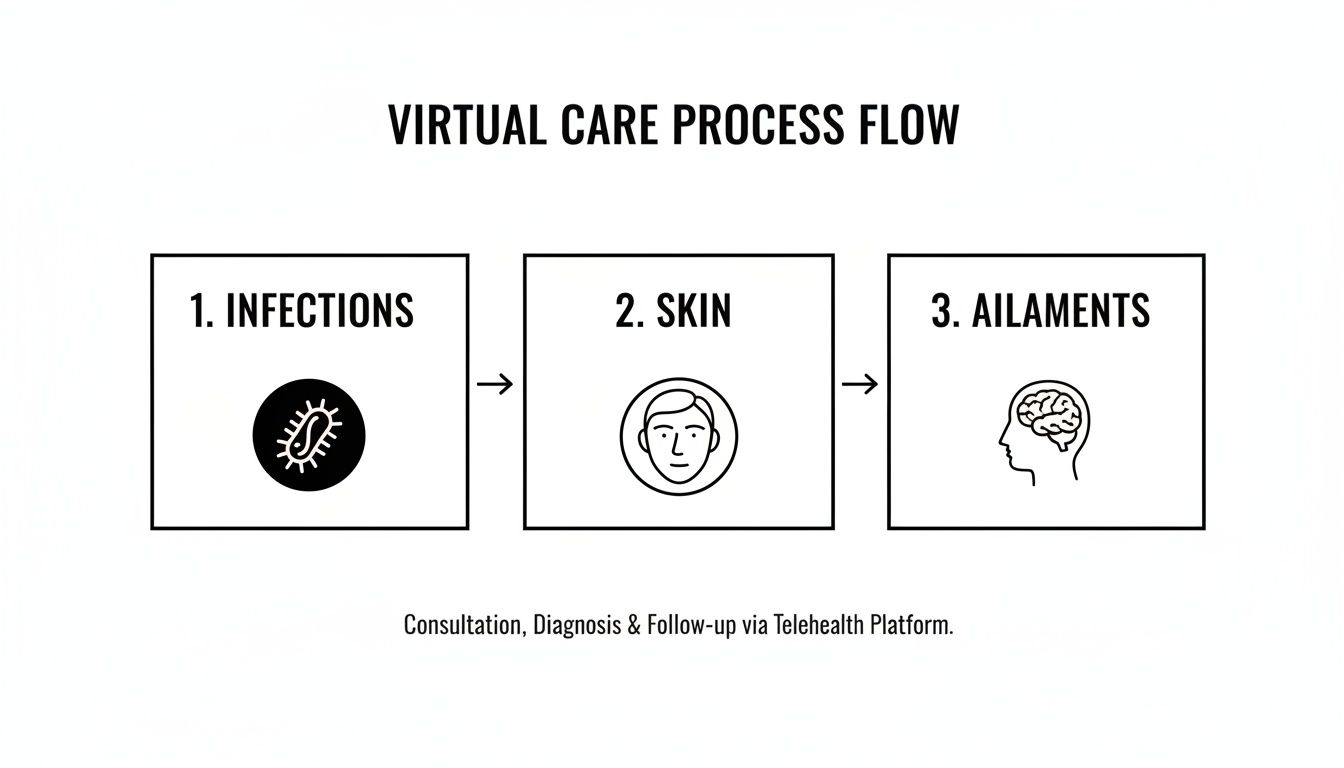
As you can see, the platform is designed to guide different health issues into one seamless path for diagnosis and treatment.
Receiving Your Treatment and Prescription
After the physician has finished their review and made a diagnosis, they'll put together your personalized treatment plan. You'll get this plan sent directly to you through the secure platform. It will clearly explain your condition, give you instructions for at-home care, and include any prescriptions you might need.
If medication is part of your treatment, the doctor sends an e-prescription directly to your preferred local pharmacy. You’ll get a notification when it’s ready for pickup, and you can use your health insurance for the medication just like you normally would. This final step closes the loop, turning a process that used to eat up hours of your day into something that’s often done in less than two hours.
Virtual Urgent Care vs In-Person Clinics
Trying to decide between a virtual doctor visit and a trip to a brick-and-mortar clinic can feel like a tough call. Both give you access to great medical help, but they really shine in different situations. Once you get the hang of the key differences in convenience, cost, and what each can actually treat, you'll know exactly which one to choose for your needs, every single time.
Think of it like this: an in-person clinic is a full-service auto shop. It’s got all the heavy machinery—X-ray machines, lab equipment, and the tools for hands-on work. It’s the only choice when you need a physical exam or complex diagnostics. Virtual urgent care, on the other hand, is like having a master mechanic on speed dial 24/7. They can diagnose most common issues just by listening to the engine and asking the right questions. It’s incredibly fast and efficient for a whole range of problems.
The Unmatched Advantage of Convenience
The most glaring difference is just how convenient virtual care is. With a traditional clinic, the process is familiar but loaded with friction. You have to carve out time, drive there, check in, and then waste time in a waiting room—a process that can easily eat up hours of your day.
Virtual urgent care blows all those barriers away. With a service like ChatWithDr, you can get care 24/7, nationwide. You can start a consultation from your couch at midnight or during a quick lunch break at work without derailing your entire schedule.
This on-demand access is a huge part of why the whole industry is booming. The U.S. virtual care market is valued at USD 3.94 billion in 2025 and is expected to rocket to USD 48.54 billion by 2034. It's all driven by patients like you who are demanding faster, easier healthcare. You can read up on the virtual care market projections to see the trends fueling this massive shift.
A Clear View on Costs
Cost is the other big differentiator. When you walk into a traditional urgent care clinic, the final bill is often a total mystery. You’ll have your co-pay, sure, but then there are facility fees and other surprise charges that pop up later, making the true cost a guessing game.
Virtual platforms bring some much-needed transparency to healthcare pricing.
Services like ChatWithDr run on a simple, flat-fee model. You know the exact cost—$39.99—before you even start talking to a doctor. There are no hidden fees or surprise bills, which gives you peace of mind and makes budgeting for healthcare way easier.
This straightforward pricing empowers you to get help for minor issues without worrying about a shockingly high bill. It puts you back in control of your healthcare spending.
Understanding the Scope of Services
While virtual care is a winner on convenience and cost, it does have clear limits. Its real strength is in treating common, low-risk conditions that a doctor can accurately diagnose just by listening to your symptoms and maybe looking at a few photos. This covers things like UTIs, sinus infections, pink eye, and rashes.
But an in-person clinic is non-negotiable for anything that requires a physical touch or advanced diagnostic tools.
- When to go in-person: You absolutely need a hands-on visit for things that require a physical exam (like listening to your lungs), lab work (strep tests, blood draws), or imaging (X-rays for a suspected broken bone).
- When virtual is ideal: Online care is perfect for straightforward diagnoses, quick prescription refills, and private consultations about sensitive health issues where a text-based or visual review is all that’s needed.
Comparing Virtual and In-Person Urgent Care
To make the choice even clearer, let's break down the key differences side-by-side. This table shows you where each option excels, helping you pick the right tool for the job.
| Feature | Virtual Urgent Care (e.g., ChatWithDr) | In-Person Urgent Care Clinic |
|---|---|---|
| Convenience | 24/7 access from anywhere. No travel or waiting rooms required. | Limited hours. Requires travel, check-in, and waiting. |
| Speed | Consultations often start within minutes or a few hours. | Can take several hours from travel to seeing a doctor. |
| Cost | Transparent, flat-fee pricing (e.g., $39.99). No surprise bills. | Variable costs with co-pays, facility fees, and potential hidden charges. |
| Services | Diagnosis and treatment for common, low-risk conditions. Prescription refills. | Hands-on exams, lab tests (strep, blood work), imaging (X-rays). |
| Best For | UTIs, sinus infections, pink eye, rashes, cold/flu, medication refills. | Broken bones, deep cuts, severe pain, conditions requiring lab work. |
Ultimately, one isn’t better than the other; they’re complementary tools in your healthcare toolkit. Think of virtual urgent care as your powerful first line of defense for common sicknesses, while in-person clinics remain absolutely essential for more complex or hands-on medical needs.
Understanding Costs and Payment Options
Let’s talk about one of the biggest headaches in healthcare: the bill. A trip to a traditional clinic can feel like a financial gamble. You’ve got co-pays, mysterious facility fees, and confusing insurance statements that show up weeks later. Virtual urgent care completely flips that script by making pricing clear and predictable, so you know exactly what you’re getting into.
The most common setup is a simple flat fee. A service like ChatWithDr charges one single price for the entire consultation—a flat $39.99. You know the cost before you even start, which means you can get help for minor issues without stressing about a surprise bill that wrecks your budget. That kind of clarity is a huge part of the appeal.
This straightforward pricing is a big reason why telehealth is exploding. The direct-to-consumer telehealth market, which includes virtual urgent care, was valued at $1.47 billion in 2023 and is only getting bigger. In fact, one major healthcare system saw its virtual visits jump from 481,000 in all of 2023 to 590,000 in just the first three quarters of 2024. That’s incredible patient demand, and it shows just how much people want this kind of accessible care. You can find more details about the dramatic growth of telehealth on the National Center for Biotechnology Information's website.
Flexible Ways to Pay for Your Visit
On top of the clear pricing, these platforms give you flexible ways to pay, making care even easier to access. You’re not just stuck with a credit or debit card. Most leading virtual urgent care services, ChatWithDr included, let you use your tax-advantaged health accounts to cover the consultation fee.
This gives you two smart ways to pay for your visit with pre-tax money:
- Health Savings Account (HSA): If you have a high-deductible health plan, you can use your HSA funds to pay for the virtual visit.
- Flexible Spending Account (FSA): You can also use money from your employer-sponsored FSA to cover the cost.
Using these accounts makes an already affordable service even more budget-friendly by letting you pay with dollars you’ve already set aside, tax-free.
The Two Parts of Your Healthcare Cost
It’s really important to understand that there are two separate costs involved in any medical visit, whether it's online or in-person: the consultation and the medication.
The fee you pay for a virtual urgent care visit, like the $39.99 for ChatWithDr, covers the doctor's time, their diagnosis, and the personalized treatment plan they create for you. This is completely separate from the cost of any medication they might prescribe.
Think of it this way: the platform fee pays for the doctor's expert advice. If they decide you need a prescription, that cost is handled separately at the pharmacy, just like it always is. You can use your regular health insurance to pay for your medications at CVS, Walgreens, or wherever you normally go. This separation is great because it lets you benefit from your insurance coverage for prescriptions while still getting the low, flat-fee deal for the medical consultation itself.
Safety, Privacy, and Quality of Care

When you’re seeking medical advice online, trust is everything. It's completely natural to wonder if your private information is actually private and if the doctor on the other side of the screen is the real deal. Reputable virtual urgent care platforms are built to answer those questions with a solid foundation of security and professional excellence.
At the heart of it all is the Health Insurance Portability and Accountability Act (HIPAA). This is the federal law that sets the gold standard for protecting your sensitive health data. Platforms like ChatWithDr use fully HIPAA-compliant systems with enterprise-grade security, ensuring your medical history and personal details are guarded with the same intensity as they would be in a hospital.
This commitment to confidentiality is non-negotiable. You can see exactly how we safeguard your information in our detailed privacy policy.
This focus on trustworthy care is fueling massive growth in the industry. The global virtual care market was valued at USD 9.0 billion in 2024 and is on track to hit an incredible USD 107.8 billion by 2035. That explosion is driven by people just like you demanding healthcare that’s both convenient and secure.
Physician Quality and Licensing
Beyond data security, what really matters is the quality of the doctor you're speaking with. This is where legitimacy is key. Every single physician on a credible virtual urgent care platform is a U.S. board-certified and state-licensed physician.
This means they’ve gone through the full gauntlet: medical school, residency, and passing incredibly tough board exams to become specialists in fields like family medicine or internal medicine.
A doctor’s credentials and professional standards remain exactly the same whether they are treating you through a screen or in an examination room. They are held to the same ethical and legal obligations, ensuring you receive legitimate, high-quality medical advice.
Maintaining these high standards is absolutely essential for building patient trust and is a core part of the general principles of quality and safety that guide reliable services.
Knowing When to Seek Emergency Care
Finally, a huge part of safety is knowing what virtual care isn't for. These services are designed for common, non-emergency conditions. For anything that could be life-threatening, you need to get in-person help immediately.
Call 911 or head to the nearest emergency room if you experience any of these red-flag symptoms:
- Chest pain or pressure
- Severe shortness of breath
- Sudden weakness, numbness, or difficulty speaking
- Uncontrolled bleeding
- Severe abdominal pain
Recognizing these boundaries empowers you to use virtual urgent care safely and effectively, getting you the right care for the right situation.
Common Questions About Virtual Urgent Care
Jumping into a new way of getting healthcare always brings up a few questions. To make sure you feel completely comfortable, we’ve put together answers to the things people ask most about virtual urgent care. This quick guide will clear up any confusion and show you just how simple it is.
Can I Get a Prescription?
Yes, absolutely. If a board-certified doctor reviews your case and decides a prescription is the right call, they’ll send an e-prescription straight to your local pharmacy. This is a crucial part of treating common issues like UTIs, sinus infections, and bronchitis quickly and effectively.
It's important to remember that controlled substances can't be prescribed this way. Once the prescription is sent, you just use your regular insurance at the pharmacy to cover the medication itself.
How Do I Know the Doctors Are Qualified?
This is a great question. Reputable platforms only partner with U.S.-based, board-certified physicians who are fully licensed to practice in your state. They meet the exact same high standards for education, training, and professionalism as any doctor you’d see in a clinic.
Every doctor's credentials are a big deal and are checked thoroughly. This guarantees you’re getting legitimate, high-quality medical care from a trusted professional every single time.
What if My Condition Can't Be Treated Virtually?
Your safety is always the number one priority. If the doctor reviewing your symptoms feels you need a physical exam, lab tests, or suspects something more serious, they will tell you to seek in-person care. It's their job to make sure you get the right level of care for your specific needs.
Good virtual urgent care services are upfront about their limits. They will never try to treat something that falls outside the safe and effective scope of telemedicine, because your well-being comes first.
Think of this professional judgment as a key safety feature built right into the system.
Is a Text-Based Consultation Really Effective Without Video?
For many common health issues, a text-based chat is not only effective but often what patients prefer. It gives you the space to write out a detailed, thoughtful description of your symptoms on your own time. Plus, you can easily upload photos for skin issues or other visible symptoms.
Doctors are incredibly skilled at making accurate diagnoses from this combination of written and visual information. This method also offers total privacy and convenience—no need to scramble to find a quiet, private spot for a video call. You get expert care, without any of the hassle.
Ready for fast, convenient medical care without the waiting room? ChatWithDr offers 24/7 access to board-certified doctors for just $39.99. Get a diagnosis and treatment plan today.