
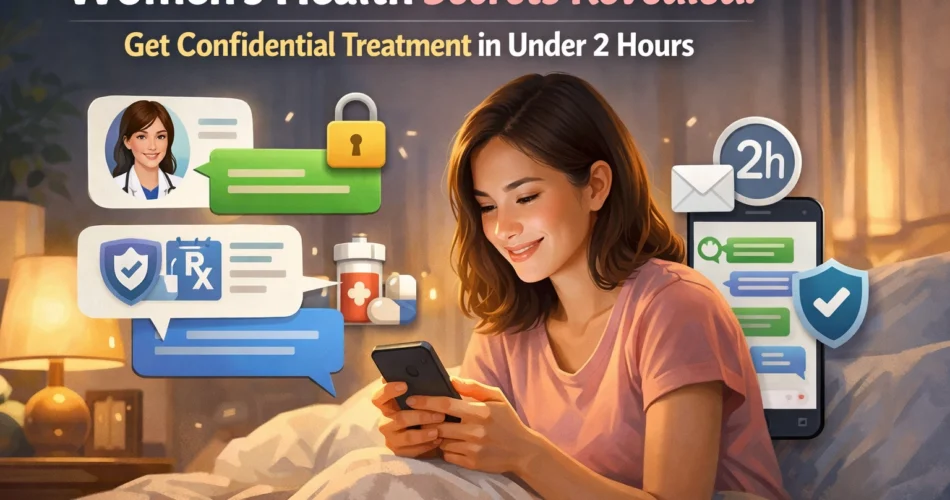
Let's talk about something that doesn't get discussed enough: 73% of women delay seeking medical care for intimate health concerns due to embarrassment, scheduling conflicts, or privacy worries. You're sitting at your desk with burning symptoms from a UTI, or you need emergency contraception after a contraceptive failure, and the thought of taking time off work, sitting in a waiting room, and explaining your situation face-to-face feels overwhelming.
Here's what most women don't realize: you can now get confidential, professional treatment for many women's health conditions in under 2 hours: without leaving your home or office.
The Women's Health Issues That Can't Wait
Certain conditions affect your quality of life immediately and need fast treatment. According to the American College of Obstetricians and Gynecologists, delaying treatment for common infections can lead to complications and prolonged discomfort.

Bacterial vaginosis (BV) affects nearly 30% of women of reproductive age and causes distinctive symptoms: fishy odor, unusual discharge, and irritation. Many women live with these symptoms for weeks before seeking help because scheduling a gynecology appointment can take 2-3 weeks in most areas. Bacterial vaginosis treatment online now makes it possible to get evaluated and prescribed appropriate antibiotics the same day.
Urinary tract infections send over 10 million women to doctors annually. That painful, urgent burning sensation isn't something you should "wait out." Online UTI treatment connects you with licensed physicians who can prescribe antibiotics within hours, not days.
Emergency contraception has a critical time window: it's most effective within 72 hours after unprotected intercourse, though some forms work up to 5 days. Every hour counts. Getting an emergency contraception online prescription eliminates the pharmacy counter awkwardness and time delays that could reduce effectiveness.
Yeast infections create intense itching and discomfort that disrupts sleep, work, and daily activities. While over-the-counter treatments exist, research shows that women frequently misdiagnose their own symptoms: what seems like a yeast infection might actually be BV or another condition requiring different treatment.
Why Confidentiality Matters More Than You Think
Privacy concerns are legitimate. A 2024 study published in JAMA Network Open found that 42% of women avoid seeking care for intimate health issues due to fears about privacy, particularly in small communities where they might know the office staff or encounter someone in the waiting room.

Traditional healthcare settings create multiple privacy vulnerabilities:
Waiting room exposure means explaining your symptoms within earshot of others or having your name called out for "a vaginal health concern."
Shared medical records within large healthcare systems mean multiple staff members may access your information.
Insurance explanations of benefits arrive in the mail with condition descriptions that family members or roommates might see.
Pharmacy pickups require standing at a counter while the pharmacist loudly asks if you have questions about your "bacterial vaginosis medication."
Text-based telehealth eliminates these exposure points entirely. You communicate privately with licensed physicians through encrypted messaging, receive prescriptions electronically, and manage everything from your smartphone.
How Same-Day Treatment Actually Works
The speed of online women's health care isn't about cutting corners: it's about eliminating the inefficiencies that delay care without improving outcomes.
Here's the typical timeline when you chat with doctors online:
0-5 minutes: Create your account and describe your symptoms through secure medical messaging. No phone trees, no "the next available appointment is in three weeks."
15-45 minutes: A licensed physician reviews your medical history and symptoms. They ask follow-up questions via text to ensure accurate diagnosis.
45-90 minutes: The doctor provides a diagnosis and treatment plan. If appropriate, they send prescriptions directly to your preferred pharmacy electronically.
90-120 minutes: Pick up your medication or have it delivered, depending on the pharmacy and your location.
Compare this to traditional care: call during business hours, schedule an appointment 1-3 weeks out, take time off work, drive to the office, sit in the waiting room, spend 10 minutes with a provider, drive to the pharmacy, wait for the prescription to be filled.
For conditions like bacterial vaginosis or UTIs in women, this streamlined approach doesn't compromise care quality: it simply removes unnecessary steps.
Why Text-Based Care Works Better for Sensitive Issues
Video calls have become synonymous with telehealth, but many women prefer text-based medical messaging for intimate health concerns. There's something easier about typing "I'm experiencing a strong fishy odor and grayish discharge" than saying those words out loud while making eye contact on camera.

Text with doctors on platforms like ChatWithDr offers several advantages:
You can communicate during work hours without ducking into a private space for a video call. You can send messages at 11 PM when symptoms feel worst and get responses from physicians working overnight shifts. You have a written record of all medical advice and instructions to reference later.
The National Library of Medicine notes that asynchronous messaging (non-real-time text communication) in healthcare increases patient satisfaction and adherence to treatment plans because patients feel less rushed and more thoughtful about describing symptoms.
For straightforward conditions like BV, yeast infections, and uncomplicated UTIs, comprehensive medical evaluation doesn't require physical examination. Laboratory testing and imaging aren't necessary for diagnosis, making text-based evaluation entirely appropriate according to telemedicine clinical guidelines.
The Financial Reality: HSA/FSA and Transparent Pricing
Women's healthcare costs add up quickly. An in-person urgent care visit for a UTI typically costs $150-$300 without insurance. A gynecologist appointment for bacterial vaginosis runs $200-$400. Add prescription costs, transportation, and lost wages from taking time off work.
Telehealth consultations generally cost $35-$75, and importantly, HSA and FSA cards are accepted for these services. This means you're using pre-tax dollars for care, reducing your effective cost by 20-30% depending on your tax bracket.

HSA/FSA eligibility covers:
- Online medical consultations
- Digital prescriptions
- Follow-up messaging with physicians
- Treatment for acute conditions
Many women don't realize that emergency contraception consultations, UTI treatment, and bacterial vaginosis care all qualify as HSA/FSA expenses. This makes professional medical care more accessible than grabbing over-the-counter products that might not even address your specific condition.
Professional Standards and Security Features
"Is online care actually legitimate?" is a fair question. The telehealth industry has grown so rapidly that quality varies significantly between platforms.
Look for these markers of professional, secure women's health services:
Board-certified, state-licensed physicians who can practice in your state. Legitimate platforms verify credentials and maintain active medical licenses.
HIPAA-compliant encryption for all messaging, medical records, and payment processing. Your health information should be protected with the same security banks use for financial data.
Transparent medical policies about which conditions can and cannot be treated online. Reputable services clearly state their limitations.
Electronic prescribing systems that send medications directly to pharmacies, reducing errors and eliminating paper prescriptions that could be lost or stolen.
According to a 2025 report from the Journal of Women's Health, telehealth platforms that follow these standards achieve patient satisfaction rates of 88-92% for women's health consultations, comparable to in-person visits for appropriate conditions.
When You Should Still Seek In-Person Care
Online women's health services excel at treating common, straightforward conditions: but they're not appropriate for everything. Seek in-person or emergency care for:
Severe symptoms: High fever over 101°F, intense abdominal pain, heavy vaginal bleeding, or severe vomiting indicate conditions that may need urgent in-person evaluation.
Pregnancy complications: Any bleeding, severe cramping, or concerning symptoms during pregnancy require immediate in-person assessment.
First-time symptoms: If you've never been diagnosed with a particular condition before, physical examination might be necessary for accurate diagnosis.
Unsuccessful treatment: If you've completed a course of antibiotics for a UTI or BV and symptoms haven't improved, you may need cultures, imaging, or specialized testing.
Complex medical history: Multiple drug allergies, immune system disorders, or several chronic conditions might require more comprehensive evaluation than online platforms can provide.
The key is matching the care setting to the clinical situation. For established conditions with typical symptoms, online urgent care provides fast, confidential, professional treatment. For complex or severe situations, traditional healthcare settings offer the necessary resources.

Taking Control of Your Health on Your Timeline
Women's health shouldn't require elaborate planning, schedule juggling, or privacy compromises. The combination of secure medical messaging, licensed physicians available for same-day consultations, and HSA/FSA payment options creates a healthcare model that fits modern life.
Whether you're dealing with the unmistakable symptoms of a UTI at 10 PM, need emergency contraception on a Sunday morning, or have been living with BV symptoms because scheduling seemed too complicated: professional medical care is now accessible in under 2 hours.
The healthcare system is finally catching up to what women have been saying for years: intimate health concerns deserve private, immediate, professional attention without bureaucratic obstacles. Text-based telehealth isn't replacing traditional healthcare: it's filling the gaps where traditional systems have consistently failed to meet women's needs.
Your health concerns are valid. Your time matters. Your privacy deserves protection. And you shouldn't have to choose between these things and getting professional medical care.
Disclaimer: This information is not a substitute for professional medical advice, diagnosis, or treatment. Always seek the advice of your physician or qualified health provider with questions regarding medical conditions or treatments.
Related posts:
 Yeast Infection vs BV: How to Tell the Difference
  Can You Really Get BV Treatment Without Leaving Home? Here’s the Truth About Online Women’s Health Care
  The Ultimate Guide to Confidential Online Care for Women’s Health: Same-Day Prescriptions, HSA/FSA Friendly
  Are You Making These Common Mistakes When Seeking Confidential Women’s Health Care Online?
  The Complete Guide to Confidential Online Treatment: BV, Emergency Contraception, and More (HSA/FSA Accepted)