

Yes, you can absolutely get treatment for a yeast infection online. In fact, it's often much faster and way more convenient than scheduling a traditional doctor's visit. Telehealth platforms connect you with real, board-certified physicians who can diagnose your symptoms and send a prescription straight to your local pharmacy, sometimes in just a few hours.
The Modern Way to Handle Yeast Infections

Let's be honest—dealing with the discomfort of a yeast infection is frustrating enough on its own. The familiar itching, burning, and irritation demand quick relief. Not too long ago, that meant booking an appointment, taking time off work, and sitting in a clinic waiting room.
Thankfully, telehealth has completely changed the game.
Getting care online offers a private, fast, and effective alternative for most common yeast infections. It skips all the logistical headaches of an in-person visit, giving you a solution that fits right into your busy life. For many women, this modern approach isn't just a backup plan; it's now their go-to method for getting care.
Why Digital Health Is a Perfect Fit for Common Ailments
The reality is that vaginal yeast infections are incredibly common. A 2020 U.S. survey found that a staggering 53% of women have had at least one provider-diagnosed yeast infection in their lifetime.
Here’s the really important part: among women who had an infection in the past year, 72% used a prescription antifungal. That tells us that over-the-counter options just aren't cutting it for a lot of people. This is exactly where online care shines, bridging the gap between self-treating and having to schedule a full-blown physical appointment. You can dive into the details yourself in the full research on vaginal candidiasis prevalence.
This shift empowers you to take control of your health without any unnecessary delays. Platforms like ChatWithDr are designed to handle these exact situations efficiently and discreetly. Understanding how our online consultation process works can give you the confidence that you're getting professional, secure, and prompt medical attention from a real doctor.
Why Online Treatment Is So Effective
So, what makes an online consultation a reliable choice for something like a yeast infection? It all comes down to a focused process. The system is built to gather the specific information a doctor needs to make an accurate diagnosis based on classic, tell-tale symptoms.
To make it even clearer, let's break down how the two approaches stack up.
Online Vs In-Person Yeast Infection Treatment
When you're deciding how to get care, it helps to see the differences side-by-side. Here’s a quick look at what to expect from an online consultation versus a traditional clinic visit.
| Feature | Online Consultation | Traditional In-Person Visit |
|---|---|---|
| Convenience | Get care from home, anytime you need it (24/7). | Requires traveling to a clinic during set business hours. |
| Speed | Diagnosis and prescription can be done in hours. | It can take days, or even weeks, to get an appointment. |
| Privacy | Discreet text-based chats or private video calls. | Public waiting rooms and face-to-face exams. |
| Cost | Usually a flat, affordable fee with no surprises. | Varies widely based on insurance copays and deductibles. |
| Access | Available anywhere with an internet connection. | Limited by clinic locations and their specific hours. |
Ultimately, both paths lead to a professional diagnosis, but the journey to get there is completely different. Your choice really depends on what you value most—speed and privacy, or a hands-on physical exam.
The biggest advantage is immediacy. Instead of suffering through the discomfort while you wait days for an appointment, you can start the process of getting relief within minutes of your symptoms starting. This rapid access to care is the fundamental benefit of modern telehealth.
Figuring Out If It's a Yeast Infection
Before you can even think about getting a yeast infection treatment online, you have to be reasonably sure that’s what you’re dealing with. A good self-assessment is your first move, and it's what helps an online doctor give you a fast, accurate diagnosis. The more specific you can be, the better.
The symptoms of a vaginal yeast infection, which is just an overgrowth of a fungus called Candida albicans, can be anything from a minor annoyance to completely derailing your week. Everyone’s experience is a bit different, but most of the time, a few classic signs show up. Spotting these is key to telling a yeast infection apart from other common issues.
The Classic Symptoms to Look For
The number one sign, and the one that drives most people to seek help, is intense itching. We’re not talking about a small, passing itch. This is a persistent, can’t-think-about-anything-else kind of irritation in and around the vagina that often feels worse at night.
Along with the itch, you’ll likely feel a burning sensation, especially when you pee or during sex. This happens because the tissue is already inflamed and sensitive, so any friction or contact makes it worse. It can sometimes feel like a urinary tract infection (UTI), but you probably won't have the constant urge to urinate that usually comes with a UTI.
Finally, the other major clue is a change in your vaginal discharge. With a yeast infection, it’s usually:
- Thick and white, with a texture that people often compare to cottage cheese.
- Odorless, or maybe with a very faint, slightly sweet or bread-like smell. The lack of a strong odor is a really important detail.
Pro Tip: If you're experiencing that trifecta—the crazy itching, the burning, and the thick, white, odorless discharge—you're very likely dealing with a classic yeast infection. This is exactly the kind of clear-cut case that can often be diagnosed and treated online.
Is It a Yeast Infection, or Something Else?
Here’s where things get tricky. Other conditions can feel a lot like a yeast infection, which is why so many people end up using the wrong over-the-counter treatment and just making things worse. This is exactly why getting a professional diagnosis, even a quick online one, is so important.
You need to know the subtle differences between a yeast infection and its most common look-alikes.
Bacterial Vaginosis (BV)
Bacterial Vaginosis, or BV, is the single most common reason for vaginal discharge and is constantly mistaken for a yeast infection. But if you know what to look for, the signs are pretty distinct.
| Symptom | Yeast Infection | Bacterial Vaginosis (BV) |
|---|---|---|
| Discharge | Thick, white, clumpy, and has no odor. | Thin, watery, and grayish-white. |
| Odor | Usually none, or a mild bread-like scent. | A very distinct and often strong "fishy" odor. |
| Main Feeling | Intense itching and burning are the biggest complaints. | The odor is the main issue; irritation is often mild. |
The dead giveaway for BV is that unmistakable fishy odor, which tends to get stronger after sex. The itching with BV is usually way less intense than the maddening itch you get from a yeast infection.
Sexually Transmitted Infections (STIs)
Some STIs, particularly trichomoniasis, can also bring on itching and discharge. But the discharge with "trich" is usually frothy, yellow-green, and has a foul smell. Other STIs like gonorrhea or chlamydia might cause weird discharge and burning, but they rarely cause the intense external itching that is the hallmark of a yeast infection.
If there is any possibility you've been exposed to an STI, or if your symptoms just don't quite fit the classic yeast infection profile, getting a real diagnosis is non-negotiable. This is where being completely honest in your medical history form for an online doctor is critical so they can tell you if online treatment is safe or if you need to get tested in person.
How to Get Your Online Yeast Infection Prescription
So, you’ve recognized the classic, tell-tale signs of a yeast infection. Now what? The next step is getting treatment, and securing a prescription online is a refreshingly straightforward process designed for speed and convenience. It lets you skip the waiting room and get on the path to relief much faster.
It really comes down to finding a credible service and knowing what to expect from the virtual consultation.
What to Expect During Your Online Consultation
Once you've landed on a platform you trust, the consultation is typically quick and efficient. Instead of a video chat or phone call, you'll usually fill out a secure, detailed online intake form. Think of this as your virtual exam.
This digital questionnaire will walk you through questions about your situation, asking for specifics like:
- Your primary symptoms: What you're feeling, how severe it is, and when it all started.
- Your health history: This includes any previous yeast infections, known allergies, or other medical conditions.
- Current medications: It's important to check for any potential interactions with antifungal treatments.
- Pregnancy status: This is a crucial detail, as it heavily influences which medications are considered safe.
Be as thorough and honest as you can. The information you provide is what allows the doctor to make an accurate diagnosis without needing a physical exam. For something as common as a yeast infection, the distinct pattern of symptoms is often more than enough for a confident assessment.
This is the typical flow of symptoms a doctor will be looking for during your online assessment.
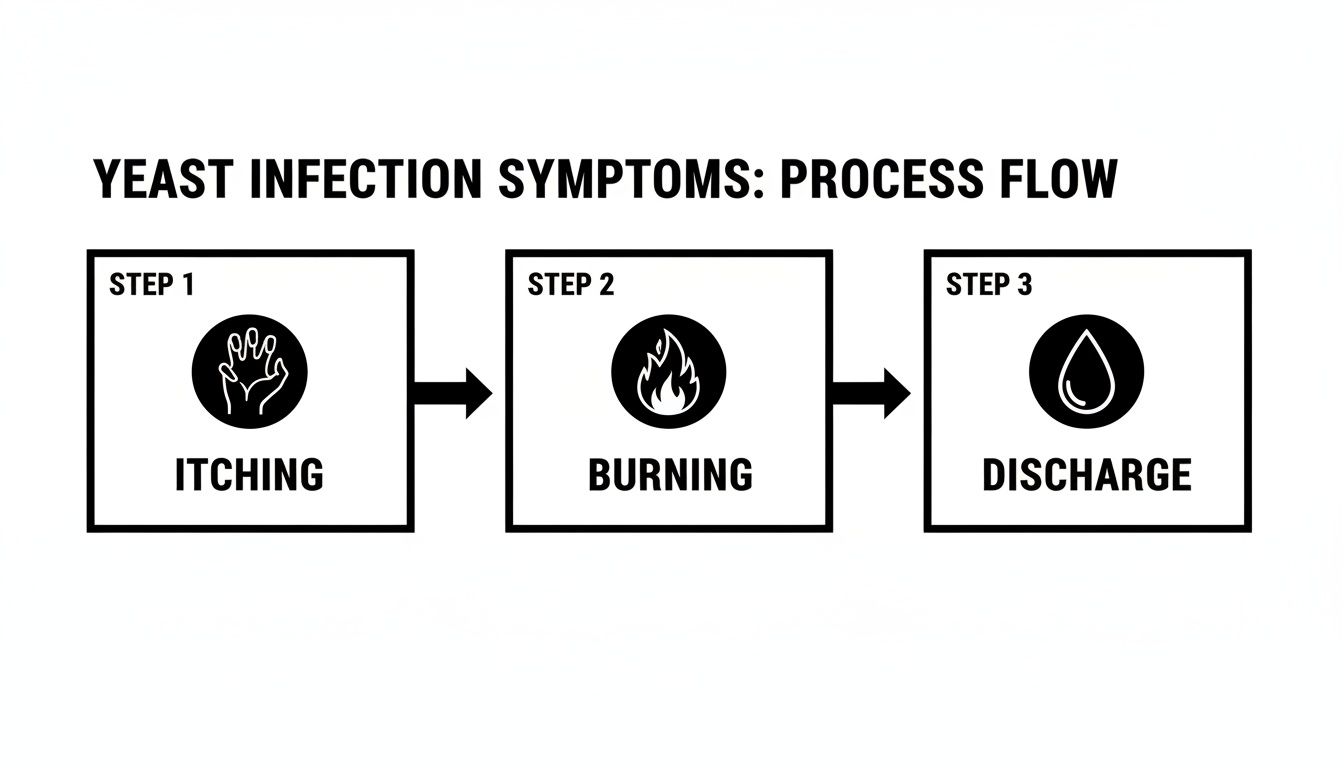
Recognizing this classic trio of itching, burning, and discharge is the key to the diagnostic process. It’s what enables physicians to provide fast, accurate, and safe care remotely.
Receiving Your Diagnosis and Treatment Plan
After you submit your information, a licensed physician reviews your case. This review often happens within just a few hours—a world away from waiting days (or longer) for a clinic appointment. Based on your answers, the doctor will either confirm the diagnosis and create a personalized treatment plan or let you know if in-person care is needed.
If your symptoms line up with a typical, uncomplicated yeast infection, the doctor will prescribe an antifungal medication. They'll typically recommend one of a few highly effective options.
Common Online Yeast Infection Treatments
The treatments prescribed online are the same gold-standard medications you'd get from an in-person visit. Here's a quick look at the prescription and over-the-counter options a doctor might recommend.
| Treatment Type | Common Name(s) | How It Works | Best For |
|---|---|---|---|
| Oral Antifungal | Fluconazole (Diflucan) | A single-dose pill that works systemically to stop fungal growth. | Convenience and ease of use; a simple one-and-done solution. |
| Topical Antifungal | Miconazole, Clotrimazole | Creams or suppositories applied directly to the affected area for 1, 3, or 7 days. | Providing immediate, localized relief from external itching and burning. |
| Combination Therapy | Fluconazole + Topical Cream | Using both an oral pill and an external cream. | Cases with severe external itching that needs rapid, targeted relief. |
The doctor's choice will depend entirely on your specific symptoms, your medical history, and sometimes your personal preference. For example, if intense external itching is your main complaint, they will likely suggest a topical cream to use alongside an oral pill for faster relief. Getting a handle on how to get an online prescription for these medications can make the whole process feel much less intimidating.
Getting Your Medication the Same Day
This is where the convenience of telehealth really shines. Once the physician finalizes your treatment plan and writes the prescription, it is sent electronically—or "e-prescribed"—directly to the pharmacy you chose during your intake.
You'll get a notification, usually via text or email, letting you know your prescription is ready. All you have to do is head to your local pharmacy and pick it up. In many cases, the entire process—from starting your online visit to having medication in hand—can be wrapped up in just a few hours.
Managing Recurrent or Complicated Infections
Most yeast infections are pretty straightforward, but some cases are just plain stubborn. When an infection keeps coming back or shows up during pregnancy, the treatment plan needs to be a lot more thoughtful. The good news is, getting yeast infection treatment online is still one of the most effective ways to handle these more complex situations.
Instead of a one-and-done solution, these scenarios usually call for a sustained management plan. This is where telehealth really proves its worth, offering a practical way to manage ongoing care without the hassle of scheduling one in-person appointment after another. Online physicians can easily adjust prescriptions, check on your progress, and give you the continuous support you need.
Tackling Recurrent Yeast Infections
A recurrent yeast infection is more than just an annoyance; it's a chronic condition that can seriously mess with your quality of life. The official definition is having four or more diagnosed yeast infections within a single year. If this sounds like you, simply treating each flare-up as it happens isn't going to cut it—you need a long-term strategy.
An online doctor will approach this very differently from a one-off infection. The goal shifts from just getting immediate relief to actually preventing future flare-ups. This almost always involves a more extended course of antifungal medication.
Your treatment plan might look something like this:
- Initial Intensive Phase: A longer starting course of fluconazole, maybe taken every few days for a week or two, to completely knock out the current infection.
- Maintenance Therapy: After that, a regular, lower dose of fluconazole is taken weekly or monthly for up to six months to stop the yeast from overgrowing again.
This suppressive therapy is a common and highly effective way to finally break that cycle of recurrence. The sheer convenience of online care makes this approach far more manageable, since you can get your maintenance prescription refilled without needing a new in-person visit every single month.
Dealing with recurrent infections is a major treatment challenge. A survey cited in one clinical review reported that about 8% of American women experience at least four episodes of vulvovaginal candidiasis every year. Because these cases often require careful adjustments and close tracking, having quick online access to a physician for ongoing management can make a world of difference.
For anyone stuck in this frustrating cycle, it's worth digging deeper into Understanding Recurrent Thrush and How to Stop It.
Special Considerations During Pregnancy
Pregnancy brings a huge wave of hormonal changes, which can unfortunately make you much more susceptible to yeast infections. Treating them requires extra caution, as not all medications are considered safe for a developing baby. This is one of those times where professional medical guidance isn't just a good idea—it's absolutely essential.
When you’re pregnant, oral antifungal pills like fluconazole are generally off the table, especially during the first trimester. The standard of care shifts completely to topical treatments.
An online doctor will almost always prescribe one of two things:
- Topical Antifungal Creams: Medications like clotrimazole or miconazole that are applied directly to the affected area.
- Longer Treatment Duration: Instead of a quick 1- or 3-day course, a 7-day treatment course is the typical recommendation during pregnancy to make sure the infection is totally gone.
Even though you're just using an external cream, it is crucial to do it under a doctor's supervision. They can confirm the diagnosis is correct and make sure you’re using a product that is both safe and effective for your specific situation. Telehealth offers a safe, accessible way to get that expert guidance without adding yet another appointment to your already busy schedule.
Knowing When You Need In-Person Medical Care
Getting a yeast infection treatment online is an incredibly convenient and effective option for straightforward cases. Let's be honest, it's a lifesaver when you know what's going on and just need to get relief fast. But telehealth isn't a silver bullet for every health concern.
It's crucial to know the difference between a simple yeast infection and something more serious that needs a hands-on evaluation. Think of this as being a smart, empowered patient. Knowing when to switch from your screen to a clinic is key to using digital health safely and responsibly.
Red Flags That Signal an In-Person Visit Is Necessary
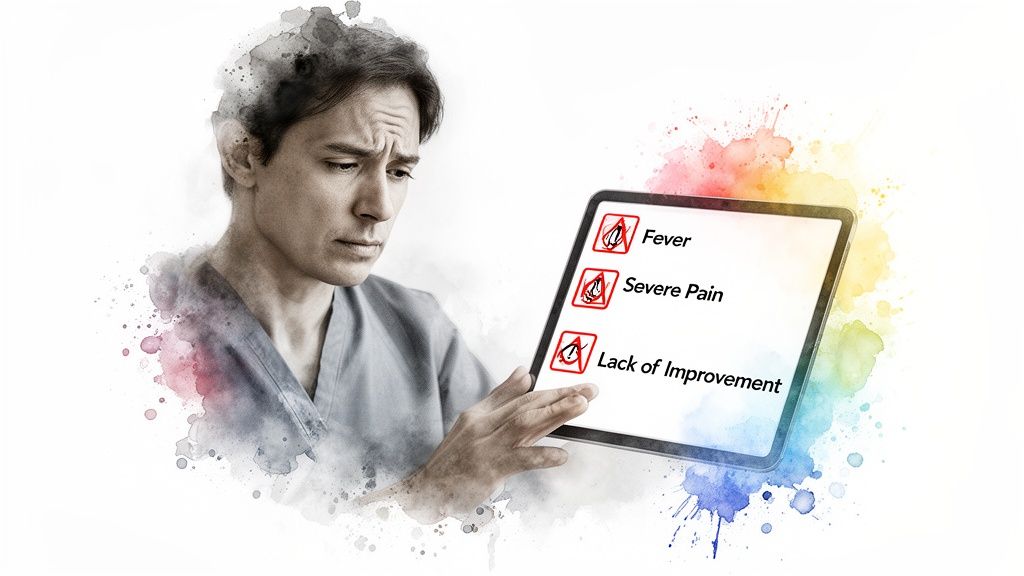
If you’re experiencing any of the following symptoms along with what you think is a yeast infection, it's time to pause the online consultation and make an appointment with a doctor in person. These are non-negotiable red flags that could point to a different or more severe condition that a text-based visit simply can't diagnose.
High Fever or Chills: A standard yeast infection is a localized problem and absolutely should not cause systemic symptoms like a fever. A temperature of 100.4°F (38°C) or higher is a clear sign that something else is going on, potentially a kidney infection or Pelvic Inflammatory Disease (PID).
Severe Abdominal or Pelvic Pain: While some mild discomfort can tag along with a yeast infection, sharp, severe, or constant pain in your lower abdomen or pelvis is a major warning. This kind of pain demands a physical exam to rule out more serious issues.
Foul-Smelling or Unusually Colored Discharge: This is a big one. The discharge from a classic yeast infection is thick, white, and mostly odorless (often described as "cottage cheese-like"). A strong, fishy odor, or discharge that's greenish, yellowish, or gray, is a tell-tale sign of something else, like bacterial vaginosis (BV) or an STI like trichomoniasis. These require totally different treatments.
Your health is the number one priority. Online services are built for convenience, but they rely on you to report your symptoms accurately. If anything feels "off" or doesn't quite fit the typical yeast infection profile, always, always err on the side of caution and see a doctor face-to-face.
When Your Treatment Fails to Provide Relief
Another critical checkpoint comes after you’ve finished your treatment. Whether you used an over-the-counter cream or a prescription pill, you should feel a noticeable improvement within a few days. If that relief never arrives, or your symptoms come roaring back, it’s a clear signal to seek in-person medical advice.
Don't just assume you need a stronger dose and try again. A lack of improvement could mean a few different things are happening.
Reasons for Treatment Failure
- Incorrect Diagnosis: It’s possible the problem was never a yeast infection to begin with. Conditions like BV, dermatitis, or certain STIs can mimic yeast infection symptoms, but they won't respond to antifungal medication.
- Resistant Yeast Strain: While most infections are caused by Candida albicans, some are from less common, more stubborn strains of yeast. These resistant strains often require a different type of antifungal medication to clear up.
- Underlying Health Condition: Sometimes, a recurring or persistent infection can be a sign of an undiagnosed health issue, like diabetes, that needs to be properly managed.
If your symptoms are sticking around after a full course of treatment, an in-person visit is the logical next step. A provider can take a swab to get a definitive diagnosis, pinpointing the exact cause of your symptoms. From there, they can create a targeted treatment plan to finally get you the relief you need.
Your Questions About Online Treatment Answered
Stepping into telehealth for something as personal as a yeast infection can feel a little strange at first. It’s completely normal to have questions about how it all works, if it's effective, and just how private the process is. Let's walk through the most common concerns to help you feel confident about getting treated online.
Can a Doctor Really Diagnose a Yeast Infection Without an Exam?
For most uncomplicated cases, absolutely. An experienced doctor can recognize the classic pattern of yeast infection symptoms from a mile away.
The secure, detailed intake forms you fill out online are designed specifically to gather the exact information a physician needs to make an accurate diagnosis and rule out other possibilities. If your symptoms are unusual, severe, or keep coming back, a good online doctor will be the first to tell you that an in-person visit is the right next step.
How Quickly Can I Get a Prescription Online?
This is where online treatment really shines. Speed.
Once you submit your online consultation, a board-certified physician typically reviews your case, confirms a diagnosis, and sends an e-prescription to your pharmacy, often within just a few hours. That means you can realistically pick up your medication and start feeling better on the very same day the symptoms start.
The ability to go from symptom to solution in hours—not days—is a massive advantage. It cuts out the painful waiting game and puts relief within reach right when you need it most.
Is My Personal Information Safe During an Online Consultation?
Yes, your privacy is the top priority. Reputable telehealth platforms are legally required to be HIPAA-compliant.
This means they use serious, enterprise-grade security and encryption to protect your personal health information. Every consultation is confidential, and your data is handled with the same level of care you'd expect from your family doctor's office. Text-based chats add another layer of privacy, letting you get care discreetly from anywhere.
For more details, you can check out our full FAQ page for answers to other common questions.
What if the Online Treatment Does Not Work?
If your symptoms don’t get better—or they get worse—after you finish the treatment, it’s critical to follow up. This could be a sign that you're dealing with a resistant strain of yeast or that something else is going on entirely.
Most online services offer follow-up support. The doctor will likely advise you to see a healthcare provider in person for a physical exam and maybe some lab tests to figure out the best course of action.
Ready for fast, discreet relief? With ChatWithDr, you can get a diagnosis and prescription from a board-certified U.S. physician in hours, all from the privacy of your home. Start your $39.99 consultation now.
Related posts:
 Yeast Infection Symptoms in Women: How to Spot Signs and Find Relief
  Understanding yeast infection after antibiotics treatment: Quick remedies
  Yeast Infection vs BV: How to Tell the Difference
  How to Prevent Recurring Yeast Infections for Good
  Why Does My Discharge Smell Sour? A Guide to Causes and Care