
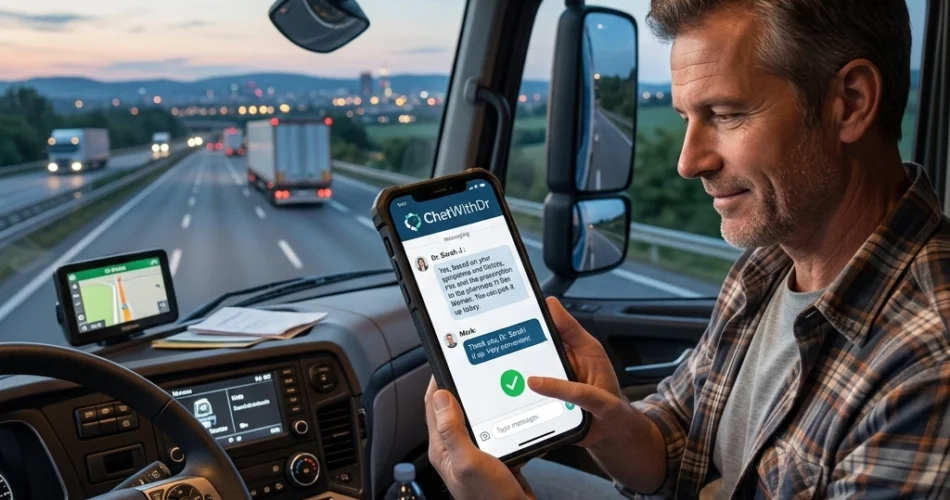
For the millions of long-haul truck drivers keeping the American economy moving, "home" is often a moving target. While the freedom of the open road is a major draw, it comes with a significant downside: accessing consistent, reliable healthcare. When you are hauling freight across state lines, finding a doctor who accepts your insurance and has a parking lot large enough for a 53-foot trailer is nearly impossible.
This is where telehealth for truck drivers becomes a game-changer. Gone are the days of sitting in a cramped urgent care waiting room for three hours or ignoring a worsening sinus infection because there’s nowhere to park the rig. Today, you can secure medical care and get prescriptions sent to a pharmacy on your route: all without leaving your cab.
In this guide, we’ll explore how professional drivers can utilize chat-based medical services to stay healthy, maintain their DOT medical certifications, and get the prescriptions they need, whenever and wherever they are.
The Unique Healthcare Challenges of the Long-Haul Driver
The trucking lifestyle is notoriously hard on the body. Long hours of sitting, irregular sleep patterns, and limited access to fresh, healthy food can lead to a variety of health issues. According to data from the National Institute for Occupational Safety and Health (NIOSH), long-haul truck drivers are at a higher risk for chronic conditions like hypertension, diabetes, and sleep apnea.
Despite these risks, the barriers to care are high:
- Logistical Nightmares: Most medical clinics are located in urban or suburban areas with zero oversized vehicle parking.
- Time Constraints: Federal Hours of Service (HOS) regulations mean that every hour spent in a waiting room is an hour of lost driving time or mandatory rest.
- Geographic Displacement: A driver might start the day in Pennsylvania and end it in Illinois. Finding a "local" doctor is a daily impossibility.
- Cost Uncertainty: Out-of-network fees can turn a simple prescription refill into a multi-hundred-dollar ordeal.
How Text-Based Telehealth Solves the "Trucker Problem"
Traditional telehealth often relies on video calls, which can be frustrating for drivers. If you’re parked at a truck stop with spotty Wi-Fi or traveling through a mountainous region with weak 5G, a video call will likely drop or lag.
Chat-based telehealth, like the service provided by ChatWithDr, is the superior alternative for the road. By using secure medical messaging, you can communicate your symptoms and medical history to a licensed U.S. doctor without needing high-bandwidth video.
No Appointments, No Registration
For a driver on a tight delivery window, the phrase "the doctor will see you in two weeks" is useless. Modern telehealth platforms allow you to start a consultation immediately. At ChatWithDr, there is no registration or account creation required. You simply start a chat, provide your details, and a licensed doctor reviews your case.
Rapid Response Times
When you have a migraine or a painful UTI, you can’t wait days for a callback. ChatWithDr offers a within 30 minutes to 4 hours average response time. This fits perfectly into a mandatory 30-minute break or an overnight reset.

Getting Prescriptions Sent to Your Route
One of the most common questions drivers ask is: "Can an online doctor actually send a prescription to a pharmacy I can reach?"
The answer is a resounding yes. Licensed doctors on telehealth platforms can send non-controlled prescriptions to virtually any pharmacy in the United States.
The Strategy for On-the-Road Pickups
- Identify Your Next Stop: Check your route for a truck stop that is near a major pharmacy chain (CVS, Walgreens, Walmart, etc.). Many large travel centers like Pilot, Flying J, or Love's are located within a mile of these pharmacies.
- Start Your Consultation: Use the ChatWithDr app to describe your symptoms.
- Provide the Pharmacy Address: When the doctor asks where to send the prescription, provide the address of the pharmacy at your upcoming stop.
- Pick Up While You Fuel: By the time you arrive, your medication is often ready for pickup.
This is particularly useful for blood pressure medication refills online, which is a critical need for maintaining a DOT medical card.
Common Conditions Treated via Chat
You don't always need a physical exam to get the right treatment. Many common ailments that plague drivers can be diagnosed through a detailed description of symptoms and, if necessary, a clear photo sent via secure message.
1. Sinus and Respiratory Infections
The recycled air in a truck cab and constant changes in climate can lead to chronic sinus issues. A doctor can assess your symptoms and prescribe antibiotics or high-strength nasal sprays to keep you breathing clearly.
2. Urinary Tract Infections (UTIs)
For drivers who often have to delay bathroom breaks, UTIs are a common and painful reality. You can get treatment online without a video call and have antibiotics waiting for you at your next stop.
3. Skin Conditions and Rashes
Whether it's a heat rash from sitting or an allergic reaction to something at a loading dock, a doctor can review a photo of the affected area via text and prescribe the necessary creams or medications.
4. Eye Issues
Pink eye is highly contagious and distracting when you're trying to focus on the road. You can get pink eye treatment online easily.

The Cost: Flat Rates vs. Insurance Headaches
One of the biggest stressors for owner-operators and independent contractors is the cost of healthcare. Many high-deductible plans make a simple doctor's visit feel like a luxury.
ChatWithDr simplifies this with a $39.99 flat-rate fee per consultation. There are no hidden costs, no subscription fees, and no surprise bills in the mail three months later. For $39.99, you get:
- Access to a licensed US doctor.
- A secure text-based consultation.
- Prescriptions sent to your pharmacy of choice.
- Care that is 24/7 available.
Furthermore, these services are often HSA and FSA eligible, allowing you to use your pre-tax dollars to cover your medical needs on the road.
Maintaining Your DOT Medical Certification
As every CDL holder knows, your health isn't just personal: it's professional. A spike in blood pressure or unmanaged diabetes can result in a failed DOT physical, effectively putting you out of a job.
Using telehealth for routine maintenance is a proactive way to ensure you pass your next physical. If you notice your blood pressure is creeping up during a check at a pharmacy kiosk, you can immediately text a doctor to discuss management options or medication adjustments before your certification expires.

Why Chat-Based Care is Better for Drivers
- Privacy: You can discuss your medical issues from the privacy of your sleeper berth. No more discussing sensitive issues in a public waiting room.
- Low Data Usage: Secure messaging uses significantly less data than video, which is vital if you are nearing your data cap for the month.
- Documentation: You have a written record of your conversation with the doctor, which can be helpful for your personal medical history or for follow-ups with your primary care provider.
- Efficiency: You can send a message, keep driving (using hands-free technology or during a stop), and check the response when you are safely parked.
How to Get Started
Keeping your health in check while on the road shouldn't be a secondary concern. With ChatWithDr, the doctor’s office is always in your pocket. Whether you are navigating the mountains of Colorado or the traffic in Houston, professional medical advice is just a text away.
- Download the app or visit our website.
- Select your symptom or condition from our list of treated conditions.
- Pay the $39.99 flat fee: no insurance required.
- Start chatting with a licensed US doctor.
- Pick up your prescription at a pharmacy on your route.
Don't let a minor health issue turn into a major breakdown. Stay healthy, stay compliant, and stay on the road.
Download the ChatWithDr App today:
- iOS: https://apps.apple.com/us/app/chatwithdr-online-doctor-24-7/id6758861710
- Android: https://play.google.com/store/apps/details?id=com.chatwithdr.app

Disclaimer: This information is not a substitute for professional medical advice, diagnosis, or treatment. Always seek the advice of your physician or qualified health provider with questions regarding medical conditions or treatments.
Related posts:
 The Truck Driver's Guide to Getting Medical Care on the Road (24/7)
  The Ultimate Guide to Telehealth for Truck Drivers: Everything You Need to Get Care on the Road
  Your Quick-Start Guide to Telehealth for Truck Drivers and Travelers: Do This First When Sick on the Road
 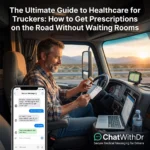 The Ultimate Guide to Healthcare for Truckers: How to Get Prescriptions on the Road Without Waiting Rooms
 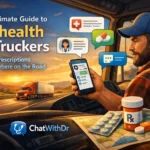 The Ultimate Guide to Telehealth for Truckers: Getting Prescriptions Anywhere on the Road